From Surf Wiki (app.surf) — the open knowledge base
East–West Line (Singapore)
Mass Rapid Transit line in Singapore

Mass Rapid Transit line in Singapore
| Field | Value | |||||
|---|---|---|---|---|---|---|
| box_width | width:12em; | |||||
| name | [[File:MRT Singapore Destination 1.svg | 25px]] [[File:MRT Singapore Destination 2.svg | 25px]] [[File:MRT Singapore Destination 3.svg | 25px]] | ||
| East–West Line | ||||||
| color | ||||||
| logo | East West Line logo.svg | |||||
| logo_width | 250px | |||||
| image | Tuas Link MRT Station 202407.jpg | |||||
| image_width | 300px | |||||
| caption | An R151 Train at the platform of Tuas Link station, the western terminus of the line. | |||||
| native_name | ||||||
| 东西地铁线 | ||||||
| status | Operational | |||||
| owner | Land Transport Authority | |||||
| locale | Singapore | |||||
| start | Pasir Ris | |||||
| Tanah Merah | ||||||
| end | Tuas Link | |||||
| Changi Airport | ||||||
| stations | 35 | |||||
| mapcolour | Green (#) | |||||
| type | Rapid transit | |||||
| system | Mass Rapid Transit (Singapore) | |||||
| routes | 3 | |||||
| operator | SMRT Trains (SMRT Corporation) | |||||
| depot | Tuas | |||||
| Ulu Pandan | ||||||
| East Coast | ||||||
| stock | Kawasaki–Sifang C151A (KSF A) | |||||
| Kawasaki–Sifang C151B (KSF B) | ||||||
| Kawasaki–Sifang C151C (KSF C) | ||||||
| Alstom Movia R151 (ALS) | ||||||
| daily_ridership | 508,957 (July 2020) | |||||
| open | (as part of North–South Line) | |||||
| (renamed as East–West Line) | ||||||
| (Initial line complete) | ||||||
| () | ||||||
| () | ||||||
| () | ||||||
| (Boon Lay extension) | ||||||
| (Tuas West extension) | ||||||
| linelength | 57.2 km | |||||
| tracklength | 57.2 km | |||||
| character | Elevated (Pasir Ris – Kallang, Redhill – Tuas Link, Expo) | |||||
| Underground (Lavender – Tiong Bahru, Changi Airport) | ||||||
| gauge | ||||||
| electrification | ||||||
| speed | limit of 80 km/h | |||||
| map_name | Maps | |||||
| map | {{switcher | |||||
| {{East–West MRT line | inline | yes}} | ||||
| {{Maplink | frame | yes | type=line | stroke-colour=# | text=Interactive Map | frame-align=center}} |
| map_state | hide |
the MRT line in Singapore
East–West Line 东西地铁线
Tanah Merah Changi Airport Ulu Pandan East Coast Kawasaki–Sifang C151B (KSF B) Kawasaki–Sifang C151C (KSF C) Alstom Movia R151 (ALS) (renamed as East–West Line) (Initial line complete) () () () (Boon Lay extension) (Tuas West extension) Underground (Lavender – Tiong Bahru, Changi Airport) | |Show route diagram | | Show interactive diagram
The East–West Line (EWL) is a high-capacity Mass Rapid Transit (MRT) line operated by SMRT in Singapore, running from Pasir Ris station in the east to Tuas Link station in the west, with an additional branch between Changi Airport and Tanah Merah stations. It is the second Mass Rapid Transit line to be built in Singapore. Coloured green on the rail map, the line serves 35 stations, 8 of which (from Lavender to Tiong Bahru and Changi Airport stations) are underground. At 57.2 km, the line is the longest on the MRT network.
Constructed and opened as part of the North–South Line (NSL) in the early stages of development, the East–West Line was the second rail line formed in Singapore after NSL, with the opening of the eastern extension to Tanah Merah on the EWL in 1989. Nevertheless, both lines use identical signalling equipment and rolling stock. The East–West Line signalling systems have been upgraded along with the North–South Line, with both MRT lines having its signalling fully upgraded, converting it from semi-automatic to fully automatic.
History
Initial developments
The first segment of what would become the East–West Line, between City Hall and Outram Park stations, was opened on 12 December 1987 as part of the North–South Line and Phase 1 of the initial system. Subsequently, it was extended westwards to Clementi station on 12 March 1988 and to Lakeside on 5 November 1988.
The 15 km eastern extension to Tanah Merah station opened on 4 November 1989, which also marked the start of independent operations as the East–West Line. The opening ceremony was attended by then First Deputy Prime Minister Goh Chok Tong.
The 6 km line extension to Pasir Ris station was opened ahead of schedule on 16 December 1989 with a sneak preview beforehand. Boon Lay station opened on 6 July 1990, marking the completion of the initial MRT system.
Subsequent developments
Dover station
Main article: Dover MRT station
Construction on a new infill station located between Buona Vista station and Clementi station, namely Dover station, began in June 1998. It is the first station in the MRT network to be built as an infill station. The building of the station was met with reservations by some members of the public over the small area it serviced and there were criticisms over the spending of "taxpayers' money" chiefly for use only by students of one educational institution. Despite some opposition, the Land Transport Authority proceeded with the construction to serve commuters along Singapore Polytechnic with Dover housing estate. The station opened on 18 October 2001. Prior to opening, test runs were conducted from 13 to 17 October 2001 when the trains stopped at the station but did not open their doors.
Tanah Merah to Airport extension line
Airport

The idea of extending the Mass Rapid Transit system to Changi Airport was reconsidered when Terminal 3 of the airport was being built. Earlier plans had long been made for a new line branching off from the existing East–West Line at Tanah Merah, with some conceptual plans showing a tentative route alignment up to the airport along Airport Boulevard, continuing beyond the airport to Changi Point, before turning southwest back towards the city along the eastern coasts. The plans were finally announced by then Deputy Prime Minister Lee Hsien Loong on 15 November 1996. However, the new route alignment showed a deviation from previous plans, where the final plan involved in building only the first two stations of Expo, and Changi Airport, the latter being the underground station built between Terminal 2 and Terminal 3. The alignment of the station at the airport also switched perpendicularly to an east–west direction, such that the station leads to two of the terminals directly from either end of the station. The station's designs were unveiled on 10 February 1998 with construction starting on 29 January 1999. Expo and Changi Airport were opened on 10 January 2001 and 8 February 2002 respectively and operates under a shuttle service. Prior to 22 July 2003, train services from Boon Lay commences after the opening, but were later reverted to shuttle services due to low patronage. On 25 May 2019, it was announced that the Changi Airport Extension will be converted to become part of Thomson–East Coast Line Extension (TELe) by 2040.
Boon Lay and Tuas extension

The 3.8 km Boon Lay extension was first announced by the LTA on 29 December 2004, set to serve residents from the Jurong West Town area and those working in the Jurong Industrial Estate. The two stations, Pioneer and Joo Koon stations, officially opened on 28 February 2009.
On 11 January 2011, the Tuas West extension, an extension of the East–West Line from Joo Koon to Tuas Link was announced. The extension has a span of 7.5 km, which spans a twin-tracked MRT viaduct, four above-ground stations and a 26 ha depot to provide stabling and maintenance facilities for the additional trains that will be bought for the extension and to cater for future expansion of the line. The viaduct is integrated with part of a 4.8 km road viaduct along Pioneer Road, which will increase the road capacity to cope with anticipated increase in traffic. The stations are Gul Circle, Tuas Crescent, Tuas West Road, and Tuas Link. On 4 May 2012, the Land Transport Authority marked the start of construction of the Tuas West extension with a groundbreaking ceremony at the site of the future Tuas Link station.
The extension began service on 18 June 2017. During initial stages after opening, the westbound trains will alternate their terminus between Joo Koon and Tuas Link, where for every two trains, one train will terminate at the former, while the other train will terminate at the latter.
In 2025, the LTA announced that 40 stations on the North–South and East–West lines will gain public artworks, as part of expansion of the Art in Transit programme.
Additional platform at Tanah Merah station
On 25 August 2014, the Land Transport Authority announced that a new island platform will be constructed at Tanah Merah, enabling faster travel and shorter waiting times for commuters heading towards Expo and Changi Airport on the Changi Airport branch line of the East–West Line.
On 26 October 2016, the Land Transport Authority awarded the civil contract to Lum Chang Building Contractors Pte. Ltd. to build a new platform at Tanah Merah and viaducts for a contract sum of S$325 million. In addition to the new platform, the existing East–West Line tracks will be extended to connect the line to the new four-in-one East Coast Integrated Depot at Changi. When completed in 2025, it will be the second station to have three island platforms side-by-side after Jurong East.
Half-height platform screen door installations
There were calls for platform screen doors (PSDs) to be installed at above-ground stations after several incidents in which passengers were killed or seriously injured by oncoming trains when they fell onto the railway tracks at above-ground stations. Underground stations already featured the doors since 1987. The authorities initially rejected the proposal by casting doubts over functionality and concerns about the high installation costs, but made an about-turn later with the government announcing plans to install half-height platform screen doors on the elevated stations by 2012 on 25 January 2008, citing lower costs due to it becoming a more common feature worldwide. Contract C1320 for the design and installation of half-height platform screen doors was awarded to Singapore Technologies Electronics Limited in September 2008 for . They were first installed at Jurong East, Pasir Ris, and Yishun stations in 2009 as trial runs. On 31 August 2011, the LTA announced completion of the installation of PSDs along the East–West Line, with Expo being the last station on the line to receive the PSDs. Installation of PSDs across both the North–South and East–West lines (NSEWL) were completed on 14 March 2012, 3 months ahead of schedule.
Improvement works
Timber to concrete sleeper replacement works
The timber sleepers on the East–West Line was required to be replaced as they were near the end of their 25-year lifespan. The replacement sleepers, made of concrete, have a significantly longer lifespan. To speed up works, train services on the East–West Line was adjusted to end earlier. The work was divided into three phases: Phase 1 (Bugis – Tanah Merah), Phase 2 (Joo Koon – Jurong East, Tanah Merah – Pasir Ris) and Phase 3 (Jurong East – Outram Park). The sleepers were fully replaced on 18 February 2017.
Re-signalling works
A new moving-block signalling system, supplied by Thales, replaced the former ageing fixed-block signalling system on the East–West Line. The new signalling system, costing $195 million, reduces waiting times for trains during peak periods from 120 seconds then to 100 seconds now. The new system became operational between Pioneer and Tuas Link stations on 18 June 2017. Newer rolling stocks, such as the C151B and C151C, are equipped for use solely on the new signalling system. Since 27 May 2018, the new signalling system has been operating full-day on the entire East–West Line.
Third-rail replacement
Replacement works on the third rail, which provides electricity to the trains, were carried out between September 2015 and August 2017. The new third rail replaced its 30-year-old predecessor and is expected to increase reliability of the East–West Line's electrical system.
Pasir Ris turnback extension
A new railway turnback located at Pasir Ris station, the eastern terminus of the line, was announced by the Land Transport Authority on 29 Jun 2018. It would extend the railway viaduct past the station by 148 m. The turnback will allow for an increase in service frequency during peak times from 30 to 36 trains per hour as trains will be able to change directions faster to head westwards on the line, to meet future increases in ridership demand. Construction started in 2019 and was completed in May 2024.
Incidents
1993 Clementi train collision
Main article: Clementi rail accident
On 5 August 1993, before opening, a maintenance vehicle spilt oil on the tracks between Clementi and Jurong East. The first ten eastbound trains reported braking problems, then the eleventh train from Jurong stopped at the Clementi station for two minutes longer than scheduled due to it using its emergency brakes to stop at the station at 7.50 am, before being hit by another eastbound train when it failed to stop in time. 156 passengers were injured by the collision.
7 July 2015 power trip
During the evening peak hours on 7 July 2015, train services on the East–West and North–South Lines were temporarily disrupted due to massive power trips detected along both lines. The cause of the disruption was due to damaged insulators which had resulted in the failure of the power supply. For this disruption that brought inconvenience to 413,000 commuters, LTA imposed a 'record' fine of S$5.4 million on SMRT.
22 March 2016 staff fatalities
Main article: Pasir Ris rail accident
At about 11:08 a.m. on 22 March 2016, two SMRT track-maintenance trainee staff were run over and killed by a C151 train approaching Pasir Ris station, resulting in a temporarily service delay between Tanah Merah and Pasir Ris for over two hours that affected at least 10,000 commuters.
The two trainee staff had joined SMRT in January 2016 and worked as technicians under a technical team of 15 staff led by a supervisor and were tasked to go down to the tracks to investigate an alarm triggered by a possible signalling equipment fault close by the station. An operator cited that they were granted access to the tracks, but did not coordinate with a Signal Unit in the station to ensure trains could not travel in the area where the team was.
Patrick Nathan, SMRT vice-president, promised that "SMRT will review all safety protocols particularly those involving track access". SMRT chief executive Desmond Kuek apologised for the incident and said SMRT will investigate how "the [two men] got hit by the train". SMRT fired both an engineer responsible for leading with the team and the train driver who was involved at the scene of the incident.
The engineer who led the inspection team was charged with negligence causing death under the Penal Code and was subsequently sentenced to 4 weeks in jail. SMRT Trains and one member of SMRT management were charged for violating the Workplace Safety and Health Act for lapses which led to the accident, and were fined $400,000 respectively. and $55,000. On 20 July 2018, the Land Transport Authority fined the operator S$1.9 million (US$ million) for this incident and the Bishan tunnel flooding.
15 November 2017 train collision and disruptions
Main article: Joo Koon rail accident
A second train collision occurred on 15 November 2017 at approximately 8.18am, where two C151A trains collided at Joo Koon MRT station. A train fault caused the first train heading in the direction of Tuas Link to stall at the station. A minute later, a second train stopped behind the first and then "moved forward unexpectedly," hitting the other train. Thirty-eight people, including two SMRT staff, were hospitalized.
Train services between Tuas Link and Joo Koon stations were temporally suspended in both directions for two hours on the day itself and the entire day on 16 November 2017, and westbound trains temporarily terminated at Joo Koon.
An update by the Land Transport Authority (LTA) & SMRT on 16 November 2017 stated that LTA and SMRT had decided to isolate for up to one month the operations of the Tuas West extension, which runs on the new signalling system, from the rest of the East–West Line, which runs on the old signalling system, enabling LTA engineers to carry out further assurance checks together with Thales. The train was switching systems when the collision took place. Train service on the line resumed on 20 November, with the Tuas West extension between Gul Circle and Tuas Link using the new signalling system and the section between Pasir Ris and Joo Koon, together with the Changi Airport Branch continuing to run on the old signalling system. Train services between Joo Koon and Gul Circle were temporarily suspended until its resumption on 28 May 2018; between the suspension a free bridging bus service is available between the two stations. Continuous service between Pasir Ris and Gul Circle resumed on 28 May 2018, with the permanent activation of the new CBTC system; since the incident, selected portions of either the North–South Line or East–West Line were closed to conduct track renewal works with early weekend closures and later station openings.
25–30 September 2024 train derailment and disruptions
Main article: 2024 East–West MRT line disruption
Train services between Boon Lay and Queenstown had been suspended since 9am on 25 September 2024 after trains lost power on a stretch near Clementi MRT station. A defective train axle box on one of the first generation C151 trains, which had been deadheading to Ulu Pandan Depot after it was withdrawn at Clementi station, dropped onto the tracks near Dover station and caused the wheels of a bogie - an undercarriage - to come off the running rail and hit track equipment, including stretches of the third rail, 3 point machines as well as power cables and rail clips. In an update at about 9:30pm on 25 September 2024, LTA and SMRT announced that train services between Buona Vista and Jurong East would remain suspended on 26 September 2024, the 1st day of the PSLE exams, while service between Boon Lay and Jurong East, and Queenstown and Buona Vista, would each run their own separate shuttle services every 10 minutes. On Thursday night, SMRT announced that no trains will run between Jurong East and Buona Vista for a third straight day, with full service expected to resume the following Monday. However, in an update at about 4:30pm on 29 September 2024, the target date for restoration of full service was pushed back to Tuesday. On September 30, SMRT and LTA announced that full service would fully resume on October 1, with westbound train speeds being reduced from the usual 60-80 kilometres per hour (37.5-50mph) to 40 kilometres per hour (25mph) until October 3, as part of a standard process after rail replacements.
Network and operations
Train services on the East–West Line operates from approximately 5:30am to around midnight daily. In general, during peak hours, train frequency is 2 to 3 minutes while during non-peak hours the frequency is reduced to 5 minutes throughout the entire route.
The first train departs from these places:
| From | Heading to | Departing at | Notes |
|---|---|---|---|
| Tanah Merah | Pasir Ris | 4:59 am - Weekdays | |
| 5:01 am - Saturdays | |||
| 5:27 am - Sundays & Public Holidays | 5:12 am (Weekdays), 5:14 am (Saturdays) and 5:40 am (Sundays & Public Holidays) as a downroute from Pasir Ris to reach Jurong East at 6:07 am (Weekdays), 6:09 am (Saturdays) and 6:33 am (Sundays & Public Holidays) | ||
| Changi Airport | 5:07 am - Weekdays | ||
| 5:07 am - Saturdays | |||
| 5:31 am - Sundays & Public Holidays | Reach one-loop at 5:29 am (Weekdays and Saturdays) and 5:52 am (Sundays and Public Holidays). | ||
| Clementi | Tanah Merah | 5:25 am - Weekdays | |
| 5:26 am - Saturdays | |||
| 5:56 am - Sundays & Public Holidays | |||
| Tuas Link | Clementi | 5:03 am - Weekdays | |
| 5:04 am - Saturdays | |||
| 5:35 am - Sundays & Public Holidays |
Train services on the East–West Line are also subjected to maintenance and renewal works, usually on selected Fridays, Saturdays or Sundays. Shuttle bus services may be provided throughout the duration of the early closures and late openings for affected commuters. Operations of the East–West Line are affected by the COVID-19 pandemic, leading to the drop of ridership.
Route
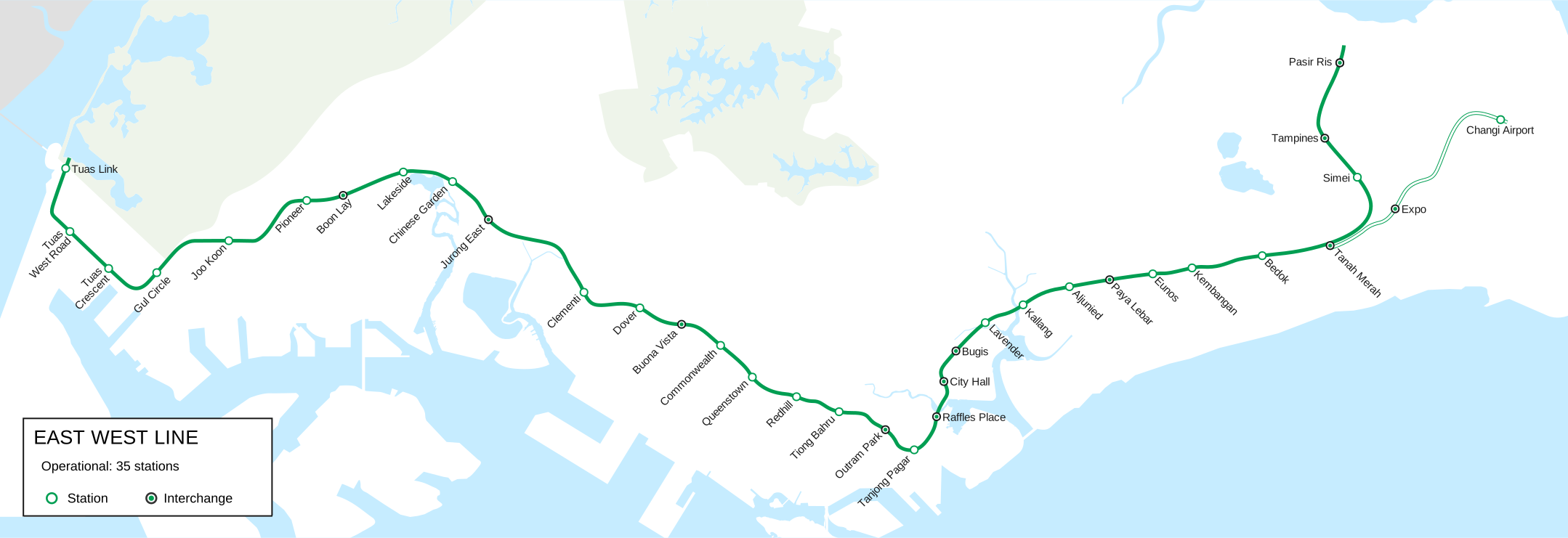
As its name implies, the East–West Line connects central Singapore to both eastern and western parts of the island, with an additional branch between Changi Airport and Tanah Merah, which operates as a separate shuttle service. It is 57.2 kilometers (35.5 miles) long and it is predominantly double-tracked, but certain short sections at Tanah Merah, Outram Park and Joo Koon widens to three tracks, four tracks nearby Jurong East station and a section between Jurong East and Clementi station and five tracks nearby Changi Depot and Tanah Merah station.
Some stations are commonly placed at the middle of the roads such as Tanah Merah, Bedok, Queenstown, Commonwealth, Dover, Clementi, Pioneer, Joo Koon, Gul Circle, Tuas Crescent and Tuas West Road. The line runs mostly on overhead viaducts but goes underground in the city area between Kallang and Redhill, Bedok and Kembangan, and between Expo and Changi Airport. Travelling from one end of the line to the other takes about 85 minutes.
The line begins above ground at Pasir Ris station from where it continues to head south towards Simei station. The line curves between Simei to Tanah Merah stations and continues westwards, joining the Changi Airport branch, paralleling New Upper Changi Road. Three branch lines to the East Coast Integrated Depot and to Changi Airport station exists between Simei and Tanah Merah stations. At Tanah Merah station, the line extends to four tracks due to its interchange with the Changi branch before turning back into two tracks in a western direction.
From Bedok station to Kembangan station, the line goes underground but then goes above-ground, and follows the route of Sims Avenue and Sims Avenue East in an opposite direction. After Kallang station, the line goes underground through the Central Area and runs heads south-west towards City Hall station. It then runs parallel to the North–South Line between City Hall and Raffles Place stations, which are cross-platform interchanges to the North–South Line. After Tanjong Pagar, the line curves northwestwards towards Outram Park. After Tiong Bahru, the line continues above ground starting with Redhill station and follows the direction of Commonwealth Avenue, Commonwealth Avenue West and Boon Lay Way. Between Clementi and Jurong East station, three branches (one going east and two going west) to Ulu Pandan Depot are deployed. At Jurong East station, the line extends again to four tracks due to its interchange with the North–South Line but then, separates into two before heading west to Chinese Garden station. After Pioneer station, the line heads south-west before curving westwards towards Joo Koon station. The line terminates at Tuas Link with a branch heading towards Tuas Depot.
The Changi Airport extension starts at Tanah Merah station as a single track before turning eastwards to Expo station. After Expo station, it goes underground and curves south before terminating at Changi Airport station.
The East–West Line was constructed along the North–South Line. As such, both lines used identical signalling equipment and rolling stock.
Stations
The line serves 35 stations across 57.2 km of track, and station codes for the line are green, corresponding to the line's colour on the system map. 8 stations, including Changi Airport, and 7 other stations on the stretch from Lavender to Tiong Bahru are underground, with the rest being elevated. With the exception of Dover, all stations have island platforms.
| Date | Project | Description |
|---|---|---|
| 7 November 1987 | Phase 1 | Yio Chu Kang – Toa Payoh (Now part of the North–South Line) |
| 12 December 1987 | Toa Payoh – Outram Park (Direct train service to Outram Park via Raffles Place) | |
| 12 March 1988 | Phase 1A | Outram Park – Clementi |
| 5 November 1988 | Phase 2B | Clementi – Lakeside |
| 20 December 1988 | Yio Chu Kang – Yishun (Now part of the North–South Line) | |
| 4 November 1989 | Phase 2A | City Hall – Tanah Merah (Separation of the North–South Line & East–West Line) |
| 16 December 1989 | Tanah Merah – Pasir Ris | |
| 10 March 1990 | Phase 2B | Jurong East – Choa Chu Kang (Operates as a branch line from Jurong East, now part of the North–South Line) |
| 6 July 1990 | Lakeside – Boon Lay | |
| 10 January 2001 | Changi Airport Extension | Tanah Merah – Expo |
| 18 October 2001 | Dover Station | Dover station between Buona Vista and Clementi |
| 8 February 2002 | Changi Airport Extension | Expo – Changi Airport |
| 28 February 2009 | Boon Lay Extension | Boon Lay – Joo Koon |
| 18 June 2017 | Tuas West Extension | Joo Koon – Tuas Link |
| 16 November 2017 | Temporary closure of Joo Koon – Tuas Link (Due to a train collision at Joo Koon) | |
| 20 November 2017 | Reopening of Gul Circle – Tuas Link (Reopens as a separate line, transfer between Joo Koon & Gul Circle) | |
| 28 May 2018 | Reopening of Joo Koon – Gul Circle (Merges into one line) |
Legend
| [[File:Aiga escalator down.svg | 15px]] | ||||||
|---|---|---|---|---|---|---|---|
| Underground | [[File:ISO 7010 W003.svg | 15px]] | |||||
| Civil Defence Shelter | [[File:Aiga carrental cropped.svg | 10px]] [[File:BSicon Mono-CHN.svg | 10px]] [[File:BSicon AETRAM.svg | 10px]] [[File:Aiga watertransportation.svg | 10px]] [[File:20 airtransportation.svg | 10px]] [[File:Aiga immigration.svg | 10px]] |
| Other transportation modes |
List
| SMRT | East–West}}" | Station code | SMRT | East–West}}" | Station name | SMRT | East–West}}" | Images | SMRT | East–West}}" | Interchange; |
|---|---|---|---|---|---|---|---|---|---|---|---|
| Adjacent transportation | SMRT | East–West}}" | Opening | SMRT | East–West}}" | Cost | Changi Airport Line (CAL) | ||||
| Pasir Ris | [[File:R151 Trains can be seen at EW1 Pasir Ris MRT Station which is the eastern terminus of the East West Line..jpg | 120px]] | (2030) | ||||||||
| (2032) | |||||||||||
| ― | |||||||||||
| [[File:Bus-logo.svg | 15px | link=]]Pasir Ris | S$5 billion | ||||||||
| – | Tampines | [[File:Tampines MRT Station 202407.jpg | 120px]] | [[File:Barrier turnstile icon.svg | 15px]] | ||||||
| ― | |||||||||||
| [[File:Bus-logo.svg | 15px | link=]]Tampines | |||||||||
| [[File:Bus-logo.svg | 15px | link=]]Tampines Concourse | |||||||||
| Simei | [[File:Simei MRT Station 2.jpg | 120px]] | |||||||||
| Tanah Merah | [[File:CG Tanah Merah MRT Station 202409.jpg | 120px]] | (until mid-2030s) | ||||||||
| (after mid-2030s) | |||||||||||
| Bedok | [[File:Bedok MRT Station.jpg | 120px]] | [[File:Bus-logo.svg | 15px | link=]]Bedok | ||||||
| Kembangan | [[File:Kembangan MRT Station 202407.jpg | 120px]] | |||||||||
| Eunos | [[File:Eunos MRT Station.jpg | 120px]] | [[File:Bus-logo.svg | 15px]]Eunos | |||||||
| Paya Lebar | [[File:Paya Lebar MRT Station 202407.jpg | 120px]] | |||||||||
| Aljunied | [[File:Aljunied Station Platform B.jpg | 120px]] | |||||||||
| Kallang | [[File:Kallang MRT Station.jpg | 120px]] | [[File:Bus-logo.svg | 15px]]Lorong 1 Geylang (until late-2020s) | |||||||
| [[File:Bus-logo.svg | 15px]]Kallang (from late-2020s) | ||||||||||
| Lavender | [[File:Lavender MRT Station 202407.jpg | 120px]] | |||||||||
| Bugis | [[File:Bugis MRT Station.jpg | 120px]] | |||||||||
| City Hall | [[File:City Hall MRT Station 202407.jpg | 120px]] | |||||||||
| Raffles Place | [[File:Raffles Place MRT Station 202407.jpg | 120px]] | |||||||||
| Tanjong Pagar | [[File:EW15 Tanjong Pagar MRT Platforms 20220708 134226.jpg | 120px]] | |||||||||
| Outram Park | [[File:EW16 Outram Park MRT Platforms 20221215 123229.jpg | 120px]] | |||||||||
| Tiong Bahru | [[File:EW17 Tiong Bahru MRT Alstom Movia R151 20230611 161251.jpg | 120px]] | rowspan="4" | ||||||||
| Redhill | [[File:Redhill MRT Station 202407 2.jpg | 120px]] | |||||||||
| Queenstown | [[File:Queenstown MRT Station 202407.jpg | 120px]] | |||||||||
| Commonwealth | [[File:Commonwealth MRT Station.jpg | 120px]] | |||||||||
| Buona Vista | [[File:Buona Vista MRT Station.jpg | 120px]] | |||||||||
| ― | |||||||||||
| [[File:Bus-logo.svg | 15px]]Buona Vista | ||||||||||
| [[File:Bus-logo.svg | 15px]]Ghim Moh | ||||||||||
| Dover | [[File:Dover MRT Station 3.jpg | 120px]] | S$45 million | ||||||||
| Clementi | [[File:Clementi MRT Station.jpg | 120px]] | (2032) | ||||||||
| ― | |||||||||||
| [[File:Bus-logo.svg | 15px | link=]]Clementi | S$5 billion | ||||||||
| Jurong East | [[File:Jurong East MRT Station 202406 4.jpg | 120px]] | |||||||||
| (2028) | |||||||||||
| ― | |||||||||||
| [[File:Bus-logo.svg | 15px | link=]]Jurong East | |||||||||
| Chinese Garden | [[File:Chinese Garden MRT Station 202407 2.jpg | 120px]] | rowspan="2" | ||||||||
| Lakeside | [[File:Lakeside MRT Station.jpg | 120px]] | |||||||||
| Boon Lay | [[File:Boon Lay MRT Station 202407.jpg | 120px]] | (2027) | ||||||||
| ― | |||||||||||
| [[File:Bus-logo.svg | 15px | link=]]Boon Lay | |||||||||
| Pioneer | [[File:Pioneer MRT Station.jpg | 120px]] | S$436 million | ||||||||
| Joo Koon | [[File:Joo Koon Station platform.jpg | 120px]] | [[File:Bus-logo.svg | 15px | link=]]Joo Koon | ||||||
| Gul Circle | [[File:Gul Circle station.jpg | 120px]] | rowspan="3" | S$3.5 billion | |||||||
| Tuas Crescent | [[File:Tuas Crescent MRT Station 202407.jpg | 120px]] | |||||||||
| Tuas West Road | [[File:Tuas West Road MRT Station 202407.jpg | 120px]] | |||||||||
| Tuas Link | [[File:Tuas Link MRT Station 202407 2.jpg | 120px]] | [[File:Bus-logo.svg | 15px]]Tuas | |||||||
| ― | |||||||||||
| [[File:Aiga carrental cropped.svg | 15px]]Tuas Checkpoint[[File:Aiga immigration.svg | 15px]] | |||||||||
| Expo | [[File:Expo MRT Station.jpg | 120px]] | S$850 million | ||||||||
| Changi Airport | [[File:Changi Airport MRT Station 202407.jpg | 120px]] | [[File:Bus-logo.svg | 15px]]Changi Airport | |||||||
| ― | |||||||||||
| [[File:20 airtransportation.svg | 15px]]Changi Airport Terminals 1–4[[File:Aiga immigration.svg | 15px]] |
The branch sector of Tanah Merah to Changi Airport was operated as a through service from Boon Lay from 18 November 2001 until 22 July 2003, until it was replaced as a shuttle service to and from Tanah Merah and Changi Airport. By the mid-2030s, the Changi Airport extension will be converted and to be served by the Thomson–East Coast Line.
Depots
| SMRT | East–West}}" | Depot name; | |||||||||
|---|---|---|---|---|---|---|---|---|---|---|---|
| Lines | SMRT | East–West}}" | Location | SMRT | East–West}}" | Image | SMRT | East–West}}" | Line-specific | ||
| stabling capacity | SMRT | East–West}}" | Cost | SMRT | East–West}}" | Opening | |||||
| *(until 2026)* | Changi | [[File:ChangiMRTDepot-Singapore-20090801.jpg | 100px]] | 35 trains | S$250 million | ||||||
| Jurong East | [[File:Ulu Pandan Depot.jpg | 100px]] | 45 trains | S$130 million | |||||||
| Tuas | [[File:EWL overrun tracks and Tuas MRT Depot 20210120 145029.jpg | 100px]] | 60 trains | S$237.1 million | |||||||
| Changi | 72 trains | url=https://www.lta.gov.sg/content/ltagov/en/newsroom/2016/3/2/lta-awards-contract-to-build-worlds-first-four-in-one-depot.html | archive-url=https://web.archive.org/web/20200213095243/https://www.lta.gov.sg/content/ltagov/en/newsroom/2016/3/2/lta-awards-contract-to-build-worlds-first-four-in-one-depot.html | url-status=dead | archive-date=13 February 2020 | title=LTA Awards Contract to Build World's First Four-In-One Depot | website=Land Transport Authority | date=21 March 2016 | access-date=13 February 2020}} |
Infrastructure
Rolling stock
Three batches of rolling stock operate on the East–West Line, namely the C151A, C151B and R151 from oldest to newest, shared with the North–South Line. Trains are maintained at Changi Depot, Ulu Pandan Depot and Tuas Depot, which provide train maintenance, inspection and overhaul facilities. These models of rolling stock were introduced to boost the capacity on both the North–South and the East–West lines in order to cope with increasing ridership.
Both the North–South and the East–West lines utilized identical rolling stock up until the 2010s, when the C151A trains were temporary suspended from operating on the North–South Line from January 2012 until November 2013 following the 2011 train disruptions. The C151B trains, which were introduced in April 2017, did not begin revenue service on the full stretch of the East–West Line until the line's trial of the CBTC signalling system in May 2018. The C151C trains, despite their introduction on 30 September 2018 on the North–South Line, rarely run on the East–West Line.
Another generation of rolling stock, the R151 trains, will be delivered from 2022 to 2026, to replace all 66 first-generation C151 trains which will be retired by 2025, as well as all 19 second-generation C651 and 21 third-generation C751B trains which were retired in 2024. The R151 trains are the first rolling stock on the East–West Line to be manufactured by Bombardier (Bought by Alstom in 2021), which has also supplied trains for the Downtown Line. The first train entered service on the East–West Line on 4 June 2023.
Signalling

The East–West Line is equipped with Thales SelTrac communications-based train control (CBTC) moving block signalling system with automatic train control (ATC) under automatic train operation (ATO) Grades of Automation (GoA) 3. The subsystems consist of automatic train protection (ATP) to govern train speed, NetTrac MT Automatic Train Supervision (ATS) to track and schedule trains and a computer-based interlocking (CBI) system that prevents incorrect signal and track points to be set.
The old signalling system has undergone decommissioning work from August 2018 and was completed on 23 November 2018. It consists of Westinghouse fixed block signalling system with Automatic train control (ATC) under Automatic train operation (ATO) GoA 2. The subsystems consist of Automatic train protection (ATP) to govern train speed, Automatic Train Supervision (ATS) to track and schedule trains and a Relay interlocking system that prevents incorrect signal and track points to be set.
The stretch of track between Pioneer and Tuas Link stations was equipped with the new signalling system which came into use in June 2017. As the section of track between Pioneer and Joo Koon support 'mixed-mode' of both signalling systems, trains terminating at either Joo Koon or Tuas Link would have to change signalling modes at Pioneer MRT station as trains terminating at Joo Koon would proceed to a turn back siding which was built as part of the TWE which only supports the new signalling system. Eastbound trains towards Pasir Ris would have to change back to the old signalling system at Pioneer MRT station. This procedure was removed after the train collision at Joo Koon as trains terminated at Joo Koon. The new signalling system became fully operational on 28 May 2018.
Platform screen doors
When the line was first opened, full-height platform screen doors supplied by Westinghouse were installed at underground stations. These doors serve to prevent suicides, enable climate control within the station, better security control by restricting access to the tunnels and tracks and for overall passenger safety considerations. The authorities initially rejected calls for platform screen doors to be installed at elevated stations by casting doubts over functionality and concerns about the high installation costs. Nevertheless, the LTA reversed its decision and made plans to install half-height platform screen doors on elevated stations on 25 January 2008. The first platform screen doors by ST Electronics were installed at Pasir Ris, Jurong East and Yishun stations in 2009 as trial runs. Subsequently, installation began in May 2011 at Ang Mo Kio station on the North–South Line. On 14 March 2012, platform screen doors became operational at all elevated stations on the East–West Line. Stations along the TWE had half-height platform screen doors manufactured by Fangda installed during the station's construction.
In popular culture
The line's Changi Branch is featured in tvN series Little Women.
References
References
- "Land Transport DataMall".
- (15 October 2024). "Parliamentary Ministerial Statement by Minister for Transport, Mr Chee Hong Tat".
- (29 January 2014). "East–West Line". [[Land Transport Authority]].
- Rav, Dhaliwal. (12 December 1987). "Shopping for Xmas the MRT way...". Straits Times.
- (12 March 1988). "Riding the MRT train to Clementi". The Business Times.
- (5 November 1988). "Three more stations for MRT system". The Business Times.
- (4 November 1989). "On right track". The Straits Times.
- Dhaliwal, Rav. (5 November 1986). "MRT Trains to Pasir Ris from Dec 16". The Straits Times.
- (17 December 1989). "MRT goes all the way east". The Straits Times.
- (15 December 1989). "Residents get sneak preview of three new MRT stations". The Straits Times.
- (9 June 1990). "Dr Yeo launches sale of commemorative tickets for the MRT". The Straits Times.
- (13 October 2001). "Trial Runs at Dover". TODAY news.
- Leong, Yit Chun. (19 August 2002). "Public should not subsidise new MRT stations". [[The Straits Times]] Forum.
- (30 July 1997). "S'pore Poly to be linked to MRT". The Straits Times.
- (5 October 2001). "Doorstep train". TODAY news.
- Fook Kong, Lau. (13 July 2001). "Next Stop: Dover". The Straits Times.
- (2 August 1994). "MRT extension to airport reconsidered.". The Straits Times.
- (2 August 1994). "Next Stop: Changi Airport?". The New Paper.
- (15 November 1996). "Singapore Mass Rapid Transit Employees' Union (SMRTEU)'s annual Dinner and Dance".
- (12 December 1996). "MRT Line will not go beyond passenger terminals".
- (12 December 1996). "Changi Airport MRT line details". The Business Times.
- (11 February 1998). "Changi Airport MRT station designed for travellers".
- (29 January 1999). "Changi Airport Line Ground Breaking Ceremony".
- (20 December 2001). "Boon Lay to Expo: MRT now running". The Straits Times.
- (18 July 2003). "Board MRT to airport from Tanah Merah.". The Straits Times.
- (25 May 2019). "LTA to assess the feasibility of new rail line connecting northeast and south Singapore". CNA.
- "Land Transport Master Plan 2040: Bringing Singapore Together {{!}} Press Room {{!}} Land Transport Authority".
- (25 May 2019). "At a glance: Key updates to MRT, bus network and more for 2040 master plan". TODAYonline.
- (29 December 2004). "Expanding The Rail Network: LTA To Build Boon Lay MRT Extension". Land Transport Authority.
- (30 October 2008). "Boon Lay Extension to Open in February 2009".
- "Boon Lay MRT Extension".
- "Speech by Mr Raymond Lim at the visit to Bedok MRT Station on 11 Jan 2011".
- (7 March 2012). "Speech (Part 1 – Public Transport) by Mr Lui Tuck Yew, Minister for Transport, for COS 2012".
- (4 May 2012). "Construction Starts for Tuas West extension". Land Transport Authority.
- (4 May 2012). "Speech by Mr Lui Tuck Yew at the Tuas West Extension Groundbreaking Ceremony on 4 May 2012".
- (27 April 2017). "Tuas West extension Opens on 18 June 2017". Land Transport Authority.
- (27 April 2017). "Tuas West extension MRT stations to open Jun 18". Channel NewsAsia.
- Lim, Kenneth. (16 June 2017). "Opening of the Tuas West extension". Channel NewsAsia.
- (5 June 2017). "Trains at 4 new stations on East–West Line's Tuas West extension to start plying on June 18". The Straits Times.
- Loi, Esther. (2025-10-21). "New artworks to enliven 40 MRT stations". The Straits Times.
- "New Platform at Tanah Merah MRT Station for Faster Travel to Expo and Changi Airport {{!}} Press Room {{!}} Land Transport Authority".
- "LTA Awards Civil Contract to Build A New Platform at Tanah Merah Station {{!}} Press Room {{!}} Land Transport Authority".
- (20 November 2005). "Safety at MRT and LRT Stations — Respect The Yellow Line". Land Transport Authority.
- (25 January 2008). "Platform screen doors for all above-ground MRT stations by 2012". The Straits Times.
- (1 September 2008). "Award of Contracts for the Installation of Half Height Platform Screen Doors and Associated Works at MRT Stations of NSEW Lines".
- Yeo Ghim Lay. (3 September 2008). "Platform doors for elevated MRT stations". The Straits Times.
- (12 August 2009). "Installation of Half Height Platform Screen Doors Pasir Ris Station". Land Transport Authority.
- (31 August 2011). "Completion of Half Height Platform Screen Doors on East–West Line". Land Transport Authority.
- (14 March 2012). "LTA completes installing elevated MRT station screen doors early".
- (17 October 2016). "SMRT Rail Improvements – Updates – SMRT Blog".
- Koh, Valerie. (17 October 2015). "Phased early closure of East–West Line MRT stations from next month". Today.
- (1 February 2012). "LTA and SMRT Award Contracts for New Trains and Re-Signalling Project". Land Transport Authority.
- Lim, Adrian. (20 November 2015). "New MRT projects and upgrades to existing lines are on track, says LTA". The Straits Times.
- (12 September 2017). "FACTSHEET ON POWER RAIL REPLACEMENT PROGRAMME FOR THE NORTHSOUTH AND EAST-WEST LINES".
- (15 December 2015). "Third Rail Replacement of the North–South East–West Line". The SMRT Blog.
- (29 June 2018). "LTA {{!}} Railway Tracks Near Pasir Ris to be Extended for Quicker Turnaround of Trains".
- Hamzah, Aqil. (23 December 2022). "Shorter waiting times for commuters when railway turnback at Pasir Ris MRT station completes in 2024".
- Singapore, National Library Board. "First MRT accident – Infopedia".
- Malinda, Kyle. (22 August 2015). "Cause of massive NSEWL train disruption in July identified, says SMRT". Channel NewsAsia.
- (23 September 2015). "SMRT to be fined a record S$5.4m for July 7 MRT breakdown". Channel NewsAsia.
- (23 March 2016). "SMRT accident: 2 men were part of group of 15 led by supervisor and walking facing oncoming train". The Straits Times.
- (22 March 2016). "2 SMRT staff dead in accident near Pasir Ris station". Channel NewsAsia.
- (23 March 2016). "SMRT acknowledges safety procedure not followed before fatal accident". Channel NewsAsia.
- (23 March 2016). "2 SMRT Staff killed in MRT accident were Singaporeans aged 24 and 26 and undergoing on-the-job training". The Straits Times.
- (2 December 2016). "SMRT charged over fatal accident". Today.
- (12 March 2018). "Engineer who led SMRT trainees onto tracks in 2016 fatal rail accident jailed for 4 weeks".
- Chong, Elena. (28 February 2017). "SMRT Trains fined $400k for workplace safety lapse which resulted in two deaths". The Straits Times.
- Chong, Elena. (29 September 2017). "SMRT Trains director of control operations fined $55,000 over fatal track accident". The Straits Times.
- (20 July 2018). "SMRT to be fined S$1.9 million for Pasir Ris fatal accident, flooding".
- (22 March 2016). "SMRT to be fined S$1.9m for two rail incidents".
- (15 November 2017). "Joint Statement by the Land Transport Authority (LTA) & SMRT – Joo Koon train incident". Land Transport Authority.
- (15 November 2017). "Joint Statement by the Land Transport Authority (LTA) & SMRT – Update on Joo Koon train incident". Land Transport Authority.
- (15 November 2017). "Update on Train Incident at Joo Koon Station". Land Transport Authority.
- "MRT train collides with stationary train at Joo Koon station: Reports". Channel NewsAsia.
- (15 November 2017). "Joo Koon train collision: 28 hurt after stalled train is hit by another one". [[The Straits Times]].
- "Second train delay hits EWL commuters on Wednesday morning".
- (15 November 2017). "Train service between Joo Koon and Tuas Link stations suspended". Channel NewsAsia.
- (15 November 2017). "Train service between Joo Koon, Tuas Link stations to be suspended on Thursday". The Straits Times.
- (16 November 2017). "Update on Train Services on Tuas West extension". Land Transport Authority.
- Tan, Christopher. (2018-05-28). "East–West Line running on new signalling system now – all the way to Tuas West and back". The Straits Times.
- "MRT service between Boon Lay and Queenstown stations disrupted for at least the rest of the day".
- Cheng, Kenneth. (2024-09-26). "Train disruption on EWL to go into third day; LTA, SMRT aim to partially restore services on Sept 27". The Straits Times.
- "MRT disruption to continue into Thursday, no services between Jurong East and Buona Vista".
- Rakshika, Vihanya. (2024-09-25). "Pupils late for PSLE written papers due to train disruptions won't be penalised: Exams board". The Straits Times.
- "East–West Line disruption: No train services from Jurong East to Buona Vista on Sep 30, new cracks found along tracks".
- "MRT disruption: Jurong East-Buona Vista stretch to remain closed for third day running; full service targeted for Monday".
- Loi, Esther. (2024-09-30). "East–West Line MRT services to fully resume on Oct 1; westbound trains to run at slower speeds". The Straits Times.
- "LTA {{!}} Getting Around {{!}} Public Transport {{!}} Rail Network".
- "Early Closure of Selected North–South Line Stations from January to March 2020".
- "Last train services for MRT and LRT (Annex B)".
- "Changes to Public Bus and Train Operating Hours and Frequency".
- "East–West Line". Land Transport Authority.
- "Tuas West Extension".
- "Best Buildable Design Awards 2003".
- "SPEECH BY MRS LIM HWEE HUA,MINISTER OF STATE FOR FINANCE AND TRANSPORT, AT THE BOON LAY MRT EXTENSION CONSTRUCTION COMMENCEMENT CEREMONY, 11 MARCH 2006, 10.00 AM AT BLE STAGING GROUND".
- (3 February 2015). "MRT Tuas West Extension to soar above the ground". The Straits Times.
- "Archived copy".
- (23 September 2011). "LTA awards contract for Tuas Depot". Land Transport Authority.
- (21 March 2016). "LTA Awards Contract to Build World's First Four-In-One Depot".
- (21 March 2016). "LTA awards S$1.99b contract to build world's first four-in-one depot".
- Lim, Adrian. (21 March 2016). "Korea-based construction firm to build four-in-one train and bus depot for $1.99 billion".
- (10 June 1984). "10 shortlisted for Bishan Depot deal". The Straits Times.
- (17 October 1986). "Building the MRT's third depot". The Straits Times.
- "North–South Line signalling system to take up to 6 months to stabilise". Channel NewsAsia.
- "海外向け車両 {{!}} 鉄道車両".
- (16 August 1992). "$290 million contracts for Woodlands MRT line". The Straits Times.
- "EMU Trains for the Singapore Land Transport Authority". Kawasaki Heavy Industries.
- "Rapid Transit {{!}} Kawasaki Heavy Industries".
- (7 May 2009). "Extra metro trains for Singapore". [[Railway Gazette International]].
- (16 May 2011). "Five new trains added to boost capacity of North–South and East–West Lines". [[SMRT Corporation]].
- "Train capacity to rise by up to 50% in 4 years".
- (13 May 2009). "CSR Sifang and Kawasaki Heavy Industries Won the Bid in the Subway Vehicle Project of Singapore".
- (15 December 2011). "North–South Line (Singapore) breakdown hits thousands". Channel News Asia.
- "2nd Update – SMRT statement: Service disruption on North–South Line (Northbound): Marina Bay Station to Bishan Station".
- (17 December 2011). "MRT breaks down again". Channel NewsAsia.
- (17 December 2011). "North–South Line service resumes after 7-hour disruption". Channel NewsAsia.
- "Service disruption on North–South Line on 17 Dec 2011".
- (9 January 2012). "Minister Updates Parliament on MRT Disruptions". Ministry Of Transport.
- (12 April 2017). "New signalling system trials extended to full day every Sunday: SMRT, LTA". Channel NewsAsia.
- (29 April 2016). "LTA Singapore Orders 12 MRT Trains (72 cars) for North–South/East–West Lines {{!}} Kawasaki Heavy Industries, Ltd.".
- (21 January 2016). "SMRT Boosts Service Excellence Efforts with first Customer Experience Innovation Conference". SMRT Corporation.
- Tan, Christopher. (14 August 2018). "SMRT adding 12 trains to two most heavily used lines". The Straits Times.
- "LTA {{!}} News Room {{!}} News Releases {{!}} 12 More Trains to Boost Capacity of North–South and East–West Lines".
- "LTA {{!}} News Room {{!}} News Releases {{!}} Bombardier to Supply 66 New Trains for North–South and East–West Lines".
- "New fleet to replace 66 oldest MRT trains from 2021". Channel NewsAsia.
- Tan, Christopher. (2018-07-25). "Bombardier awarded $1.2 billion contract to replace 66 oldest MRT trains". The Straits Times.
- Loi, Esther. (2023-06-01). "New MRT trains with more space, larger windows to run on North–South, East–West lines from June 4". The Straits Times.
- "Thales awarded signalling contracts for Singapore North–South, East–West lines and Tuas West Extension {{!}} Thales Group".
- "Archived copy".
- (6 February 2012). "Thales awarded signalling contracts for Singapore North–South, East–West lines and Tuas West Extension". Thales Group.
- "New MRT signalling system to be trialled on EWL for 5 Sundays from Apr 29". Channel NewsAsia.
- Woodland, Daniel. (August 2004). "Optimisation of Automatic Train Protection Systemstion Systems".
- [http://www.platformscreendoors.com/psd/projects/massrapid.php Westinghouse Platform Screen Doors – Completed Projects] {{webarchive. link. (13 February 2008)
- (20 November 2005). "Safety at MRT and LRT Stations — Respect The Yellow line". Land Transport Authority.
- (25 January 2008). "Platform screen doors for all above-ground MRT stations by 2012". The Straits Times.
- (25 January 2008). "Speech by Mr Raymond Lim, Minister for Transport, at the Visit to Kim Chuan Depot, 25 January 2008, 9.00am". Ministry of Transport.
- Yeo Ghim Lay. (3 September 2008). "Platform doors for elevated MRT stations". The Straits Times.
- "LTA completes installing elevated MRT station screen doors early". Channel NewsAsia.
- "方大集团-方大集团股份有限公司—Rail transit equipment and system industry".
- (4 October 2022). "A Little Women guide to Singapore so far: From confusing MRT routes to a strange Boat Quay view".
This article was imported from Wikipedia and is available under the Creative Commons Attribution-ShareAlike 4.0 License. Content has been adapted to SurfDoc format. Original contributors can be found on the article history page.
Ask Mako anything about East–West Line (Singapore) — get instant answers, deeper analysis, and related topics.
Research with MakoFree with your Surf account
Create a free account to save articles, ask Mako questions, and organize your research.
Sign up freeThis content may have been generated or modified by AI. CloudSurf Software LLC is not responsible for the accuracy, completeness, or reliability of AI-generated content. Always verify important information from primary sources.
Report