From Surf Wiki (app.surf) — the open knowledge base
Dowd–Beckwith ring-expansion reaction
Organic reaction
Organic reaction
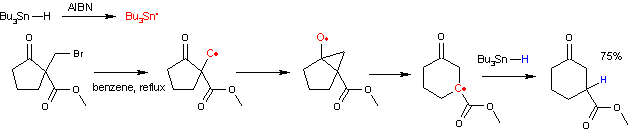
The Dowd–Beckwith ring-expansion reaction is an organic reaction in which a cyclic carbonyl (typically a β-keto ester) is expanded by up to 4 carbons in a free radical ring expansion reaction through an α-alkylhalo substituent. The radical initiator system is based on azobisisobutyronitrile and tributyltin hydride. The cyclic β-keto ester can be obtained through a Dieckmann condensation. The original reaction consisted of a nucleophilic aliphatic substitution of the enolate of ethyl cyclohexanone-2-carboxylate with 1,4-diiodobutane and sodium hydride followed by ring expansion to ethyl cyclodecanone-6-carboxylate. A side-reaction is organic reduction of the iodoalkane. center|Dowd–Beckwith Ring Expansion.gif
Reaction mechanism
The reaction mechanism involves a bicyclic intermediate. The reaction is initiated by thermal decomposition of AIBN. The resulting radicals abstract hydrogen from tributyltin hydride to a tributyltin radical which in turn abstracts the halogen atom to form an alkyl radical. This radical attacks the carbonyl group to an intermediate bicyclic ketyl. This intermediate then rearranges with ring expansion to a new carbon radical species which recombines with a proton radical from tributyltin hydride propagating the catalytic cycle.
Scope

A side reaction accompanying this ring expansion is organic reduction of the halo alkane to a saturated alkyl group. One study shows that the success depends critically on the accessibility of the carbonyl group. Deuterium experiments also show the presence of a 1,5 hydride shift. The reaction of the alkyl radical with the ester carbonyl group is also a possibility but has an unfavorable activation energy.
References
- A new tributyltin hydride-based rearrangement of bromomethyl .beta.-keto esters. A synthetically useful ring expansion to .gamma.-keto esters Paul Dowd, Soo Chang Choi; J. Am. Chem. Soc.; 1987; 109(11); 3493–3494.
- Free radical ring expansion by three and four carbons Paul Dowd, Soo Chang Choi; J. Am. Chem. Soc.; 1987; 109(21); 6548–6549.
- Rearrangement of suitably constituted aryl, alkyl, or vinyl radicals by acyl or cyano group migration Athelstan L. J. Beckwith, D. M. O'Shea, Steven W. Westwood; J. Am. Chem. Soc.; 1988; 110(8); 2565–2575.
- Three-Carbon Dowd–Beckwith Ring Expansion Reaction versus Intramolecular 1,5-Hydrogen Transfer Reaction: A Theoretical Study Diego Ardura and Tomás L. Sordo J. Org. Chem.; 2005; 70(23) pp. 9417–9423; (Article)
References
- (August 2022). "The Dowd-Beckwith Reaction: History, Strategies, and Synthetic Potential". Chemistry – A European Journal.
This article was imported from Wikipedia and is available under the Creative Commons Attribution-ShareAlike 4.0 License. Content has been adapted to SurfDoc format. Original contributors can be found on the article history page.
Ask Mako anything about Dowd–Beckwith ring-expansion reaction — get instant answers, deeper analysis, and related topics.
Research with MakoFree with your Surf account
Create a free account to save articles, ask Mako questions, and organize your research.
Sign up freeThis content may have been generated or modified by AI. CloudSurf Software LLC is not responsible for the accuracy, completeness, or reliability of AI-generated content. Always verify important information from primary sources.
Report