From Surf Wiki (app.surf) — the open knowledge base
Cinnamon
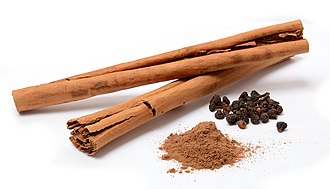
Spice from Cinnamomum trees
the spice
Cinnamon is a spice obtained from the inner bark of several tree species from the genus Cinnamomum. Cinnamon is used mainly as an aromatic condiment and flavouring additive in a wide variety of cuisines, in particular sweet and savoury dishes such as biscuits, breakfast cereals, snack foods, bagels, teas, hot chocolate, and traditional foods. The aroma and flavour of cinnamon derive from its essential oil and principal component, cinnamaldehyde, as well as numerous other constituents, including eugenol.

Cinnamon is the name for several species of trees and the commercial spice products that some of them produce. All are members of the genus Cinnamomum in the family Lauraceae. Only a few Cinnamomum species are grown commercially for spice. Cinnamomum verum (alternatively C. zeylanicum), known as "Ceylon cinnamon" after its origins in Sri Lanka (formerly Ceylon), is considered to be "true cinnamon", but most cinnamon in international commerce is derived from four other species, usually and more correctly referred to as "cassia": C. burmanni (Indonesian cinnamon or Padang cassia), C. cassia (Chinese cinnamon or Chinese cassia), C. loureiroi (Saigon cinnamon or Vietnamese cassia), and the less common C. citriodorum (Malabar cinnamon).
In 2023, world production of cinnamon was 238,403 tonnes, led by China with 39% of the total.
Etymology
The English word "cinnamon", attested in English since the 15th century, derives from the Ancient Greek κιννάμωμον (, later κίνναμον: ), via Latin and medieval French intermediate forms. The Greek was borrowed from a Phoenician word, which was similar to the related Hebrew word קנמון ().
The name "cassia", first recorded in late Old English from Latin, ultimately derives from the Hebrew word קציעה , a form of the verb קצע , "to strip off bark".
Early Modern English also used the names canel and canella, similar to the current names of cinnamon in several other European languages, which are derived from the Latin word cannella, a diminutive of canna, "tube", from the way the bark curls up as it dries.
History

Cinnamon has been known from remote antiquity. It was imported to Egypt as early as 2000 BC, but those who reported that it had come from China had confused it with Cinnamomum cassia, a related species. Its source was kept a trade secret in the Mediterranean world for centuries by those in the spice trade, to protect their monopoly as suppliers.
Cinnamomum verum, which translates from Latin as "true cinnamon", is native to India, Sri Lanka, Bangladesh and Myanmar. Cinnamomum cassia (cassia) is native to China. Related species, all harvested and sold in the modern era as cinnamon, are native to Vietnam ("Saigon cinnamon"), Indonesia, and other Southeast Asian countries with warm climates.
In Ancient Egypt, cinnamon was used to embalm mummies. From the Ptolemaic Kingdom onward, Ancient Egyptian recipes for kyphi, an aromatic used for burning, included cinnamon and cassia. The gifts of Hellenistic rulers to temples sometimes included cassia and cinnamon.
The first Greek reference to κασία is found in a poem by Sappho in the 7th century BC. According to Herodotus, both cinnamon and cassia grew in Arabia, together with incense, myrrh, and labdanum, and were guarded by winged serpents. Herodotus, Aristotle and other authors named Arabia as the source of cinnamon; they recounted that giant "cinnamon birds" collected the cinnamon sticks from an unknown land where the cinnamon trees grew and used them to construct their nests.
Pliny the Elder wrote that cinnamon was brought around the Arabian Peninsula on "rafts without rudders or sails or oars", taking advantage of the winter trade winds. He also mentioned cassia as a flavouring agent for wine, and that the tales of cinnamon being collected from the nests of cinnamon birds was a traders' fiction made up to charge more. However, the story remained current in Byzantium as late as 1310.
According to Pliny the Elder, a Roman pound (327 g) of cassia, cinnamon (serichatum), cost up to 1,500 denarii, the wage of fifty months' labour. Diocletian's Edict on Maximum Prices from 301 AD gives a price of 125 denarii for a pound of cassia, while an agricultural labourer earned 25 denarii per day. Cinnamon was too expensive to be commonly used on funeral pyres in Rome, but the Emperor Nero is said to have burned a year's worth of the city's supply at the funeral for his wife Poppaea Sabina in AD 65.
Middle Ages
Through the Middle Ages, the source of cinnamon remained a mystery to the Western world. From reading Latin writers who quoted Herodotus, Europeans had learned that cinnamon came up the Red Sea to the trading ports of Egypt, but where it came from was less than clear. When the Sieur de Joinville accompanied his king, Louis IX of France to Egypt on the Seventh Crusade in 1248, he reported—and believed—what he had been told: that cinnamon was fished up in nets at the source of the Nile out at the edge of the world (i.e., Ethiopia). Marco Polo avoided precision on the topic.
The first mention that the spice grew in the area of India was in Maimonides's Mishneh Torah, about 1180. The first mention that the spice grew specifically in Sri Lanka was in Zakariya al-Qazwini's ("Monument of Places and History of God's Bondsmen") about 1270. This was followed shortly thereafter by John of Montecorvino in a letter of about 1292.
Indonesian rafts transported cinnamon directly from the Moluccas to East Africa (see also Rhapta), where local traders then carried it north to Alexandria in Egypt. Venetian traders from Italy held a monopoly on the spice trade in Europe, distributing cinnamon from Alexandria. The disruption of this trade by the rise of other Mediterranean powers, such as the Mamluk sultans and the Ottoman Empire, was one of many factors that led Europeans to search more widely for other routes to Asia.
Early modern period
During the 1500s, Ferdinand Magellan was searching for spices on behalf of Spain; in the Philippines, he found Cinnamomum mindanaense, which was closely related to C. zeylanicum, the cinnamon found in Sri Lanka. This cinnamon eventually competed with Sri Lankan cinnamon, which was controlled by the Portuguese.
In 1638, Dutch traders established a trading post in Sri Lanka, took control of the manufactories by 1640, and expelled the remaining Portuguese by 1658. "The shores of the island are full of it," a Dutch captain reported, "and it is the best in all the Orient. When one is downwind of the island, one can still smell cinnamon eight leagues out to sea." The Dutch East India Company continued to overhaul the methods of harvesting in the wild and eventually began to cultivate its own trees.
In 1767, Lord Brown of the British East India Company established the Anjarakkandy Cinnamon Estate near Anjarakkandy in the Kannur district of Kerala, India. It later became Asia's largest cinnamon estate. The British seized control of Ceylon from the Dutch in 1796.
Cultivation


Cinnamon is an evergreen tree characterised by oval-shaped leaves, thick bark, and a berry fruit. When harvesting the spice, the bark and leaves are the primary parts of the plant used.
The stems must be processed immediately after harvesting while the inner bark is still wet. The cut stems are processed by scraping off the outer bark, then beating the branch evenly with a hammer to loosen the inner bark, which is then pried off in long rolls. Only 0.5 mm of the inner bark is used; the outer, woody portion is discarded, leaving metre-long cinnamon strips that curl into rolls ("quills") on drying. The processed bark dries completely in four to six hours, provided it is in a well-ventilated and relatively warm environment. Once dry, the bark is cut into 5 to lengths for sale.
A less-than-ideal drying environment encourages the proliferation of pests in the bark, which may then require treatment by fumigation with sulphur dioxide. In 2011, the European Union approved the use of sulphur dioxide at a concentration of up to 150 mg/kg for the treatment of C. verum bark harvested in Sri Lanka.
Species
Several species are often sold as cinnamon:
- Cinnamomum cassia (Cassia or Chinese cinnamon, the most common commercial type in the USA)
- C. burmanni (Korintje, Padang cassia, or Indonesian cinnamon)
- C. loureiroi (Saigon cinnamon, Vietnamese cassia, or Vietnamese cinnamon)
- C. verum (Sri Lanka cinnamon, Ceylon cinnamon or Cinnamomum zeylanicum)
- C. citriodorum (Malabar cinnamon)
Cassia induces a strong, spicy flavour and is often used in baking, especially associated with cinnamon rolls, as it handles baking conditions well. Among cassia, Chinese cinnamon is generally medium to light reddish-brown, hard and woody in texture, and thicker (2 - thick), as all of the layers of bark are used. Ceylon cinnamon, using only the thin inner bark, has a lighter brown colour and a finer, less dense, and more crumbly texture. It is subtle and more aromatic in flavour than cassia, and it loses much of its flavour during cooking.
The barks of the species are easily distinguished when whole, both in macroscopic and microscopic characteristics. Ceylon cinnamon sticks (quills) have many thin layers and can easily be made into powder using a coffee or spice grinder, whereas cassia sticks are much harder. Indonesian cinnamon is often sold in neat quills made up of one thick layer, capable of damaging a spice or coffee grinder. Saigon cinnamon (C. loureiroi) and Chinese cinnamon (C. cassia) are always sold as broken pieces of thick bark, as the bark is not supple enough to be rolled into quills.
The powdered bark is harder to distinguish, but if it is treated with tincture of iodine (a test for starch), little effect is visible with pure Ceylon cinnamon; however, when Chinese cinnamon is present, a deep-blue tint is produced.
Grading, of quills
The Sri Lankan grading system divides the cinnamon quills into four groups:
- Alba, less than 6 mm in diameter
- Continental, less than 16 mm in diameter
- Mexican, less than 19 mm in diameter
- Hamburg, less than 32 mm in diameter
These groups are further divided into specific grades. For example, Mexican is divided into M00000 special, M000000 and M0000, depending on quill diameter and number of quills per kilogram. Any pieces of bark less than 106 mm long are categorised as quillings. Featherings are the inner bark of twigs and twisted shoots. Chips are trimmings of quills, outer and inner bark that cannot be separated, or the bark of small twigs.
Production
| Source: FAOSTAT of the United Nations |
|---|
In 2023, four countries accounted for 98% of the world's cinnamon production, a total of 238,403 tonnes: China, Vietnam, Indonesia, and Sri Lanka.
Counterfeit
True cinnamon from C. verum bark can be mixed with cassia (C. cassia) as counterfeit and falsely marketed as authentic cinnamon. In one analysis, authentic Ceylon cinnamon bark contained 12–143 mg/kg of coumarin a phenolic typically low in content in true cinnamon but market samples contained coumarin with levels as high as 3462 mg/kg, indicating probable contamination with cassia in the counterfeit cinnamon. ConsumerLab.com found the same problem in a 2020 analysis; "a supplement that contained the highest amount of coumarin was labeled as Ceylon cinnamon".
Food uses
Cinnamon bark is used as a spice. It is principally employed in cookery as a condiment and flavouring material. It is used in the preparation of chocolate, especially in Mexico. Cinnamon is often used in savoury dishes of chicken and lamb. In the United States and Europe, cinnamon and sugar are often used to flavour cereals, bread-based dishes such as toast, and fruits, especially apples; a cinnamon and sugar mixture (cinnamon sugar) is sold separately for such purposes. It is also used in Portuguese and Turkish cuisine for both sweet and savoury dishes. Cinnamon can also be used in pickling, and in Christmas drinks such as eggnog and mulled wine. Cinnamon powder has long been an important spice in enhancing the flavour of Persian cuisine, used in a variety of thick soups, drinks, and sweets.
Cinnamon is a common ingredient in Jewish cuisine across various communities. In Sephardic cooking, it is incorporated into vegetable stews and desserts such as tishpishti and travados, both of which are soaked in honey. In Ashkenazi cuisine, cinnamon features in dishes like honey cakes, and kugels. It is also one of "four sibling spices" (rempah empat beradik) essential in Malay cuisine along with clove, star anise and cardamom.
Nutrient composition
Ground cinnamon is 11% water, 81% carbohydrates (including 53% dietary fiber), 4% protein and 1% fat.
Characteristics
Texture
Ceylon cinnamon may be crushed into small pieces by hand, while Indonesian cinnamon requires a powerful blender.
Flavour, aroma and taste
The flavour of cinnamon is due to the aromatic essential oils that make up 0.5 to 1% of its composition.
Cinnamon bark can be macerated, then extracted in 80% ethanol, to a tincture.
Cinnamon essential oil can be prepared by roughly pounding the bark, macerating it in sea water, and then quickly distilling the whole. It is golden-yellow, with the characteristic odour of cinnamon and a very hot aromatic taste.
Cinnamon oil nanoemulsion can be made with polysorbate 80, cinnamon essential oil, and water, by ultrasonic emulsification.
Cinnamon oil macroemulsion can be made with a dispersing emulsifying homogeniser.
Cinnamaldehyde is responsible for the pungent taste and scent, and constitutes about 90% of cinnamon bark essential oil. Cinnamaldehyde decomposes, in high humidity and high temperatures, to styrene, and, by reaction with oxygen as it ages, it darkens in colour and forms resinous compounds.
Cinnamon constituents include some 80 aromatic compounds, including eugenol, found in the oil from leaves or bark of cinnamon trees.
Alcohol flavourant
Cinnamon is used as a flavouring in cinnamon liqueur, such as cinnamon-flavoured whiskey in the United States, and , a cinnamon brandy in Greece.
Toxicity
A systematic review of adverse events as a result of cinnamon use reported gastrointestinal disorders and allergic reactions as the most frequently reported side effects.
Coumarin
In 2008, the European Food Safety Authority considered the toxicity of coumarin, a component of cinnamon, and confirmed a maximum recommended tolerable daily intake (TDI) of 0.1 mg of coumarin per kg of body weight. Coumarin is known to cause liver and kidney damage in high concentrations and metabolic effects in humans with CYP2A6 polymorphism. Based on this assessment, the European Union set a guideline for maximum coumarin content in foodstuffs of 50 mg per kg of dough in seasonal foods, and 15 mg per kg in everyday baked foods.
| *C. cassia* | *C. verum* | Min | Max | Min | Max |
|---|---|---|---|---|---|
| mg coumarin/g cinnamon | 0.09 | 12 (He et al., 2005) | 0.007 | 0.9 | |
| TDI cinnamon at 50 kg body weight (bw) | 59 g | 0.4 g | 714 g | 6 g |
Due to the variable amount of coumarin in C. cassia, usually well over 1 mg of coumarin per g of cinnamon and sometimes up to 12 times that, C. cassia has a low safe-intake-level upper limit to adhere to the above TDI. In contrast, C. verum has only trace amounts of coumarin.
Lead adulteration
In March 2024, the US Food and Drug Administration recommended a voluntary recall on six brands of cinnamon apple sauce due to extreme contamination with lead, after an investigation stemming from 500 reports of child lead poisoning across the US. The FDA determined that cinnamon (in apple sauce pouches manufactured by AUSTROFOOD S.A.S. with cinnamon from Negasmart, both of Ecuador) was adulterated with lead chromate. The two suppliers are now Red Listed to forestall future adulteration.
Gallery
File:“Spiced” Tea – Flavoured by Cinnamon and Cardamom, Comilla, Bangladesh, 26 April 2014.jpg|Cinnamon-flavoured tea
File:Mmm... cinnamon toast (4197664913).jpg|Cinnamon toast can be made with cinnamon baked in, or just sprinkled on top.
File:ദന്തധാവനചൂർണ്ണം.JPG|Ground cinnamon
Notes
References
References
- "Cinnamon, plant and spice". Encyclopaedia Britannica.
- Iqbal, Mohammed. (1993). "International trade in non-wood forest products: An overview". Food and Agriculture Organization of the United Nations.
- (2009). "A history of food". Wiley-Blackwell.
- {{cite OED2. cinnamon
- {{Etymonline. cinnamon
- {{cite OED2. cassia
- {{Etymonline. cassia
- {{cite OED2. canella; canel
- {{EB1911
- Cinnamon was so highly prized among ancient nations that it was regarded as a gift fit for monarchs and even for a deity; an inscription records the gift of cinnamon and cassia to the temple of [[Apollo]] at [[Miletus]].Toussaint-Samat 2009, p. 437
- Mohammadifar, Shamameh. (2010-08-23). "The Origin, History and Trade Route of Cinnamon". Journal for the History of Science.
- (2008). "Encyclopaedia Britannica". Encyclopaedia Britannica.
- Davis, Michelle. (2 January 2019). "Where Did Those Spices Come From?". [[University of California]] Agriculture and Natural Resources.
- (2010). "Herbal principles in cosmetics: properties and mechanisms of action". [[CRC Press]].
- Nguyen, Ngoc. (18 March 2022). "What is cinnamons? Origin, History and Types of Cinnamons". VHB Group.
- (8 May 2021). "Sweet wood". [[Deccan Herald]].
- "RC 5".
- "Book 3, sections 107-113".
- (1852). "An Analysis and Summary of Herodotus: With a Synchronistical Table of Principal Events; Tables of Weights, Measures, Money, and Distances; an Outline of the History and Geography; and the Dates Completed from Gaisford, Baehr, Etc". H. G. Bohn.
- "Book 12, chapter 42, section 87".
- Pliny the Elder. (1938). "Natural History". Harvard University Press.
- (1860). "Ceylon: an account of the island". Longman.
- "Book 12, chapter 42, section 93".
- Graser, E. R.. (1940). "An Economic Survey of Ancient Rome". [[Johns Hopkins Press]].
- "Book 12, chapter 41, section 83".
- Toussaint-Samat 2009, p. 437f.
- Toussaint-Samat 2009, p. 438 discusses cinnamon's hidden origins and Joinville's report.
- "Mishneh Torah".
- Tennent, James Emerson. (1860). "Account of the Island of Ceylon". Longman, Green, Longman, and Roberts.
- Yule, Henry. "Cathay and the Way Thither".
- (1984). "The life of spice; cloves, nutmeg, pepper, cinnamon". Findarticles.com.
- Woods, Sean. (4 March 2004). "Discovery: Sailing the Cinnamon Route".
- (1970). "The Spice Trade of the Roman Empire 29 B.C. – A.D. 641". [[The Journal of Roman Studies]].
- Hess, Andrew C.. (1973). "The Ottoman Conquest of Egypt (1517) and the Beginning of the Sixteenth-Century World War". International Journal of Middle East Studies.
- Mallari, Francisco. (December 1974). "The Mindanao Cinnamon". [[Philippine Quarterly of Culture & Society]].
- (1984). "The Perspective of the World: Civilization and Capitalism, 15th–18th Century". [[University of California Press]].
- Overmeer, Marjolein. (October 2013). "The Dutch East India Company in Ceylon". Schaakstukkenmuseum.
- Klein, Wouter. (17 February 2021). "Plant of the Month: Cinnamon". [[JSTOR Daily]].
- "Cinnamon Valley". Kerala Tourism.
- (2011). "Under a Tropical Sun". [[Macquarie University]].
- (2017). "Cinnamon". Plant Village, Pennsylvania State University.
- (September 1981). "Source Book of Flavors". [[Springer Science & Business Media]].
- (16 June 2017). "Learn How to Tell Ceylon Cinnamon Apart from Cassia Cinnamon". Sri Lanka Export Development Board.
- European Commission. (22 October 2010). "Commission Directive 2010/69/EU of 22 October 2010". [[Official Journal of the European Union]].
- (March 2014). "Differentiation of the four major species of cinnamons (C. burmannii, C. verum, C. cassia, and C. loureiroi) using a flow injection mass spectrometric (FIMS) fingerprinting method". [[Journal of Agricultural and Food Chemistry]].
- Grieve, M.. "A Modern Herbal – Cassia (Cinnamon)".
- (1854). "The Elements of materia medica and therapeutics".
- (2025). "Global cinnamon production in 2023; Crops/Regions/World Regions/Production Quantity/Year (pick lists)". UN [[Food and Agriculture Organization Corporate Statistical Database]] (FAOSTAT).
- (1 January 2018). "Quantification of coumarin and related phenolics in cinnamon samples from south India using UHPLC-ESI-QqQLIT-MS/MS method". International Journal of Food Properties.
- (11 December 2020). "Tests Suggest Caution With Cinnamon". ConsumerLab.com.
- Czarra, Fred. (1 May 2009). "Spices: A Global History". Reaktion Books.
- Gavin, Paola. (2024-07-19). "Old Spice".
- Hariati Azizan. (Aug 2, 2015). "A spicy blend of tradition". [[The Star (Malaysia).
- (1 April 2019). "Spices, cinnamon, ground". FoodData Central, [[US Department of Agriculture]].
- (March 2018). "Antibacterial activity of cinnamon ethanol extract ( cinnamomum burmannii ) and its application as a mouthwash to inhibit streptococcus growth". IOP Conference Series: Earth and Environmental Science.
- (15 March 2021). "Antibacterial and antibiofilm activities of cinnamon essential oil nanoemulsion against multi-species oral biofilms". Scientific Reports.
- (December 2020). "The effect of Macro and Nano-emulsions of cinnamon essential oil on the properties of edible active films". Food Science & Nutrition.
- "Ultra-Turrax® T 25".
- PubChem. "Cinnamaldehyde".
- (18 August 2006). "High daily intakes of cinnamon: Health risk cannot be ruled out". [[Federal Institute for Risk Assessment]] (BfR).
- (1 July 2009). "Influence of composition upon the variety of tastes in Cinnamomi cortex". Journal of Natural Medicines.
- (2011). "Chemistry, biogenesis, and biological activities of Cinnamomum zeylanicum". Critical Reviews in Food Science and Nutrition.
- (6 August 2002). "Oil of cinnamon". [[Toxicology Data Network]] (TOXNET).
- Willard, Haley. (16 Dec 2013). "11 Cinnamon-Flavored Liquors for the Holidays".
- (2016). "Cinnamon". [[National Institutes of Health]].
- "Cinnamon: Usefulness and Safety".
- (2016). "Do Cinnamon Supplements Have a Role in Glycemic Control in Type 2 Diabetes? A Narrative Review". [[Journal of the Academy of Nutrition and Dietetics]].
- (2013). "Cinnamon use in type 2 diabetes: an updated systematic review and meta-analysis". [[The Annals of Family Medicine]].
- (20 April 2012). "Cinnamon in glycaemic control: Systematic review and meta analysis". [[Clinical Nutrition (journal).
- (12 September 2012). "Cinnamon for diabetes mellitus". [[Cochrane Database of Systematic Reviews]].
- (April 2019). "The impact of cinnamon on anthropometric indices and glycemic status in patients with type 2 diabetes: A systematic review and meta-analysis of clinical trials". [[Complementary Therapies in Medicine]].
- "Cinnamon".
- (2017). "The effects of cinnamon supplementation on blood lipid concentrations: A systematic review and meta-analysis". J Clin Lipidol.
- (1 April 2019). "Cinnamon: A systematic review of adverse events". [[Clinical Nutrition (journal).
- Harris, Emily. "German Christmas Cookies Pose Health Danger". [[National Public Radio]].
- (7 October 2008). "Coumarin in flavourings and other food ingredients with flavouring properties - Scientific Opinion of the Panel on Food Additives, Flavourings, Processing Aids and Materials in Contact with Food (AFC)". [[EFSA Journal]].
- Russell, Helen. (20 December 2013). "Cinnamon sparks spicy debate between Danish bakers and food authorities". The Guardian.
- (2014). "Coumarin content in cinnamon containing food products on the Danish market". Food Control.
- (2013). "Cassia cinnamon as a source of coumarin in cinnamon-flavored food and food supplements in the United States". [[Journal of Agricultural and Food Chemistry]].
- (6 March 2024). "FDA Alert Concerning Certain Cinnamon Products Due to Presence of Elevated Levels of Lead".
- Aleccia, Jonel. (8 March 2024). "Lead-tainted cinnamon has been recalled. Here's what you should know".
- (16 April 2024). "Investigation of Elevated Lead & Chromium Levels: Cinnamon Applesauce Pouches (November 2023)".
- "Import Alert 99-42".
This article was imported from Wikipedia and is available under the Creative Commons Attribution-ShareAlike 4.0 License. Content has been adapted to SurfDoc format. Original contributors can be found on the article history page.
Ask Mako anything about Cinnamon — get instant answers, deeper analysis, and related topics.
Research with MakoFree with your Surf account
Create a free account to save articles, ask Mako questions, and organize your research.
Sign up freeThis content may have been generated or modified by AI. CloudSurf Software LLC is not responsible for the accuracy, completeness, or reliability of AI-generated content. Always verify important information from primary sources.
Report