From Surf Wiki (app.surf) — the open knowledge base
Chua's diode
Electronic resistor
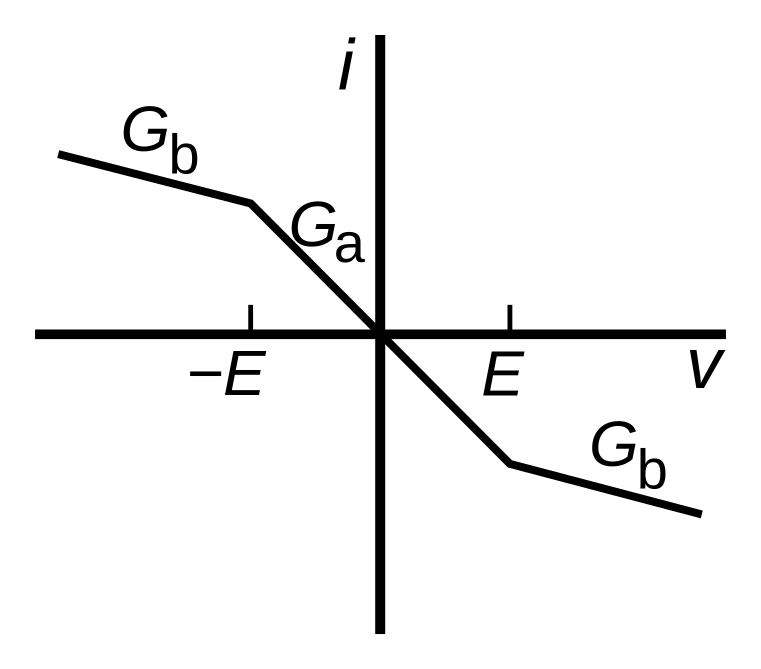
Electronic resistor
In electronics and chaos theory, Chua's diode is a type of two-terminal, nonlinear active resistor which can be described with piecewise-linear equations. It is an essential part of Chua's circuit, a simple electronic oscillator circuit which exhibits chaotic oscillations and is widely used as an example for a chaotic system. It is implemented as a voltage-controlled, nonlinear negative resistor.
The diode is not sold commercially, and is usually built from standard circuit components such as diodes, capacitors, resistors and op-amps. There are multiple ways to simulate Chua's diode using such components. One standard design is realized by connecting two negative impedance converters in parallel. A negative impedance converter (NIC) is a simple op amp circuit that has negative resistance. Another implementation uses one negative impedance converter to create the negative resistance characteristic, and a diode-resistor network to create the nonlinear characteristic.
Chua's diode was invented by Leon Chua, who is also the inventor of Chua's circuit.
References
- {{Cite book
References
- (9 October 2007). "The Chua Diode is Locally Active". Scholarpedia.
This article was imported from Wikipedia and is available under the Creative Commons Attribution-ShareAlike 4.0 License. Content has been adapted to SurfDoc format. Original contributors can be found on the article history page.
Ask Mako anything about Chua's diode — get instant answers, deeper analysis, and related topics.
Research with MakoFree with your Surf account
Create a free account to save articles, ask Mako questions, and organize your research.
Sign up freeThis content may have been generated or modified by AI. CloudSurf Software LLC is not responsible for the accuracy, completeness, or reliability of AI-generated content. Always verify important information from primary sources.
Report