From Surf Wiki (app.surf) — the open knowledge base
Café au lait spot
Type of birthmark caused by a collection of melanocytes
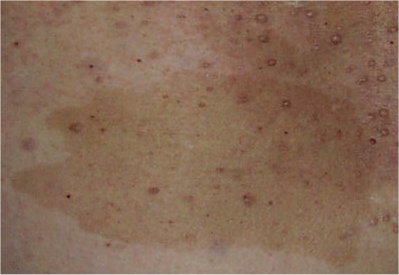
Type of birthmark caused by a collection of melanocytes
| Field | Value |
|---|---|
| name | Café au lait spot |
| image | CALSpot.jpg |
| caption | A café au lait spot on a patient's left cheek |
Café au lait spots, or café au lait macules, are flat, hyperpigmented birthmarks. The name café au lait is French for "coffee with milk" and refers to their light-brown color. They are caused by a collection of pigment-producing melanocytes in the epidermis of the skin. These spots are typically permanent and may grow or increase in number over time.
Café au lait spots are often harmless but may be associated with syndromes such as neurofibromatosis type 1 and McCune–Albright syndrome. Café au lait lesions with rough borders ("coast of Maine") may be seen in McCune–Albright syndrome. In contrast, café au lait lesions of neurofibromatosis type 1 have smooth borders ("coast of California").
Cause
Café au lait spots can arise from diverse and unrelated causes:
- Ataxia–telangiectasia
- Basal cell nevus syndrome
- Benign congenital skin lesion
- Bloom syndrome
- Chédiak–Higashi syndrome
- Congenital melanocytic naevus
- Fanconi anemia
- Fibrous dysplasia of bone
- Gaucher disease
- Hunter syndrome
- Jaffe–Campanacci syndrome
- Legius syndrome
- Maffucci syndrome
- They can be caused by vitiligo in the rare McCune–Albright syndrome.
- Multiple mucosal neuroma syndrome
- Having six or more café au lait spots greater than 5 mm in diameter before puberty, or greater than 15 mm in diameter after puberty, is a diagnostic feature of neurofibromatosis type I (NF-1), but other features are required to diagnose NF-1. Familial multiple cafe-au-lait spots have been observed without an NF-1 diagnosis.
- Noonan syndrome
- Silver–Russell syndrome
- Tuberous sclerosis
- Watson syndrome
- Wiskott–Aldrich syndrome
Diagnosis
Diagnosis is visual with measurement of spot size. The number of spots can have clinical significance for diagnosis of associated disorders such as neurofibromatosis type I. Six or more spots of at least 5 mm in diameter in pre-pubertal children and at least 15 mm in post-pubertal individuals is one of the major diagnostic criteria for NF1.
Prognosis
Café au lait spots are usually present at birth, permanent, and may grow in size or increase in number over time.
Café au lait spots are themselves benign and do not cause any illness or problems. However, they may be associated with syndromes such as neurofibromatosis type 1 and McCune–Albright syndrome.
The size and shape of the spots can vary in terms of description. In neurofibromatosis type 1, the spots tend to be described as ovoid, with smooth borders. In other disorders, the spots can be less ovoid, with jagged borders. In neurofibromatosis type 1, the spots tend to resemble the "coast of California" rather than the "coast of Maine", meaning the edges are smoother and more linear.
Treatment
Café au lait spots can be removed with lasers. Results are variable as the spots are often not completely removed or can come back after treatment. Often, a test spot is treated first to help predict the likelihood of treatment success.
References
References
- (January 2009). "Common pigmentation disorders". American Family Physician.
- Morelli, JG. (2013). "CURRENT Diagnosis & Treatment: Pediatrics, 22e". McGraw-Hill.
- "coast of Maine spots - General Practice Notebook".
- (13 August 2018). "Harrison's principles of internal medicine". McGraw-Hill Education.
- [http://emedicine.medscape.com/article/911900-overview "Cafe Au Lait Spots", by William D James, MD]
- [http://www.wrongdiagnosis.com/sym/_cafe_au_lait_spots.htm Cafe Au Lait Spots]
- (2000). "Café-au-lait spots caused by vitiligo in McCune-Albright syndrome". J Bone Miner Res.
- (1994). "Familial Multiple Cafe au lait Spots". Archives of Dermatology.
- (1993). "Neurofibromatosis 1".
- (2012). "Fitzpatrick's dermatology in general medicine". McGraw-Hill Medical.
- Scheinfeld, Noah S.. (2011). "Laser Treatment of Benign Pigmented Lesions". Medscape Reference.
- (2012). "Fitzpatrick's dermatology in general medicine". McGraw-Hill Medical.
This article was imported from Wikipedia and is available under the Creative Commons Attribution-ShareAlike 4.0 License. Content has been adapted to SurfDoc format. Original contributors can be found on the article history page.
Ask Mako anything about Café au lait spot — get instant answers, deeper analysis, and related topics.
Research with MakoFree with your Surf account
Create a free account to save articles, ask Mako questions, and organize your research.
Sign up freeThis content may have been generated or modified by AI. CloudSurf Software LLC is not responsible for the accuracy, completeness, or reliability of AI-generated content. Always verify important information from primary sources.
Report