From Surf Wiki (app.surf) — the open knowledge base
Brown-Séquard syndrome
Human spinal cord disorder
Human spinal cord disorder
| Field | Value |
|---|---|
| name | Brown-Séquard syndrome |
| image | Cord-en.png |
| width | 200px |
| synonyms | Brown-Séquard's paralysis |
Brown-Séquard syndrome (also known as Brown-Séquard's hemiplegia, Brown-Séquard's paralysis, hemiparaplegic syndrome, hemiplegia et hemiparaplegia spinalis, or spinal hemiparaplegia) is a neurological condition caused by damage to one half of the spinal cord. The condition presents clinically with spastic paralysis and loss of fine touch perception, vibratory sensation and proprioception just below the lesion on the same side of the body as the lesion, but with loss of crude touch, pain and temperature sensation on the opposite side and beginning somewhat lower than the lesion. At the level of the lesion, on the same side of the lesion, there is meanwhile a region of flaccid paralysis and complete loss of all sensation.
Because injury to a whole half but only one half of the spinal cord only rarely occurs under real-life circumstances, the condition is most often encountered in partial forms.
It is named after physiologist Charles-Édouard Brown-Séquard, who first described the condition in 1850.
Presentation and pathophysiology
The syndrome is frequently encountered in clinical practice, but only rarely presents in its classical form because most lesions are irregular; partial hemisection is common, but complete hemisection is rare. The development of characteristic pathology is preceded by a period of spinal shock.
Neuroanatomy
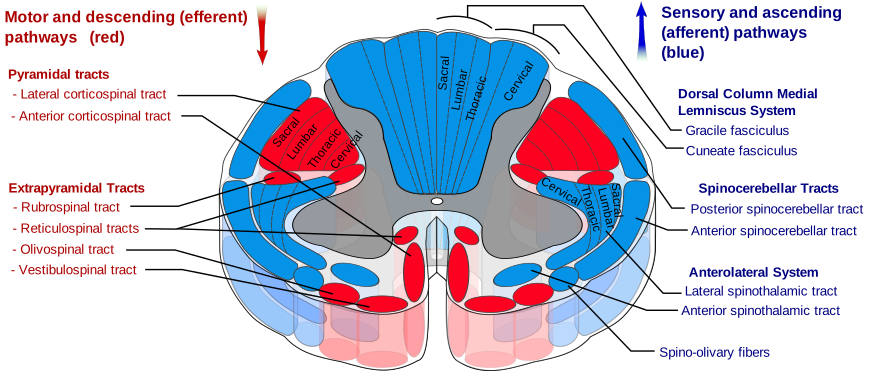
The hemisection of the spinal cord produces the classical triad characterising this syndrome by disrupting the following three structures of the spinal cord:
- Corticospinal tract - the "pyramidal" tract containing upper motor neurons mediates voluntary movements of skeletal muscle. It consists of two subdivisions: the lateral corticospinal tract which is situated in the lateral funiculus, controls musculature associated with the limbs and does not decussate within the spinal cord; and the anterior corticospinal tract which is situated in the anterior funiculus, controls the musculature of the trunk and does decussate within the spinal cord.
- Posterior funiculus - posterior anatomical division of the white matter of the spinal cord exclusively containing axons of 1st-order neurons of the dorsal column–medial lemniscus pathway which conveys sensory stimuli regarding fine (discriminative) touch, proprioception, and vibratory sense from the trunk and limbs. These do not decussate within the spinal cord.
- Spinothalamic tract - consists of two subdivisions: the lateral spinothalamic tract which is situated within the lateral funiculus and conveys sensory stimuli regarding pain, temperature, and pressure; and the anterior spinothalamic tract which is situated within the anterior funiculus and conveys sensory stimuli concerning crude (non-discriminative) touch and pressure information. Both tracts decussate within the spinal cord.
Motor

At the level of the lesion, destruction of the anterior gray column and potentially also of the anterior (motor) root of the corresponding spinal nerve results in destruction of lower motor neurons of the spinal segment on the affected side, causing flaccid paralysis and consequent muscle atrophy of the corresponding myotome.
Disruption of the upper motor neuron corticospinal tract produces ipsilateral spastic paralysis below the level of the lesion. Spasticity is a consequence of disruption of ipsilateral extrapiramidal tracts.
Reflexes
BSS is associated with ipsilateral Babinski sign and possibly (depending upon the level of the lesion) with loss of ipsilateral cremasteric reflex, and abdominal reflex.
Sensory
At the level of the lesion, destruction of the posterior (sensory) root of the corresponding spinal nerve causes complete loss of sensation (anaesthesia) of the corresponding dermatome.
Disruption of the dorsal column pathway causes ipsilateral loss of fine (discriminative) touch, vibration, and proprioceptive perception.
Disruption of the spinothalamic tract causes contralateral loss of pain, temperature, and crude (non-discriminative) touch sensation loss starting from 2-3 spinal cord segments inferior to the level of the lesion (because 2nd-order axons of the spinothalamic tract decussate obliquely).
Causes
Brown-Séquard syndrome may be caused by trauma (either blunt trauma or penetrative injury), spinal cord tumors, syringomyelia, hematomyelia, ischemia (obstruction of a blood vessel), infection (e.g. spinal tuberculosis, human herpesvirus 3) or autoimmune disease (e.g. multiple sclerosis). The most common cause is penetrating trauma such as gunshot injury or a stab wound to the spinal cord.
History
Charles-Édouard Brown-Séquard studied the anatomy and physiology of the spinal cord. He described this injury after observing spinal cord trauma which happened to farmers while cutting sugar cane in Mauritius. French physician, Paul Loye, attempted to confirm Brown-Séquard's observations on the nervous system by experimentation with decapitation of dogs and other animals and recording the extent of each animal's movement after decapitation.
Notes
Sources
References
- C.-É. Brown-Séquard: De la transmission croisée des impressions sensitives par la moelle épinière. ''Comptes rendus de la Société de biologie'', (1850) 1851, 2: 33–44.
- (2023). "Adams and Victor's Principles of Neurology". McGraw-Hill.
- Waxman, Stephen G.. "Clinical Neuroanatomy". McGraw-Hill Education.
- Snell, Richard S.. "Clinical Neuroanatomy". Wolters Kluwer/Lippincott Williams & Wilkins.
- (2021). "Guyton and Hall Textbook of Medical Physiology". Elsevier.
- (1889). "Death by Decapitation.". The American Journal of the Medical Sciences.
This article was imported from Wikipedia and is available under the Creative Commons Attribution-ShareAlike 4.0 License. Content has been adapted to SurfDoc format. Original contributors can be found on the article history page.
Ask Mako anything about Brown-Séquard syndrome — get instant answers, deeper analysis, and related topics.
Research with MakoFree with your Surf account
Create a free account to save articles, ask Mako questions, and organize your research.
Sign up freeThis content may have been generated or modified by AI. CloudSurf Software LLC is not responsible for the accuracy, completeness, or reliability of AI-generated content. Always verify important information from primary sources.
Report