From Surf Wiki (app.surf) — the open knowledge base
Biliran
Province in the Philippines
Province in the Philippines
| Field | Value |
|---|---|
| name | Biliran |
| settlement_type | |
| image_skyline | {{Photomontage |
| size | 250 |
| spacing | 2 |
| color | transparent |
| border | 0 |
| image_caption | clockwise from top: Biliran Bridge, Almeria, Sambawan Island, Biliran island satellite imagery in 2009 |
| image_flag | Flag of Biliran.svg |
| flag_size | 120x80px |
| image_seal | Seal of Biliran.svg |
| seal_size | 120x80px |
| image_map | Biliran in Philippines.svg |
| map_caption | Location in the Philippines |
| coordinates | |
| subdivision_type | Country |
| subdivision_name | |
| subdivision_type1 | Region |
| subdivision_name1 | |
| established_title | Founded |
| established_date | May 11, 1992 |
| seat | |
| leader_title | Governor |
| leader_name | Rogelio J. Espina (NP) |
| leader_title1 | Vice Governor |
| leader_name1 | Roselyn E. Paras (Lakas-CMD) |
| leader_title2 | Legislature |
| leader_name2 | Biliran Provincial Board |
| area_footnotes | |
| area_total_km2 | |
| area_rank | 78th out of 82 |
| elevation_max_footnotes | |
| elevation_max_m | 1,346 |
| elevation_max_point | Mount Naliwatan |
| population_footnotes | |
| population_total | |
| population_as_of | |
| population_rank | 75th out of 82 |
| population_density_km2 | auto |
| population_density_rank | 21st out of 82 |
| demographics_type1 | Divisions |
| demographics1_title1 | Independent cities |
| demographics1_info1 | 0 |
| demographics1_title2 | Component cities |
| demographics1_info2 | 0 |
| demographics1_title3 | Municipalities |
| demographics1_info3 | {{Collapsible list |
| titlestyle | font-weight:normal;text-align:left;background-color:WhiteSmoke; |
| title | 8 |
| demographics1_title4 | Barangays |
| demographics1_info4 | 132 |
| demographics1_title5 | Districts |
| demographics1_info5 | Lone district of Biliran |
| timezone | PHT |
| utc_offset | +8 |
| postal_code_type | ZIP code |
| postal_code | |
| area_code_type | |
| area_code | |
| iso_code | |
| blank_name_sec1 | Spoken languages |
| blank_info_sec1 | |
| blank_name_sec2 | Income classification |
| blank_info_sec2 | 4th class |
| website | |
| seat_type | Capital |
| and largest town | |
| mapframe | yes |
| mapframe-zoom | 8 |
| mapframe-wikidata | yes |
Biliran Bridge.jpg Biliran.jpg Sunset Agta Beach Resort - Biliran Philippines.jpg 2nd panorama island.jpg | and largest town | mapframe-zoom = 8 | mapframe-wikidata = yes
Biliran, officially the Province of Biliran (Waray-Waray: Probinsya han Biliran; ; ), is an island province in the Philippines located in the Eastern Visayas region (Region VIII). Biliran is one of the country's smallest and newest provinces. Formerly a sub-province of Leyte, it became an independent province in 1992.
Biliran lies less than a kilometer north of the island of Leyte. A bridge-causeway fixed link over Poro Island in the gateway town of Biliran connects the province to Leyte. Its capital is the municipality of Naval on the western coast of the island which is the most populous in the province.
Etymology
During the early Spanish era, what is now called Biliran was known as Isla de Panamao. The present name, believed to be adopted sometime between the late 17th century and the early 18th century, was, according to many publications, derived from a native grass called borobiliran which once grew abundantly on the island's plains. A contending theory states that the name came from the word bilir, which was defined in an old Visayan dictionary to be the "corner or edge of a boat, vase or anything protruding, like veins, or the furrow made by the plow." The dictionary also gives biliran as an alternate spelling for bilir. This theory is supported by the fact that Biliran was site of the first large-scale shipyard, built in the 17th century. Galleons were built to support the Galleon trade between Manila and Acapulco in Mexico.
History
Spanish colonial period
The first town, named Biliran, was founded in 1712 after petitioning for a municipality and parish status. During this time, the island was a part of Cebu Province. Biliran, together with the islands of Samar and Leyte, were constituted into a separate province in 1735. Later when Samar and Leyte were split into two provinces in 1768, Biliran became part of Leyte Province as its sub-province. The first parish priest, Gaspar Ignacio de Guevara, was assigned in 1765, but its parish status was apparently withdrawn because of Padre Gaspar's apostasy. The parish was re-established on February 22, 1782.
Moro raids
In May 1735, representative inhabitants of Leyte petitioned Governor-General Fernando Valdes y Tamon to allow them to resettle Biliran Island. They claimed it had been abandoned for the past 50 years and was presently inhabited by bagamundos (vagabonds) due to the frequent Moro raids.
On May 26, 1754, Moros destroyed Biliran and the town of Catbalogan in Samar. Panamao was reportedly razed to the ground and only the gobernadorcillo (mayor) of Biliran town escaped capture by the raiders. The old settlements of Caybiran, Mapuyo and Maripipi were also destroyed by the Moros.
The Moros staged their attack by marching inland along the Anas River for a distance of 1.5-2 leguas (leagues). Having covered part of the interior around a mountain, they managed to capture the inhabitants, with the exception of the gobernadorcillo who escaped. The houses and property of the natives were burned or destroyed. The church building suffered the same fate and its valuables were taken away by the raiders.
Post-Muslim raids
When the Muslim raiders were diminished in the early 19th century, Leytenians organized new towns in the present geography of Biliran Province.
In 1828, Caibiran on the east became an independent municipality and parish, the second to be created on Biliran Island.
Naval became the third town, carved out of the territory of Biliran town. It first became a separate parish in 1860. The Spanish colonial government officially recognized its municipality status on September 23, 1869, following the petition submitted around 1861.
Almeria became a separate town in 1886 and was named after the city of Almería in Spain.
Maripipi used to be a barrio of Naval. It was officially inaugurated as a town in 1867, two years ahead of its mother town, then folded up and was reduced into a barrio of Almeria, and then became a town again in 1899. Maripipi and the new towns of San Clemente (later Kawayan), Culaba and Esperanza (later Cabucgayan) were created around 1899 by the revolutionary government under President Emilio Aguinaldo.
Japanese occupation
During the World War II, Biliran had its own guerrilla forces under the Leyte command of Colonel Ruperto Kangleon. The guerrilla operation was of invaluable assistance to the successful landing of the American liberation forces at Palo, Leyte, on October 20, 1944, just before the Battle of Leyte Gulf.
In 1945, Biliran was liberated by the Philippine Commonwealth forces of the 9th Infantry Division of the Philippine Commonwealth Army who landed in Biliran. Aided by the local guerrilla forces, they attacked the Japanese troops on the island during the Battle of Biliran during World War II.
Philippine independence
Provincehood
On April 8, 1959, Republic Act No. 2141 was signed into law effectively making Biliran a sub-province of Leyte. The island became an independent province on May 11, 1992, through Republic Act No. 7160, making it one of the newest provinces in the country.
Geography
Biliran has a total land area of 536.01 km2, making it the fourth smallest province in the Philippines. The island lies off the northern coast of Leyte island across Biliran Strait. To the southeast is Carigara Bay, to the northeast is the Samar Sea, and across this sea is Samar. To the west is the Visayan Sea and Masbate lies 30 km to the northwest. The province is composed of two major volcanic islands: the main island also named Biliran and Maripipi, a smaller island to the northwest. Other smaller islands include Higatangan and Dalutan.
Topography
The main volcanic island of Biliran features mountainous interiors with very narrow coastal areas. Only the municipalities of Naval and Caibiran have wide plains extending about 7 km from the coast suitable for agriculture. Mount Suiro, an inactive volcano, is the highest point on Biliran with an elevation of 1301 m.
The only known historical volcanic activity at Biliran was a phreatic eruption and possible debris avalanche at a thermal area on September 26, 1939. There are five active solfatara fields on the island. The solfatara on the west side of Mt. Giron contained more than 400 tones of sulfur in 1880.
Maripipi is a 924 m volcanic island with the Maripipi Volcano located in the center and the Municipality of Maripipi surrounding its shores and lower slopes. The volcano is classified as potentially active but has had no historical eruptions.
Climate
Biliran has a combination of warm and cool climatic zones, thus the prevailing climate is ideal for the cultivation of a wide range of agricultural crops. There is no distinct dry season but the heavy wet season generally occurs in December.
Administrative divisions
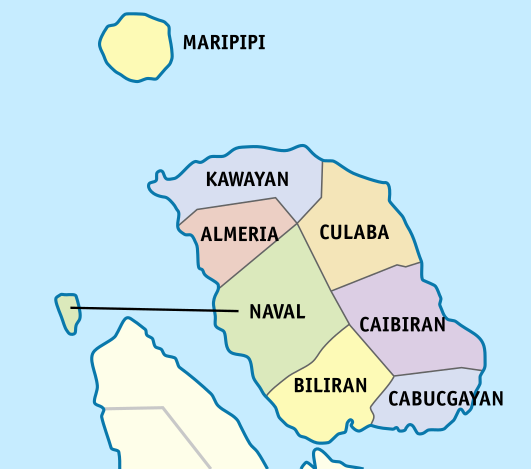
Biliran is subdivided into 8 municipalities, with a total of 132 barangays. All municipalities are located on Biliran Island, with the exception of Maripipi, which is an island municipality located to the northwest. The largest among the towns in terms of land area is the provincial capital Naval, while the smallest is Maripipi.
| Municipality | Population | Area | Density | Barangay | (2020) | (2015) | km2 | sqmi | /km2 | /sqmi | Total | 179,312 | 171,612 | 536.01 | 536.01 km2 | {{sigfig | 179,312/536.01 | 2}} PD/km2 | 132 |
|---|---|---|---|---|---|---|---|---|---|---|---|---|---|---|---|---|---|---|---|
| Almeria | 16,951 | 57.46 km2 | {{sigfig | 17,954/57.46 | 2}} PD/km2 | 13 | |||||||||||||
| Biliran | 16,882 | 70.30 km2 | {{sigfig | 17,662/70.30 | 2}} PD/km2 | 11 | |||||||||||||
| Cabucgayan | 20,788 | 54.19 km2 | {{sigfig | 21,542/54.19 | 2}} PD/km2 | 13 | |||||||||||||
| Caibiran | 22,524 | 83.55 km2 | {{sigfig | 24,167/83.55 | 2}} PD/km2 | 17 | |||||||||||||
| Culaba | 12,325 | 73.42 km2 | {{sigfig | 12,972/73.42 | 2}} PD/km2 | 17 | |||||||||||||
| Kawayan | 20,291 | 61.02 km2 | {{sigfig | 20,455/61.02 | 2}} PD/km2 | 20 | |||||||||||||
| Maripipi | 7,159 | 27.83 km2 | {{sigfig | 6,373/27.83 | 2}} PD/km2 | 15 | |||||||||||||
| Naval | † | 54,692 | 108.24 km2 | {{sigfig | 58,187/108.24 | 2}} PD/km2 | 26 | ||||||||||||
| Provincial capital | Municipality |
Demographics
The population of Biliran in the 2024 census was 179,312 people, with a density of {{sigfig|179,312/536.01|2}} PD/km2.
Based on the May 2000 census, the province had a total population of 140,274, which made it the fifth least populous province in the country, and the smallest in the region. There were 27,907 households in the province with an average size of 5.02 persons, slightly higher than the national average of 4.99. 87.05% of the population was Roman Catholic.
Languages
Waray-Waray and Cebuano are the languages spoken by the majority of the people in Biliran Province. The latter is primarily spoken in Naval, Almeria and Kawayan. Whereas Waray-waray is spoken in the towns of Caibiran, Culaba, Cabucgayan, Biliran and Maripipi. Both are Visayan languages.
The majority of the residents also speak and understand English and Filipino.
Economy
The economy of Biliran is largely based on fishing. Most of its towns, especially Naval and Biliran, have excellent seaports. There are 95 ha of brackish water fish ponds which produce prawns, shrimps and milkfish. Another 30 ha of seawater are suitable for seaweed farming and 10 more hectares for fishcage culture.
Being mountainous, Biliran can support various agricultural crops. The warm lowlands are conducive to rice (palay) production and other tropical crops. The cool highlands are favorable to high-value crops such as cut flowers and varieties of upland vegetables.
The inhabitants also engage in hunting, lumber, and manufacturing. The principal raw material produced is copra and coconut oil. Processed goods include white clay ceramics, dried fish, raw gulaman, and citronella oil.
The untapped natural resources of the island include geothermal power and the abundant sulfur and gypsum deposits.
Major industries includes fashion bags, Romblon bags, baskets, shellcrafts, placemats, hot pads, beverage coasters and trays.
Biliran has been eyed as an emerging destination for mountaineers, bikers, canyoneers, hikers, and other adventure seekers. For example, Sampao River in the municipality of Almeria has been developed into a canyoning venue.
Points of interest
- Bagongbong Falls
Ask Mako anything about Biliran — get instant answers, deeper analysis, and related topics.
Research with MakoFree with your Surf account
Create a free account to save articles, ask Mako questions, and organize your research.
Sign up freeThis content may have been generated or modified by AI. CloudSurf Software LLC is not responsible for the accuracy, completeness, or reliability of AI-generated content. Always verify important information from primary sources.
Report