From Surf Wiki (app.surf) — the open knowledge base
Barber's pole
Type of sign
Type of sign

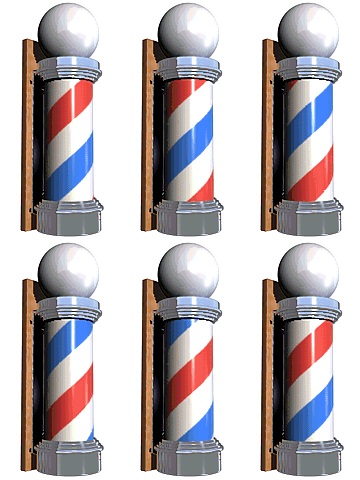
A barber's pole is a type of sign used by barbers to signify the place or shop where they perform their craft. The trade sign is, by a tradition dating back to the Middle Ages, a staff or pole with a helix of colored stripes (often red and white in many countries, but usually red, white and blue in Canada, Japan, the Philippines, South Korea, Vietnam, Hungary, and the United States). The pole may be stationary or may rotate, often with the aid of an electric motor. The consistent use of this advertising symbol can be seen as analogous to an apothecary's show globe, a tobacconist's cigar store Indian and a pawn broker's three gold balls.
A "barber's pole" with a helical stripe is a familiar sight, and is used as a secondary metaphor to describe objects in many other contexts. For example, if the shaft or tower of a lighthouse has been painted with a helical stripe as a daymark, the lighthouse could be described as having been painted in "barber's pole" colors.
Origin in barbering and surgery

During the Middle Ages, barbers performed surgery on customers, as well as tooth extractions. The original pole had a brassen wash basin at the top (representing the vessel in which leeches were kept) and bottom (representing the basin that received the blood). The pole itself represents the staff that the patient gripped during the procedure to encourage blood flow, and the twined pole motif is likely related to the Caduceus, the staff of the Greek god of speed and commerce Hermes, evidenced for example by early physician van Helmont's description of himself as "Francis Mercurius Van Helmont, A Philosopher by that one in whom are all things, A Wandering Hermite."
Under Pope Innocent II edicts were given forth (Council of Clermont 1130, of Rheims 1131, Second Council of the Lateran 1139) against medical practice by ecclesiastics. At the Council of Tours in 1163, the Roman Catholic clergy was banned from the practice of surgery. From then, physicians were clearly separated from the surgeons and barbers. Later, the role of the barbers was defined by the College de Saint-Côme et Saint-Damien, established by Jean Pitard in Paris circa 1210, as academic surgeons of the long robe and barber surgeons of the short robe.
In Renaissance-era Amsterdam, the surgeons used the colored stripes to indicate that they were prepared to bleed their patients (red), set bones or pull teeth (white), or give a shave if nothing more urgent was needed (blue).
After the formation of the United Barber Surgeon's Company in England, a statute required the barber to use a red and white pole and the surgeon to use a red pole. In the Kingdom of France, surgeons used a red pole with a basin attached to identify their offices. Blue often appears on poles in the United States, possibly as a homage to its national colors. Another, more fanciful interpretation of these barber pole colors is that red represents arterial blood, blue is symbolic of venous blood, and white depicts the bandage.
In any event, the barber pole became emblematic of the profession.
Manufacture of barber poles
Prior to 1950, there were four manufacturers of barber poles in the United States. In 1950, William Marvy of St. Paul, Minnesota, started manufacturing barber poles. Marvy made his 50,000th barber pole in 1967, and, by 2010, over 82,000 had been produced. The William Marvy Company is now the sole manufacturer of barber poles in North America, and sells only 500 per year (compared to 5,100 in the 1960s). In recent years, the sale of spinning barber poles has dropped considerably, since few barber shops are opening, and many jurisdictions prohibit moving signs. Koken of St. Louis, Missouri, manufactured barber equipment such as chairs and assorted poles in the 19th century.
Use in barbering{{anchor|Barber Pole Use in Barbering}}
The barber pole used to indicate the practice of a "barber-surgeon" who also performed tooth extraction, cupping, leeching, bloodletting, enemas, amputations, etc. Today's barber poles represent only barbershops where hair is cut and beards are shaved. As early as 1905, use of the poles was reported to be "diminishing" in the United States.
Barber poles have become a topic of controversy in the hairstyling business. In some American states, such as Michigan in March 2012, legislation has emerged proposing that barber poles should only be permitted outside barbershops, but not traditional beauty salons. Barbers and cosmetologists have engaged in several legal battles claiming the right to use the barber pole symbol to indicate to potential customers that the business offers haircutting services. Barbers claim that they are entitled to exclusive rights to use the barber pole because of the tradition tied to the craft, whereas cosmetologists think that they are equally capable of cutting men's hair (though many cosmetologists are not permitted to use razors, depending on their state's laws).
Use in prostitution{{anchor|Barber Pole Use in Prostitution}}
In South Korea, barber's poles are used both for actual barbershops and for brothels. Brothels disguised as barbershops, referred to as 이발소 (ibalso) or 미용실 (miyongsil), are more likely to use two poles next to each other, often spinning in opposite directions, though the use of a single pole for the same reason is also quite common. Actual barbershops, or 미용실 (miyongsil), are more likely to be hair salons; to avoid confusion, they will usually use a pole that shows a picture of a woman with flowing hair on it with the words hair salon written on the pole.
Visual illusion
A spinning barber pole creates a visual illusion, in which the stripes appear to be traveling up or down the length of the pole, rather than around it.
Other uses of the term
Visual similarity
- The Swan portion of M17, the Omega Nebula in the Sagittarius nebulosity is said to resemble a barber's pole.
- Barber pole-like structures have been observed at the cellular level. The effects, origins and causes are controversial, and are subject to intense research.
- Matthew Walker's knot is a decorative knot said to vaguely resemble a section of a barber's pole.
- Sinosauropteryx (meaning "Chinese reptilian wing", in Chinese 中华龙鸟: zhonghua longniao) is the first genus of non-avian dinosaur found with the fossilized impressions of feathers, as well as the first non-avian dinosaur where coloration has been determined. It lived in China during the early Cretaceous period and was a close relative of Compsognathus. It was the first non-avialan dinosaur genus discovered from the famous Jehol Biota of Liaoning Province. Zhang found "that the filaments running down its back and tail may have made the dinosaur look like an orange-and-white-striped barber pole. Such a vibrant pattern suggest that 'feathers first arose as agents for color display,' Benton says."
Referential naming
Animal husbandry
Haemonchus contortus, or "barber's pole worm", is the parasitic nematode responsible for anemia, bottle jaw, and death of infected sheep and goats, mainly during summer months in warm, humid climates. Humans may become infected by the worms.
Crustacea
Stenopus hispidus is a decapod crustacean sometimes called the "barber pole shrimp".
Entomology
In the insect world, there is the barber pole grasshopper, Dactylotum bicolor. It is also known as the "painted grasshopper" and is said to be the "most beautiful" grasshopper.
Ichthyology
Because of its bright bands and colors, the redbanded rockfish Sebastes babcocki is referred to as "barber pole". Other pseudonyms include bandit, convict, canary, Hollywood, and Spanish flag.
Candy
The old-fashioned American stick candy is sometimes also referred to as "barber pole candy" due to its colorful, swirled appearance. (See also candy cane.) "Candy stripe" is a generic description of the candy cane color scheme. Among many other names, the candy has been called Polkagris.
Computer science
In user interface design, a barber pole-like pattern is used in progress bars when the wait time is indefinite. It is intended to be used like a throbber to tell the user that processing is continuing, although it is not known when the processing will complete.
Barber pole is also sometimes used to describe a text pattern where a line of text is rolled left or right one character on the line below. The CHARGEN service generates a form of this pattern. It is used to test RAM, hard disks and printers. A similar pattern is also used in secure erasure of media.((cn))
Electronics
The strength and direction of magnetic fields and electric currents can be measured using a "magnetoresistive barber-pole sensor" (also called a "hermetic proximity sensor"), and its performance can be depicted using a mathematical formula. Such a sensor interleaves a series of permanent magnet strips with a series of magnetoresistive strips. The "conductive barberpole strips are canted across the sensor and connect one magnetoresistive strip, over a permanent magnet strip, to another magnetoresistive strip." This is said to provide a "uniform magnetic field throughout the sensor" thereby enhancing its resistance to external magnetic fields. The technology is used in wireless sensor networks which "have gathered a lot of attention as an important research domain" and were "deployed in many applications, e.g., navigation, military, ambient intelligence, medical, and industrial tasks. Context-based processing and services, in particular location-context, are of key interest ..." (See Music (acoustic illusion), infra.)
Aviation and space flight
The term on the barber pole or keep it on the barber pole is pilot jargon that refers to flying an aircraft at the maximum safe velocity. The airspeed Indicator on aircraft capable of flying at altitude features a red/white striped needle resembling a barber pole. This needle displays the VMO (Maximum Operating Velocity) or—at altitude—the MMO (Mach Limit Maximum Operating Speed) of the aircraft. This needle also indicates the maximum operating Mach number above the VMO/MMO changeover level. As the aircraft increases in altitude and the air decreases in density and temperature, the speed of sound also decreases. Close to the speed of sound, an aircraft becomes susceptible to buffeting caused by shock waves produced by flying at transonic speeds. Thus, as the speed of sound decreases, so the maximum safe operating speed of the aircraft is reduced. The "barber pole" needle moves to indicate this speed. Flying "on the barber pole" therefore means to be flying the aircraft as fast as is safe to do so in the current conditions.
Barberpole is a phrase used to describe the striped output of indicators used during the Apollo and Shuttle programs. Typically an indicator was positioned below a switch. When the switch was activated and the activation indeed performed, the resulted activation was talked back via a separated electrical line to the barberpole indicator to show a grey and white striped pattern, thus verifying the action to the astronaut. Such switches with barberpole indicators were called talkback switches. Various indicators in the Apollo Command Modules indicated barberpole when the corresponding system was inactive. Astronaut Jim Lovell can also be found describing system indications as "barber poled" in the transcript of radio transmissions during the Apollo 13 accident.
The phrase barberpole continues to be found in many subsystem descriptions in the Space Shuttle News Reference Manual, as well as the NASA/KSC Acronym List.
During World War I and World War II, the pattern has also been used as an insignia for aircraft identification. Spad XIIIs of the 94th Aero Squadron USAS in early 1919 used variations on barber pole patterns, including: "Barber Pole" of Lieutenant Dudley "Red" Outcault; S.16546 "Flag Bus" of Captain Reed Chambers; and "Rising Sun" of Lieutenant John Jeffers.
Flyfishing
Used in flyfishing, Au Sable River guide Earl Madsen's "Madsen's Barber pole" is a traditional Michigan fly in the form of a "Stonefly" imitation "with grizzly hackle tip wings tied in a downwing fashion". Photo of Madsen's Barber Pole Fly, parachute form.
Gambling
The phrase barber pole is derisive jargon in craps, and refers to the commingling of "gaming cheques of different denominations". Wagers that combine different denominations are "supposed to be stacked with the highest denomination at the bottom".
Parachuting
- The Screaming Eagles 101st Airborne Division (Air Assault) Command Parachute Demonstration Team, which operates out of Fort Campbell, Kentucky, executes a "barber pole maneuver" (also known as "the Baton Pass") during demonstrations. Two jumpers leave the aircraft and fly their bodies together to link while in free fall. "Once together they will then exchange a wooden baton ... [and] maneuver their bodies ... to create the illusion of a giant barber pole in the sky."
- Alternatively, a "Four Man Star" can "Hook Up" and then the formation rotates to the right, creating a "Barber Pole" effect with use of trailing smoke.
- Another parachuting use of the term describes having a mess of lines tangled "behind your head and you have to cut away your main chute and pull your reserve."
Meteorology
- According to the National Oceanic and Atmospheric Administration, barber pole is a slang term used by weather and storm spotters to describe "a thunderstorm updraft with a visual appearance including cloud striations that are curved in a manner similar to the stripes of a barber pole. The structure typically is most pronounced on the leading edge of the updraft, while drier air from the rear flank downdraft often erodes the clouds on the trailing side of the updraft." See Supercell. Supercell/barber's pole photograph.
- A lynchpin of the NOAA National Hurricane Research Laboratory's hurricane-research fleet is the Lockheed WP-3D Orion (P-3). It has two barber-pole samplers (named for their red-and-white stripes) which protrude from the aircraft's front, a tail Doppler weather radar, and other unique-looking instruments hanging from the wing.
Booksellers
Red or rubric posts were sometimes used by booksellers in England prior to 1800. William Roberts reports in The Book Hunter in London that certain 18th-century bookshops in the Little Britain district of London sported such poles:
A few years before Nichols published [in 1816] his *Literary Anecdotes*, two booksellers used to sport their rubric posts close to each other here in Little Britain, and these rubric posts were once as much the type of a bookseller's shop as the pole is of a barber's ... Sewell, Cornhill, and Kecket and De Hondt, Strand, were among the last to use these curious trade signs.
Border and lane markers
- Among the Fortifications of the inner German border, 2622 barber pole-styled markers were placed about 500 ft apart to demarcate the no-man's land between East Germany and West Germany.
- The 41 Combat Engineer Regiment, a part of the Canadian Military Engineers, produced and delivered over 16,000 distinctive barber pole lane markers during World War II.
Canadian Naval group
The famous Barber Pole Group was originally a group of 120 Flower-class corvettes built in Canada during World War II, and charged primarily with protecting freighter convoys. The original group was Escort Group C-3. This group of ships, with its red and white barber pole stripes painted on the funnel, is still represented in the current Royal Canadian Navy: all Atlantic fleet ships wear this insignia. is the last remaining Flower-class corvette.
Daymarks as a navigational aid

- A barber pole motif has been used as a daymark and navigational aid for lighthouses. The White Shoal Light is the only "barber pole" lighthouse in the United States, and has been used in Michigan's "Save our Lights" license plate. However, black and white helical daymarks do appear on other lights, such as Cape Hatteras Light and St. Augustine Light.
- Barber pole channel markers are sometimes used as they are in the Tamaki River.
Hockey
- In the 1896–97 season, the Ottawa Senators first adopted the "barber pole" design for their hockey jersey, with which the team became identified. The design featured strong horizontal stripes of red, black and white; white pants; and red, white and black striped stockings. This basic design would be used for the rest of the organization's existence, except for the 1909–1910 season. In that season, the stripes were vertical and Montreal fans nicknamed the team derisively as les suisses, a slang term for chipmunk. In the 1929–30 season, the club added the "O" logo to the chest of the jersey. The "barber-pole" uniform was later adopted by the Ottawa 67's junior hockey team.
- The National Hockey League's Montreal Canadiens had a barber pole or "barber shop" design jersey for the year 1912–1913.
- In the 1920s and 1930s, beginning in the 1927–28 season, the Senators, Boston Bruins, Montreal Maroons, Chicago Blackhawks, Detroit Cougars, and Toronto Maple Leafs had a barber's pole variation in their jerseys. Meanwhile, the New York Americans, wore "basically ... the United States flag as a jersey." The style endured, but in the 1938–39 season, the Blackhawks were the last to have a barber pole jersey in the traditional sense. The Hawks retired their barber pole at the end of the 1954–55 season.
- In junior ranks, the Chicoutimi Saguenéens and the Ottawa 67's use them in the Quebec Major Junior Hockey League (QMJHL) and Ontario Hockey League (OHL). During their existence in the Pacific Coast Hockey Association, the Seattle Metropolitans wore a red/white/green striped design: this has occasionally been brought back by the Seattle Thunderbirds of the Western Hockey League (WHL) to honor the history of hockey in the city.
- The style remained dormant until the National Hockey League's 75th anniversary, when Chicago wore replicas of their barber-pole sweaters as part of the league's celebrations. Since then, Montreal has also worn barber-pole replicas during their centenary season, and the design has become popular with amateur teams. See NHL uniform and Throwback uniform.
Music (acoustic illusion)
- The Shepard tone has been described as "a sonic barber pole" and an auditory illusion.
- "Barberpole flanging", also known as "infinite flanging" sonic illusion, is similar to the Shepard tone effect. "Barberpole Flanger" is one such, open source VST audio plug-in, implementation (with four different algorithms). The sweep of the "flanged sound seems to move in only one direction ("up" or "down") infinitely, instead of sweeping back-and-forth."
- "Barberpole phaser". Roger Shepard's original work used a computer program written by Max Mathews. However, the same type of effect can be accomplished using an analog synthesizer controlled by a gadget which may be called a "Shepard Function Generator". Harald Bode (popularizer of the Moog vocoder) invented a rack-mounted device called a "barberpole phaser" which was marketed in the 1980s. See also Buchla 200 series Electric Music Box and Buchla 200e.
Trademark
Barbasol cans use a barber pole motif. The can's motif is a registered trademark of Barbasol.
Footnotes
Citations
References
- (2010). "Barber Pole". Wiley Publishing.
- "Why Barber Poles are Red and White". Sensational Color.
- [https://news.google.com/newspapers?id=iOwQAAAAIBAJ&sjid=FYwDAAAAIBAJ&dq=cigar-store-indian&pg=5528%2C1776329 The Freelance Star (Sep 11, 1982) ''Cigar Store Indian was Early Advertising Sign''] Retrieved 2010 May 3
- van Helmont, Jean Baptiste. (1644). "Van Helmont's Workes, containing his ... Philosophy, Physick, Chirurgery, Anatomy".
- [https://archive.org/details/b30324038/page/n23/mode/2up Van Helmont's works: containing his most excellent philosophy, anatomy]
- (1978). "Medieval Canon Law on Medical and Surgical Practice by the Clergy". The Johns Hopkins University Press.
- MacNalty, Sir Arthur Salusbury. (1 December 1945). "The Renaissance and its Influence on English Medicine, Surgery and Public Health". [[British Medical Association]].
- (1749). "Histoire de l'origine et des progrès de la chirurgie en France". Ganeau.
- Wallace, Robert. (1968). "The World of Rembrandt: 1606–1669". Time-Life Books.
- Nix, Elizabeth. (2014-06-25). "Why are barber poles red, white and blue?".
- Journeyman Barber. (September 9, 2021). "Prize Contest No 4, Prize Contest No. 5". [[Barbers, Beauticians and Allied Industries International Association.
- (2010). "About Us". William Marvy Company.
- Censky, Annalyn. (2007). "Last of Their Kind: From Barber Poles to Limburger Cheese, These 5 Companies are the Last Left in America Making Iconic Products now in their Twilight.". [[CNNMoney.com]].
- (8 March 2012). "History of the Barber - Barber Schools". barber-schools.org.
- Tunis, Edwin.. (1905). "Colonial Craftsmen and the Beginnings of American Industry". World Publishing.
- (26 March 2012). "Banning Barber Poles at Michigan Salons? - Barber Schools". barber-schools.org.
- (1997). "Sex Among Allies: Military Prostitution in U.S.–Korea Relations". [[Columbia University Press]].
- (2007). "Love and Blood: At the World Cup with the Footballers, Fans, and Freaks". [[Houghton Mifflin Harcourt]].
- "Barber Pole Illusion". sandlotscience.com.
- (Spring 2007). "Book Reviews: What Are Musical Paradox and Illusion?". [[University of California, Santa Cruz]].
- (2007). "Nebulae and how to observe them". [[Springer Science]] Media.
- (15 July 2009). "Cell biology: Ahead of the curve {{ndash}} Cellular life is all slopes, arcs and circles – but there is much debate about how these curves are built". [[Nature (journal).
- "Double Matthew Walker Knot". animated knots by Grog.
- Ji, Q. (1996). "On discovery of the earliest bird fossil in China and the origin of birds". Chinese Geology.
- (December 2010). "Dinosaurs' Living Descendants". [[Smithsonian Institution]].
- (2010). "Barber's Pole Worm (''Haemonchus contortus'')". Australian Wool Innovation.
- (February 2005). "Management of Barber Pole Worm in Sheep and Goats in the Southern U.S". [[U.S. Department of Agriculture]] Dale Bumpers Small Farms Research Center.
- Schoenian, Susan. (15 February 2005). "Diseases: Worms". Sheep 101.
- (23 November 2010). "Barberpole worms in Humans". Daily Puppy.com.
- Calado, Ricardo. (2017). "Shrimp". John Wiley & Sons, Ltd.
- Marlos, Daniel. (16 September 2010). "Barber Pole Grasshopper". What's That Bug?.
- (9 September 2010). "Ugh: What to do about Grasshoppers". The Recorder.
- "Redbanded rockfish". [[National Marine Fisheries Service]] [[National Oceanic and Atmospheric Administration]].
- (7 October 2010). "Candy Cane". The Titi Tudorancea Bulletin, English Edition..
- (August 1985). "The Optimization and Design of Magnetoresistive Barber-Pole Sensors". NATO Advanced Study Institute on Chemically Sensitive Electronic Devices.
- "Barberpole MR sensor having interleaved permanent magnet and magnetoresistive segments".
- Carrella, Stefano. (18–19 May 2010). "3D-Localization of Low-Power Wireless Sensor Nodes Based on AMR-Sensors in Industrial and AmI Applications". Berlin Offenbach.
- "McGraw Hill Dictionary of Aviation". McGraw Hill.
- Avery, Rob. "The Conventional Airspeed Indicator".
- (17 June 2011). "Detailed Chronology of Events Surrounding the Apollo 13 Accident".
- (31 August 2000). "NSTS 1988 News Reference Manual". [[National Aeronautic and Space Administration]].
- (20 February 2009). "NASA/KSC Acronym List". National Aeronautic and Space Administration.
- (12 August 2010). "North American P-51 Mustang/F-51 Cavalier—USA". Wing's Palette.
- Pearson, Bob. (September 2000). "The "Showbirds" of Spad XIIIs of the 94th Aero Squadron USAS". Internet Modeler.
- (May 2005). "A 'Michigan Original,' Tier Jerry Regan brings AuSable Lore to Livonia". Michigan Fly Fishing Club.
- Cameron, Scott. (2010). "Craps Lingo". CasinoDealers.
- (2010). "Crap Dictionary". World Casino Directory.
- "101st Airborne Division (Air Assault) Command Parachute Demonstration Team "Screaming Eagles"". Globalsecurity.org.
- "British Virgin Islands Airshow, 2009. Retrieved 29 November 2010.".
- (July–August 1988). "Jump School at Fort Benning". Screaming Eagle Magazine.
- "A Comprehensive Glossary of Weather Terms for Storm Spotters". [[National Oceanic and Atmospheric Administration]], [[National Weather Service]] Weather Forecast Office.
- "Glossary". Tornado Chaser.net.
- (3 April 2003). "The Majestic Supercell – Barber pole photograph". Roger's Sky Pix.
- (March 2008). "USGS Extreme Storm Team Receives Christmas Week Tour of NOAA Aircraft Facility".
- Roberts, William. (1895). "The Book-Hunter in London: Historical and Other Studies of Collectors and Collecting". Elliot Stock.
- "HMCS ''Sackville'' History". Canadian Navy Memorial Trust.
- (2002). "HMCS ''Sackville'': The Last Flower: 1941–2000". History in Illustration.
- (17 February 2010). "A Hundred Years of Naval Service Captured in Ice". [[Ottawa Start]].
- Wobser, David. "White Shoal Light". Great Lakes & Seaway Shipping.
- (23 August 2003). "White Shoal Lighthouse, Mackinaw City, Michigan". Michigan Lighthouse Conservancy.
- [https://web.archive.org/web/20131213134601/http://www.whitworthfamily.org/images/2003-SaveOurLights-BU81R.JPG "Save our Lights" license plate]
- (2010). "Buxton, North Carolina—America's Tallest Lighthouse—Climb It". Roadside America.
- Kitchen (2008), p. 167
- Kitchen (2008), p. 303
- Wazz, Scotty. (6 November 2009). "Defending the Barber-Pole". Internet Radio.
- (October 2016). "Jerseys and Logos: From 1909 to 1946". [[Montreal Canadiens]].
- (October 2016). "1912–1913 Season". Montreal Canadiens.
- Cycleback, David Rudd. "The Sonic Barber Pole: Shepard's Scale". cycleback.com.
- Budde, Christian. "Barberpole Flanger". KVR Audio Plugin Resources.
- Simonton, John. (February 1983). "Shepard Function (Barberpole) CV Generator". [[Polyphony (magazine).
- Irwin, Michael. "Frequency shifters add an exotic dimension to the world of modular synthesis signal processing". Frequency Shifter electronic design.
- "Barberpole phaser". Ampage Tube Amps /Music Electronics Forum.
- (26 April 2005). "Barbasol Taps Gary Hall Jr. as First-Ever "Real Man"; Campaign Designed to ..". Business Wire.
- "Barbasol-American-Original".
- "Barbasol Shave Cream: An American Original".
- (28 February 1947). "The Barbasol Company vs. Jacobs". 7th CCA.
This article was imported from Wikipedia and is available under the Creative Commons Attribution-ShareAlike 4.0 License. Content has been adapted to SurfDoc format. Original contributors can be found on the article history page.
Ask Mako anything about Barber's pole — get instant answers, deeper analysis, and related topics.
Research with MakoFree with your Surf account
Create a free account to save articles, ask Mako questions, and organize your research.
Sign up freeThis content may have been generated or modified by AI. CloudSurf Software LLC is not responsible for the accuracy, completeness, or reliability of AI-generated content. Always verify important information from primary sources.
Report