From Surf Wiki (app.surf) — the open knowledge base
Baade's Window
Gap in interstellar dust allowing for observation of the center of the Milky Way Galaxy
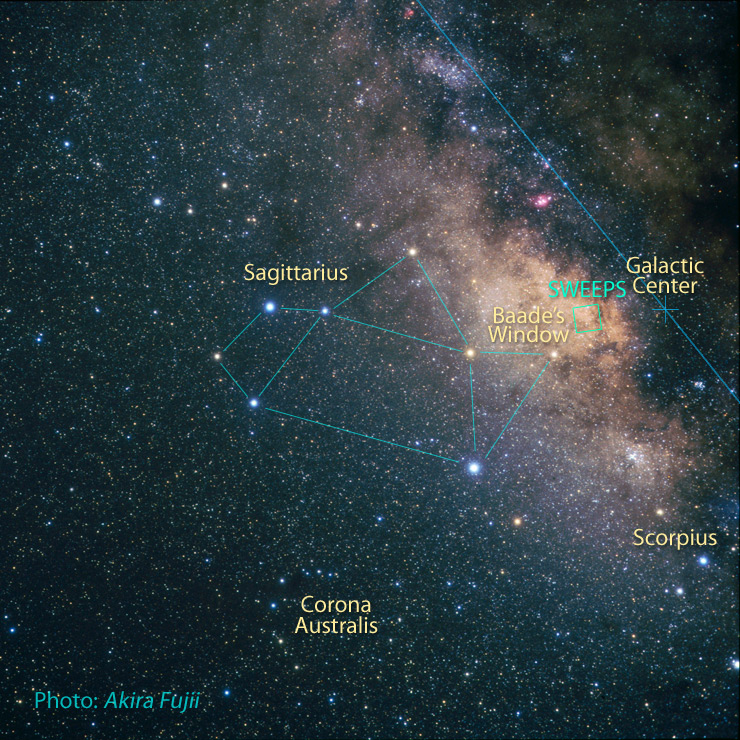
Gap in interstellar dust allowing for observation of the center of the Milky Way Galaxy
.jpg)
Baade's Window is an area of the sky with relatively low amounts of interstellar dust along the line of sight from Earth. This area is considered an observational "window" as the normally obscured Galactic Center of the Milky Way is visible in this direction. This makes the apparent Large Sagittarius Star Cloud visible.
It is named for astronomer Walter Baade, who first recognized its significance. This area corresponds to one of the brightest visible patches of the Milky Way. It is centered at a galactic longitude (l) of 1.02° and a galactic latitude (b) of -3.92°, which corresponds to a right ascension of 18h 03m 32.14s and a declination of -30d 02m 06.96s, in the direction of the constellation Sagittarius.
History
Walter Baade observed the stars in this area in the mid-1940s using the 100 in Hooker telescope at Mount Wilson Observatory in California while searching for the center of the Milky Way galaxy. Up until this time the structure and location of the galactic center was not known with certainty.{{cite journal
In 2006, the Sagittarius Window Eclipsing Extrasolar Planet Search (SWEEPS) conducted an astronomical survey to monitor 180,000 stars for seven days to detect extrasolar planets via the transit method. | access-date=2009-05-21
Significance
Baade's Window is frequently used to study distant central bulge stars in visible and near-visible wavelengths of light. Important information on the internal geometry of the Milky Way is still being refined by measurements made through this "window". The window is now known to be slightly "south" of the main central galaxy bulge. The window is irregular in outline and subtends about 1 degree of the sky. It is centered on the globular cluster NGC 6522.{{cite journal
Baade's Window is the largest of the six areas through which central bulge stars are visible.{{cite journal
OGLE and other observation programs have successfully detected extrasolar planets orbiting around central bulge stars in this area by the gravitational microlensing method.
Stars observed in Baade's Window can be called BW stars, similarly giant stars can be called BW giants.
References
References
- (May 2011). "Coordinates and 2MASS and OGLE identifications for all stars in Arp's 1965 finding chart for Baade's Window". [[Astronomy & Astrophysics]].
- "NAME Baade Window".
- "Your NED Search Results-Input: Galactic/Output: Equatorial J2000.0".
- Rich, R. M.. (March 1988). "Spectroscopy and abundances of 88 K giants in Baade's Window". Astronomical Journal.
This article was imported from Wikipedia and is available under the Creative Commons Attribution-ShareAlike 4.0 License. Content has been adapted to SurfDoc format. Original contributors can be found on the article history page.
Ask Mako anything about Baade's Window — get instant answers, deeper analysis, and related topics.
Research with MakoFree with your Surf account
Create a free account to save articles, ask Mako questions, and organize your research.
Sign up freeThis content may have been generated or modified by AI. CloudSurf Software LLC is not responsible for the accuracy, completeness, or reliability of AI-generated content. Always verify important information from primary sources.
Report