From Surf Wiki (app.surf) — the open knowledge base
Arab Revolt
1916–1918 uprising against the Ottoman Turks
1916–1918 uprising against the Ottoman Turks
| Field | Value | |||||||
|---|---|---|---|---|---|---|---|---|
| conflict | Arab Revolt | |||||||
| الثورة العربية | ||||||||
| partof | the Middle Eastern theatre of World War I | |||||||
| image | 030Arab.jpg | |||||||
| image_size | 300 | |||||||
| caption | Soldiers of the Sharifian Army carrying the flag of the Arab Revolt in southern Yanbu | |||||||
| date | 10 June 1916 – 25 October 1918 | |||||||
| () | ||||||||
| place | Middle East | |||||||
| result | Arab rebel victory | |||||||
| territory | Partition of the Ottoman Empire and Sykes–Picot Agreement{{bulletedlist | |||||||
| combatant1 | Kingdom of Hejaz | |||||||
| **Supported by:** | ||||||||
| United Kingdom of Great Britain and Ireland | ||||||||
| French Third Republic | ||||||||
| combatant2 | Ottoman Empire | |||||||
| **Supported by:** | ||||||||
| Emirate of Jabal Shammar | ||||||||
| German Empire | ||||||||
| commander1 | {{unbulletedlist | |||||||
| commander2 | {{unbulletedlist | |||||||
| strength1 | **Total:** 100,000+ | |||||||
| **June 1916:** | ||||||||
| 30,000 troops | ||||||||
| **October 1918:** | ||||||||
| 50,000+ troops | ||||||||
| strength2 | **May 1916:** | |||||||
| 6,500–7,000 troops | ||||||||
| **September 1918:** | ||||||||
| 25,000 troops | ||||||||
| 340 guns | ||||||||
| casualties1 | Unknown total | |||||||
| * 20,000+ killed<ref>{{cite web | title | Secretary's Notes of a Conversation Held in M. Pichon's Room at the Quai d'Orsay, Paris, on Thursday, 6 February, 1919, at 3 p.m. | url=https://history.state.gov/historicaldocuments/frus1919Parisv03/d61 | website=Office of the Historian | publisher=Department of State, United States of America | access-date=7 February 2025}} | ||
| casualties2 | 47,000+ total{{bulletedlist | |||||||
| 22,000+ captured<ref>{{cite book | author1 | War Office | author-link1=War Office | title=Statistics of the military effort of the British Empire during the Great War, 1914–1920 | date=1922 | publisher=London H.M. Stationery Office | url=https://archive.org/details/statisticsofmili00grea | page=633}}: 8000 prisoners taken by the Arab insurgents in Syria-Palestine in 1918, joining 98,600 taken by the British. |
| campaignbox |
the anti-Ottoman uprising during World War I
الثورة العربية () | British occupation of Palestine, Transjordan, and Mesopotamia | French occupation of Syria and Lebanon}} Supported by: United Kingdom of Great Britain and Ireland French Third Republic Supported by: Emirate of Jabal Shammar German Empire | Hejaz Hussein bin Ali | Hejaz Faisal bin Hussein | Hejaz Abdullah bin Hussein | Hejaz Ali bin Hussein | Hejaz Auda Abu Tayi | UKGBI Edmund Allenby | UKGBI T. E. Lawrence | French Third Republic Édouard Brémond}} | Ottoman Empire Mehmed V | Ottoman Empire Ahmed Djemal | Ottoman Empire Fakhri Pasha | Ottoman Empire Muhittin Akyüz | Ottoman Empire Recep Peker | Ottoman Empire Ismet Pasha | Ottoman Empire Nureddin Pasha | Jabal Shammar Saud bin Abdulaziz}} June 1916: 30,000 troops October 1918: 50,000+ troops 6,500–7,000 troops September 1918: 25,000 troops 340 guns
- 20,000+ killed | 5,000 killed | 10,000 wounded | 22,000+ captured | ~10,000 disease-related deaths}}
The Arab Revolt ( ar), also known as the Great Arab Revolt (الثورة العربية الكبرى ar), was an armed uprising by the Hashemite-led Arabs of the Hejaz against the Ottoman Empire amidst the Middle Eastern theatre of World War I.
On the basis of the McMahon–Hussein Correspondence, exchanged between Henry McMahon of the United Kingdom and Hussein bin Ali of the Kingdom of Hejaz, the rebellion against the ruling Turks was officially initiated at Mecca on 10 June 1916. The primary goal of the Arab rebels was to establish an independent and unified Arab state stretching from Aleppo to Aden, which the British government had promised to recognize.
The Sharifian Army, led by Hussein and the Hashemites with backing from the British military's Egyptian Expeditionary Force, successfully fought and expelled the Ottoman military presence from much of the Hejaz and Transjordan. By 1918, the rebels had captured Damascus and proclaimed the Arab Kingdom of Syria, a short-lived monarchy that was led by Hussein's son Faisal I.
The Arab-majority Ottoman territories of the Middle East were broken up into a number of League of Nations mandates, jointly controlled by the British and the French. Amidst the partition of the Ottoman Empire, the defeated Ottomans' mainland in Anatolia came under a joint military occupation by the victorious Allies. This was gradually broken by the Turkish War of Independence, which established the present-day Republic of Turkey.
Background
The rise of nationalism in the Ottoman Empire dates from at least 1821. Arab nationalism has its roots in the Mashriq, the Arab lands east of Egypt, particularly in countries of the Levant. The political orientation of Arab nationalists before World War I was generally moderate. Their demands were of a reformist nature and generally limited to autonomy, a greater use of Arabic in education and changes in peacetime conscription in the Ottoman Empire to allow Arab conscripts local service in the Ottoman army.
The Young Turk Revolution began on 3 July 1908 and quickly spread throughout the empire. As a result, Sultan Abdul Hamid II was forced to announce the restoration of the 1876 constitution and the reconvening of the Ottoman parliament. The period is known as the Second Constitutional Era. In the 1908 elections, the Young Turks' Committee of Union and Progress (CUP) managed to gain the upper hand against the Liberal Union, led by Sultanzade Sabahaddin. The new parliament had 142 Turks, 60 Arabs, 25 Albanians, 23 Greeks, 12 Armenians (including four Dashnaks and two Hunchaks), five Jews, four Bulgarians, three Serbs and one Vlach.
The CUP now gave more emphasis to centralisation and modernisation. It preached a message that was a mixture of pan-Islamism, Ottomanism, and pan-Turkism, which was adjusted as the conditions warranted. At heart, the CUP were Turkish nationalists who wanted to see the Turks as the dominant group within the Ottoman Empire, which antagonised Arab leaders and prompted them to think in similarly nationalistic terms.
Arab members of the parliament supported the countercoup of 1909, which aimed to dismantle the constitutional system and to restore the absolute monarchy of Sultan Abdul Hamid II. The dethroned sultan attempted to restore the Ottoman Caliphate by putting an end to the secular policies of the Young Turks. He was driven away to exile in Selanik by the 31 March Incident, in which the Young Turks defeated the countercoup. He was eventually replaced by his brother Mehmed V.
In 1913, intellectuals and politicians from the Mashriq met in Paris at the First Arab Congress. They produced a set of demands for greater autonomy and equality within the Ottoman Empire, including for elementary and secondary education in Arab lands to be delivered in Arabic, for peacetime Arab conscripts to the Ottoman army to serve near their home region and for at least three Arab ministers in the Ottoman cabinet.
Forces
It is estimated that the Arab forces involved in the revolt numbered around 5,000 soldiers. This number probably applies to the Arab regulars who fought during the Sinai and Palestine campaign with Edmund Allenby's Egyptian Expeditionary Force, and not the irregular forces under the direction of T. E. Lawrence and Faisal, though other sources place this number lower, at 2,000-3,500 soldiers. On a few occasions, particularly during the final campaign into Syria, this number grew significantly. The Arab Bureau of the British Empire in Cairo believed that the revolt would draw the support of all Arabs throughout the Ottoman Empire and Arab lands.
Faisal and Sharif Hussein reportedly expected to be joined by 100,000 Arab troops. The large desertions predicted by the British Arab Bureau never materialized, as the majority of Arab officers remained loyal to the Ottomans until the end. Many Arabs joined the Revolt sporadically, often as a campaign was in progress, or only when the fighting entered their home region. During the Battle of Aqaba, for instance, while the initial Arab force numbered only a few hundred, over a thousand more from local tribes joined them for the final assault on Aqaba. Estimates of Faisal's effective forces vary, but through most of 1918 at least, they may have numbered as high as 30,000 men, though it is claimed that the initial forces numbered at 70,000, and even 100,000+.
The Hashemite Army comprised two distinctive forces: tribal irregulars who waged a guerrilla war against the Ottoman Empire and the Sharifian Army, which was recruited from Ottoman Arab POWs and fought in conventional battles. Hashemite forces were initially poorly equipped, but later received significant supplies of weapons, most notably rifles and machine guns from Britain and France.
In the early days of the revolt, Faisal's forces were largely made up of Bedouins and other nomadic desert tribes, who were only loosely allied, loyal more to their respective tribes than the overall cause. The Bedouin would not fight unless paid in advance with gold coin. By the end of 1916, the French had spent 1.25 million gold francs in subsidizing the revolt. By September 1918, the British were spending £220,000/month to subsidize the revolt.
Faisal had hoped that he could convince Arab troops serving in the Ottoman Army to mutiny and join his cause, but the Ottoman government sent most of its Arab troops to the Western front-lines of the war, and thus only a handful of deserters actually joined the Arab forces until later in the campaign.
By the beginning of the First World War, Arab conscripts constituted about 30% of the wartime Ottoman military of 3 million, serving in all ranks, from the lowest to the highest, and forming a crucial component of the Ottoman Army. Ottoman troops in the Hejaz numbered 20,000 men by 1917. At the outbreak of the revolt in June 1916, the VII Corps of the Fourth Army was stationed in the Hejaz. It was joined by the 58th Infantry Division, commanded by Lieutenant-Colonel Ali Necib Pasha, the 1st Kuvvie- Mürettebe (Provisional Force) led by General Mehmed Cemal Pasha, which had the responsibility of safeguarding the Hejaz railway and the Hejaz Expeditionary Force (), which was under the command of General Fakhri Pasha.
In face of increasing attacks on the Hejaz railway, the 2nd Kuvve i Mürettebe was created by 1917. The Ottoman force included a number of Arab units who stayed loyal to the Sultan-Caliph and fought well against the Allies.
The Ottoman troops enjoyed an advantage over the Hashemite troops at first, in that they were well supplied with modern German weapons. The Ottoman forces had the support of both the Ottoman Aviation Squadrons, air squadrons from Germany and the Ottoman Gendarmerie or zaptı. The Ottomans relied upon the support of Emir Saud bin Abdulaziz Al Rashid of the Emirate of Jabal Shammar, whose tribesmen dominated what is now northern Saudi Arabia, and tied down both the Hashemites and Saʻudi forces with the threat of their raiding attacks.
The great weakness of the Ottoman forces was they were at the end of a long and tenuous supply line in the form of the Hejaz railway, and because of their logistical weaknesses, were often forced to fight on the defensive. Ottoman offensives against the Hashemite forces more often faltered due to supply problems than to the actions of the enemy.
The main contribution of the Arab Revolt to the war was to pin down tens of thousands of Ottoman troops who otherwise might have been used to attack the Suez Canal and to conquer Damascus, allowing the British to undertake offensive operations with a lower risk of counter-attack. This was the British justification for supporting the revolt, a textbook example of asymmetric warfare that has been studied time and again by military leaders and historians alike.
History
Revolt
The Ottoman Empire took part in the Middle Eastern theatre of World War I, under the terms of the Ottoman–German Alliance. Many Arab nationalist figures in Damascus and Beirut were arrested, then tortured. The flag of the resistance was designed by Sir Mark Sykes, in an effort to create a feeling of "Arab-ness", in order to fuel the revolt.
Prelude (November 1914 – October 1916)

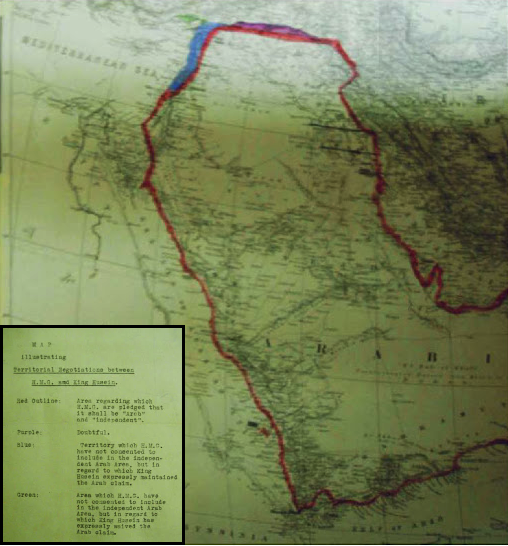
When Herbert Kitchener was Consul-General in Egypt, contacts between Abdullah and Kitchener culminated in a telegram of 1 November 1914 from Kitchener, recently appointed as Secretary of War, to Hussein, wherein Britain would, in exchange for support from the Arabs of Hejaz, "guarantee the independence, rights and privileges of the Sharifate against all foreign external aggression, in particular that of the Ottomans." The Sharif indicated that he could not break with the Ottomans immediately, and it did not happen till the following year.
From 14 July 1915, to 10 March 1916, ten letters, five from each side, were exchanged between Sir Henry McMahon and Sherif Hussein. Hussein's letter of 18 February 1916 appealed to McMahon for £50,000 in gold, plus weapons, ammunition, and food. Faisal claimed that he was awaiting the arrival of 'not less than 100,000 people' for the planned revolt. McMahon's reply of 10 March 1916 confirmed British agreement to the requests and concluded the correspondence.
Hussein, who until then had officially been on the Ottoman side, was now convinced that his assistance to the Triple Entente would be rewarded by an Arab empire, encompassing the entire span between Egypt and Qajar Iran, with the exception of imperial possessions and interests in Kuwait, Aden, and the Syrian coast. He decided to join the Allied camp immediately, because of rumours that he would soon be deposed as Sharif of Mecca by the Ottoman government in favor of Sharif Ali Haidar, leader of the rival Zaʻid family. The much-publicized executions of the Arab nationalist leaders in Damascus led Hussein to fear for his life if he were deposed in favour of Ali Haidar.
Hussein had about 50,000 men under arms, but fewer than 10,000 had rifles. On 5 June 1916, two of Hussein's sons, the emirs ʻAli and Faisal, began the revolt by attacking the Ottoman garrison in Medina, but were defeated by an aggressive Turkish defence, led by Fakhri Pasha. The revolt proper began on 10 June 1916, when Hussein ordered his supporters to attack the Ottoman garrison in Mecca. In the Battle of Mecca, there ensued over a month of bloody street fighting between the out-numbered, but far better armed Ottoman troops and Hussein's tribesmen. Hashemite forces in Mecca were joined by Egyptian troops sent by the British, who provided much needed artillery support, and took Mecca on 9 July 1916.
Indiscriminate Ottoman artillery fire, which did much damage to Mecca, turned out to be a potent propaganda weapon for the Hashemites, who portrayed the Ottomans as desecrating Islam's most holy city. Also on 10 June, another of Hussein's sons, the Emir Abdullah, attacked Ta'if, which after an initial repulse, settled down into a siege. With the Egyptian artillery support, Abdullah took Ta'if on 22 September 1916.
French and British naval forces cleared the Red Sea of Ottoman gunboats early in the war. The port of Jeddah was attacked by 3,500 Arabs on 10 June 1916 with the assistance of bombardment by British warships and seaplanes. The seaplane carrier , provided crucial air support to the Hashemite forces. The Ottoman garrison surrendered on 16 June. By the end of September 1916, the Sharifian Army had taken the coastal cities of Rabigh, Yanbu, al Qunfudhah, and 6,000 Ottoman prisoners with the assistance of the Royal Navy.
The capture of the Red Sea ports allowed the British to send over a force of 700 Ottoman Arab POWs, who primarily came from what is now Iraq, who had decided to join the revolt led by Nuri al-Saʻid and a number of Muslim troops from French North Africa. Fifteen thousand well-armed Ottoman troops remained in the Hejaz. A direct attack on Medina in October resulted in a bloody repulse of the Arab forces.
Arrival of T. E. Lawrence (October 1916 – January 1917)
In June 1916, the British sent out a number of officials to assist the revolt in the Hejaz, most notably Colonel Cyril Wilson, Colonel Pierce C. Joyce, and Lt-Colonel Stewart Francis Newcombe. Herbert Garland was also involved. In addition, a French military mission commanded by Colonel Édouard Brémond was sent out. The French enjoyed an advantage over the British in that they included a number of Muslim officers, such as Captain Muhammand Ould Ali Raho, Claude Prost, and Laurent Depui. The latter two converted to Islam during their time in Arabia. Captain Rosario Pisani of the French Army, though not a Muslim, played a notable role in the revolt as an engineering and artillery officer with the Arab Northern Army.
In October 1916, the British government in Egypt sent a young officer, Captain T. E. Lawrence, to work with the Hashemite forces in the Hejaz. Lawrence arrived in Jeddah together with Ronald Storrs, Secretary for the Orient at the Cairo Residency and Sir Henry McMahon's trusted aide in the delicate negotiations with Sharif Hussein bin Ali. During 1916 the rebellion hadn't gone according to the wishes of Sharif Hussein. It had come to a standstill, which in the case of an irregular war is always the beginning of the end.
Lawrence suspected that what was missing was the right leadership. The main purpose of Lawrence's visit was to find the man who could become the soul of the rebellion and lead to the goal Lawrence had set. After traveling a long distance by camel to meet with leaders of the rebellion, Lawrence concluded that Feisal, Hussein's third son, was the right candidate. The Arab rebels in Jeddah suffered from a severe shortage of weapons and lack of ammunition; they had no machine guns and only 2 cannons. The weapons they had were very outdated compared to the weapons of the Ottoman army.
Lawrence judged that there was potential for success for the rebels in the war against the Ottomans if the British cooperated with Feisal and equipped the rebels with more modern weapons and weapon specialists. Lawrence traveled to Cairo and submitted a long report to his superior and to General Reginald Wingate. The British historian David Murphy wrote that though Lawrence was just one of many British and French officers serving in Arabia, historians often write as though Lawrence alone represented the Allied cause in Arabia.
David Hogarth credited Gertrude Bell for much of the success of the Arab Revolt. She had travelled extensively in the Middle East since 1888 after graduating from Oxford with a First in Modern History. Bell met Sheikh Harb of the Howeitat in January 1914 and thus was able to provide a "mass of information" which was crucial to the success of Lawrence's occupation of Aqaba, covering the "tribal elements ranging between the Hejaz Railway and the Nefud, particularly about the Howeitat group." It was this information, Hogarth emphasized, which "Lawrence, relying on her reports, made signal use of in the Arab campaigns of 1917 and 1918."
Lawrence obtained assistance from the Royal Navy to turn back an Ottoman attack on Yenbu in December 1916. Lawrence's major contribution to the revolt was convincing the Arab leaders, Faisal and Abdullah, to coordinate their actions in support of British strategy. Lawrence developed a close relationship with Faisal, whose Arab Northern Army was to become the main beneficiary of British aid.
Since Lawrence's relations with Abdullah were not as good, Abdullah's Arab Eastern Army received considerably less in way of British aid. Lawrence persuaded the Arabs not to drive the Ottomans out of Medina. Instead, the Arabs attacked the Hejaz railway on many occasions. This tied up more Ottoman troops, who were forced to protect the railway and repair the constant damage.
On 1 December 1916, Fakhri Pasha began an offensive with three brigades out of Medina, with the aim of taking the port of Yanbu. At first, Fakhri's troops defeated the Hashemite forces in several engagements, and seemed set to take Yanbu. On 11–12 December 1916, it was fire and air support from the five ships of the Royal Navy Red Sea Patrol that defeated the Ottoman attempts to take Yanbu, with heavy losses. Fakhri then turned his forces south to take Rabegh, but owing to the guerrilla attacks on his flanks and supply lines, air attacks from the newly established Royal Flying Corps base at Yanbu, and the over-extension of his supply lines, he was forced to turn back on 18 January 1917, to Medina.
The coastal city of Wejh was to be the base for attacks on the Hejaz railway. On 3 January 1917, Faisal began an advance northward along the Red Sea coast with 5,100 camel riders, 5,300 men on foot, four Krupp mountain guns, ten machine guns, and 380 baggage camels. The Royal Navy resupplied Faisal from the sea during his march on Wejh. While the 800-man Ottoman garrison prepared for an attack from the south, a landing party of 400 Arabs and 200 Royal Navy bluejackets attacked Wejh from the north on 23 January 1917. Wejh surrendered within 36 hours, and the Ottomans abandoned their advance toward Mecca in favor of a defensive position in Medina, with small detachments scattered along the Hejaz railway.
The Arab force had increased to about 70,000 men, armed with 28,000 rifles and deployed in three main groups. Ali's force threatened Medina, Abdullah operated from Wadi Ais harassing Ottoman communications and capturing their supplies, and Faisal based his force at Wejh. Camel-mounted Arab raiding parties had an effective radius of 1,000 miles (1,600 km), carrying their own food and taking water from a system of wells approximately 100 miles (160 km) apart.
In late 1916, the Allies started the formation of the Regular Arab Army, also known as the Sharifian Army, raised from Ottoman Arab POWs. The soldiers of the Regular Army wore British-style uniforms with the keffiyahs and, unlike the tribal guerrillas, fought full-time and in conventional battles. Some of the more notable former Ottoman officers to fight in the Revolt were Nuri as-Said, Ja'far al-Askari and 'Aziz 'Ali al-Misri.
Northward expeditions (January–November 1917)
The year 1917 began well for the Hashemites, when the Emir Abdullah and his Arab Eastern Army ambushed an Ottoman convoy led by Ashraf Bey in the desert, and captured £20,000 worth of gold coins that were intended to bribe the Bedouin into loyalty to the Sultan. Starting in early 1917, the Hashemite guerrillas began attacking the Hejaz railway. At first, guerrilla forces commanded by officers from the Regular Army such as al-Misri, and by British officers such as Newcombe, Lieutenant Hornby and Major Herbert Garland focused their efforts on blowing up unguarded sections of the Hejaz railway. Garland was the inventor of the so-called "Garland mine", which was used with much destructive force on the Hejaz railway.
In February 1917, Garland succeeded for the first time in destroying a moving locomotive with a mine of his own design. In February 1917, around Medina, Captain Muhammad Ould Ali Raho of the French Military Mission carried out his first railway demolition attack. Captain Raho emerged as one of the leading destroyers of the Hejaz railway. In March 1917, Lawrence led his first attack on the Hejaz railway. Typical of such attacks was the one commanded by Newcombe and Joyce, who on the night of 6/7 July 1917, planted over 500 charges on the Hejaz railway, which all went off at about 2 am. In a raid in August 1917, Captain Raho led a force of Bedouin in destroying 5 kilometers of the Hejaz railway and four bridges.
In March 1917, an Ottoman force joined by tribesmen from Jabal Shammar led by Ibn Rashid carried out a sweep of the Hejaz, that did much damage to the Hashemite forces. However, the Ottoman failure to take Yanbu in December 1916 led to the increased strengthening of the Hashemite forces, and led to the Ottoman forces to go on the defensive. Lawrence later claimed that the failure of the offensive against Yanbu was the turning point that ensured the ultimate defeat of the Ottomans in the Hejaz.
In 1917, Lawrence arranged a joint action with the Arab irregulars and forces under Auda Abu Tayi, until then, in the employ of the Ottomans, against the port city of Aqaba. This is now known as the Battle of Aqaba. Aqaba was the only remaining Ottoman port on the Red Sea and threatened the right flank of Britain's Egyptian Expeditionary Force defending Egypt, and preparing to advance into Sanjak Maan of the Syria Vilayet. Capture of Aqaba would aid transfer of British supplies to the Arab revolt. Lawrence and Auda left Wejh on 9 May 1917 with a party of 40 men, to recruit a mobile force from the Howeitat, a tribe located in the area. On 6 July, after an overland attack, Aqaba fell to those Arab forces with only a handful of casualties.
Lawrence then rode 150 miles to Suez to arrange Royal Navy delivery of food and supplies for the 2,500 Arabs and 700 Ottoman prisoners in Aqaba. Soon the city was co-occupied by a large Anglo-French flotilla, including warships and sea planes, which helped the Arabs secure their hold on Aqaba. Even as the Hashemite armies advanced, they still encountered sometimes fierce opposition from local residents. In July 1917, residents of the town of Karak fought against the Hashemite forces and turned them back. Later in 1917, British intelligence reports suggested that most of the tribes in the region east of the Jordan River were "firmly in the Ottoman camp." The tribes feared repressions and losing the money they had received from the Ottomans for their loyalty.
Later in 1917, the Hashemite warriors made a series of small raids on Ottoman positions in support of British General Allenby's winter attack on the Gaza–Bersheeba defensive line, which led to the Battle of Beersheba. Typical of such raids was one led by Lawrence in September 1917, that saw Lawrence destroy a Turkish rail convoy by blowing up the bridge it was crossing at Mudawwara and then ambushing the Turkish repair party. In November 1917, as aid to Allenby's offensive, Lawrence launched a deep-raiding party into the Yarmouk River valley, which failed to destroy the railway bridge at Tel ash-Shehab, but succeeded in ambushing and destroying the train of General Mehmed Cemal Pasha, the commander of the Ottoman VII Corps. Allenby's victories led directly to the British capture of Jerusalem just before Christmas 1917.
Increased Allied assistance and the end of fighting (November 1917– October 1918)
By the time of Aqaba's capture, many other officers joined Faisal's campaign. A large number of British officers and advisors, led by Lt. Col.s Stewart F. Newcombe and Cyril E. Wilson, arrived to provide the Arabs rifles, explosives, mortars, and machine guns. Artillery was only sporadically supplied due to a general shortage, though Faisal had several batteries of mountain guns under French Captain Pisani and his Algerians for the Megiddo Campaign. Egyptian and Indian troops also served with the Revolt, primarily as machine gunners and specialist troops, a number of armoured cars were allocated for use. The Royal Flying Corps often supported the Arab operations, and the Imperial Camel Corps served with the Arabs for a time.
The French military mission of 1,100 officers under Brémond established good relations with Hussein and especially with his sons, the Emirs Ali and Abdullah, and for this reason, most of the French effort went into assisting the Arab Southern Army commanded by the Emir Ali that was laying siege to Medina and the Eastern Army commanded by Abdullah that had the responsibility of protecting Ali's eastern flank from Ibn Rashid. Medina was never taken by the Hashemite forces, and the Ottoman commander, Fakhri Pasha, only surrendered Medina when ordered to by the Turkish government on 9 January 1919. The total number of Ottoman troops bottled up in Medina by the time of the surrender were 456 officers and 9,364 soldiers.
Under the direction of Lawrence, Wilson, and other officers, the Arabs launched a highly successful campaign against the Hejaz railway, capturing military supplies, destroying trains and tracks, and tying down thousands of Ottoman troops. Though the attacks were mixed in success, they achieved their primary goal of tying down Ottoman troops and cutting off Medina. In January 1918, in one of the largest set-piece battles of the Revolt, Arab forces, including Lawrence, defeated a large Ottoman force at the Battle of Tafilah, inflicting over 1,000 Ottoman casualties for the loss of a mere forty men.
In March 1918 the Arab Northern Army consisted of :Arab Regular Army commanded by Ja'far Pasha el Askeri
Ask Mako anything about Arab Revolt — get instant answers, deeper analysis, and related topics.
Research with MakoFree with your Surf account
Create a free account to save articles, ask Mako questions, and organize your research.
Sign up freeThis content may have been generated or modified by AI. CloudSurf Software LLC is not responsible for the accuracy, completeness, or reliability of AI-generated content. Always verify important information from primary sources.
Report