From Surf Wiki (app.surf) — the open knowledge base
82nd Street–Jackson Heights station
New York City Subway station in Queens

New York City Subway station in Queens
| Field | Value | ||
|---|---|---|---|
| name | 82 Street–Jackson Heights | ||
| image | 82_St_IRT_Flushing_Line.jpg | ||
| address | 82nd Street and Roosevelt Avenue | ||
| Queens, New York | |||
| borough | Queens | ||
| locale | Jackson Heights, Elmhurst | ||
| coordinates | |||
| division | IRT | ||
| line | IRT Flushing Line | ||
| service | Flushing local | ||
| other | {{Unbulleted list | ||
| MTA Bus: , [[Image:20 airtransportation.svg | 12px | alt | Airport transportation]] |
| platforms | 2 side platforms | ||
| tracks | 3 | ||
| structure | Elevated | ||
| opened | |||
| former | 25th Street | ||
| 25th Street (Jackson Heights) | |||
| services | {{Adjacent stations | system=New York City Subway | |
| line1 | Flushing local | left1=74th Street–Broadway | right1=90th Street–Elmhurst Avenue |
| note-row2 | does not stop here}} | ||
| footnotes | |||
| route_map | {{NYCS 3-tracked local station | inline=y | |
| 1 | 90th Street–Elmhurst Avenue | ||
| 2 | 74th Street–Broadway | ||
| deg | 285 | ||
| caption | 82 St–Jackson Heights view from onboard a train (2024) |
Queens, New York | NYCT Bus: | MTA Bus: , [[Image:20 airtransportation.svg|12px|alt=Airport transportation]] 25th Street (Jackson Heights) |note-row2= does not stop here}}
The 82nd Street–Jackson Heights station (formerly known as 25th Street (Jackson Heights) station) is a local station on the IRT Flushing Line of the New York City Subway. Located at the intersection of 82nd Street and Roosevelt Avenue on the border of Jackson Heights and Elmhurst in Queens, it is served by the 7 train at all times. The train skips this station when it operates.
History
Early history
The 1913 Dual Contracts called for the Interborough Rapid Transit Company (IRT) and Brooklyn Rapid Transit Company (BRT; later Brooklyn–Manhattan Transit Corporation, or BMT) to build new lines in Brooklyn, Queens, and the Bronx. Queens did not receive many new IRT and BRT lines compared to Brooklyn and the Bronx, since the city's Public Service Commission (PSC) wanted to alleviate subway crowding in the other two boroughs first before building in Queens, which was relatively undeveloped. The IRT Flushing Line was to be one of two Dual Contracts lines in the borough, along with the Astoria Line; it would connect Flushing and Long Island City, two of Queens's oldest settlements, to Manhattan via the Steinway Tunnel. When the majority of the line was built in the early 1910s, most of the route went through undeveloped land, and Roosevelt Avenue had not been constructed. Community leaders advocated for more Dual Contracts lines to be built in Queens to allow development there.
The Flushing Line was opened from Queensboro Plaza to Alburtis Avenue (now 103rd Street–Corona Plaza) on April 21, 1917, with a local station at what is now 82nd Street. The current 82nd Street station was known as "25th Street" from its opening until March 10, 1921, when it was renamed "25th Street (Jackson Heights)". The station was again renamed on April 2, 1925, to "82nd Street–Jackson Heights".
Later years
The city government took over the IRT's operations on June 12, 1940. The IRT routes were given numbered designations in 1948 with the introduction of "R-type" rolling stock, which contained rollsigns with numbered designations for each service. The route from Times Square to Flushing became known as the 7. On October 17, 1949, the joint BMT/IRT operation of the Flushing Line ended, and the line became the responsibility of the IRT. After the end of BMT/IRT dual service, the New York City Board of Transportation announced that the Flushing Line platforms would be lengthened to 11 IRT car lengths; the platforms were only able to fit nine 51-foot-long IRT cars beforehand. The platforms at the station were extended in 1955–1956 to accommodate 11-car trains. However, nine-car trains continued to run on the 7 route until 1962, when they were extended to ten cars. With the opening of the 1964 New York World's Fair, trains were lengthened to eleven cars.
In 1981, the Metropolitan Transportation Authority (MTA) listed the station among the 69 most deteriorated stations in the subway system. A renovation of the 82nd Street station was funded as part of the MTA's 1980–1984 capital plan. The MTA received a $106 million grant () from the Urban Mass Transit Administration in October 1983; most of the grant would fund the renovation of eleven stations, including 82nd Street.
As part of the 2015–2019 Capital Program, the MTA announced plans to renovate the 52nd, 61st, 69th, 82nd, 103rd and 111th Streets stations, a project that had been delayed for several years. Conditions at these stations were reported to be among the worst of all stations in the subway system. The Manhattan-bound platform at the 82nd Street–Jackson Heights station was closed for renovation on May 15, 2023, and reopened on April 19, 2024. The Flushing-bound platform at this station was closed for renovation on May 6, 2024, and reopened on January 22, 2025.
Station layout
| **Ground** | Street level | Entrances/exits |
|---|
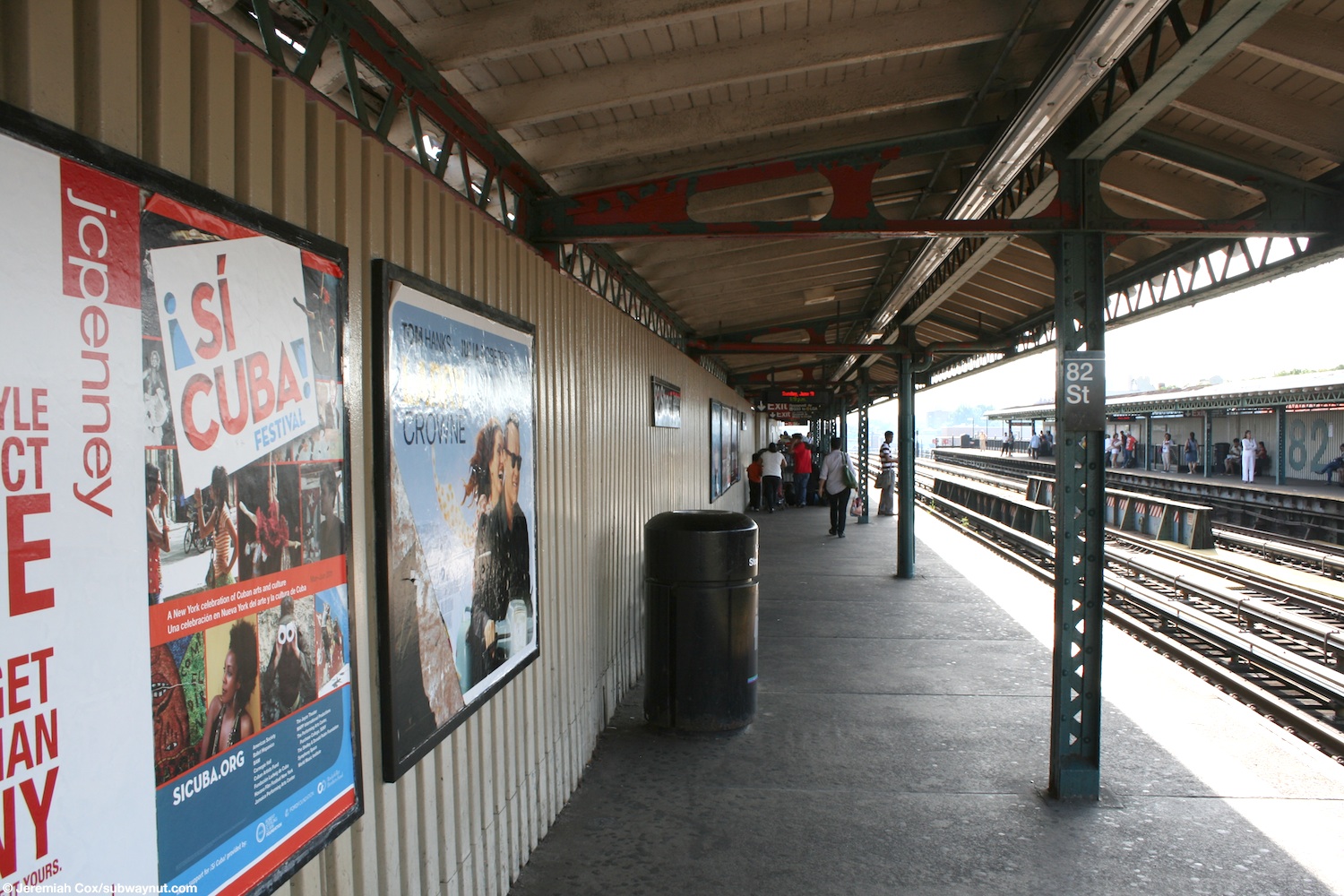
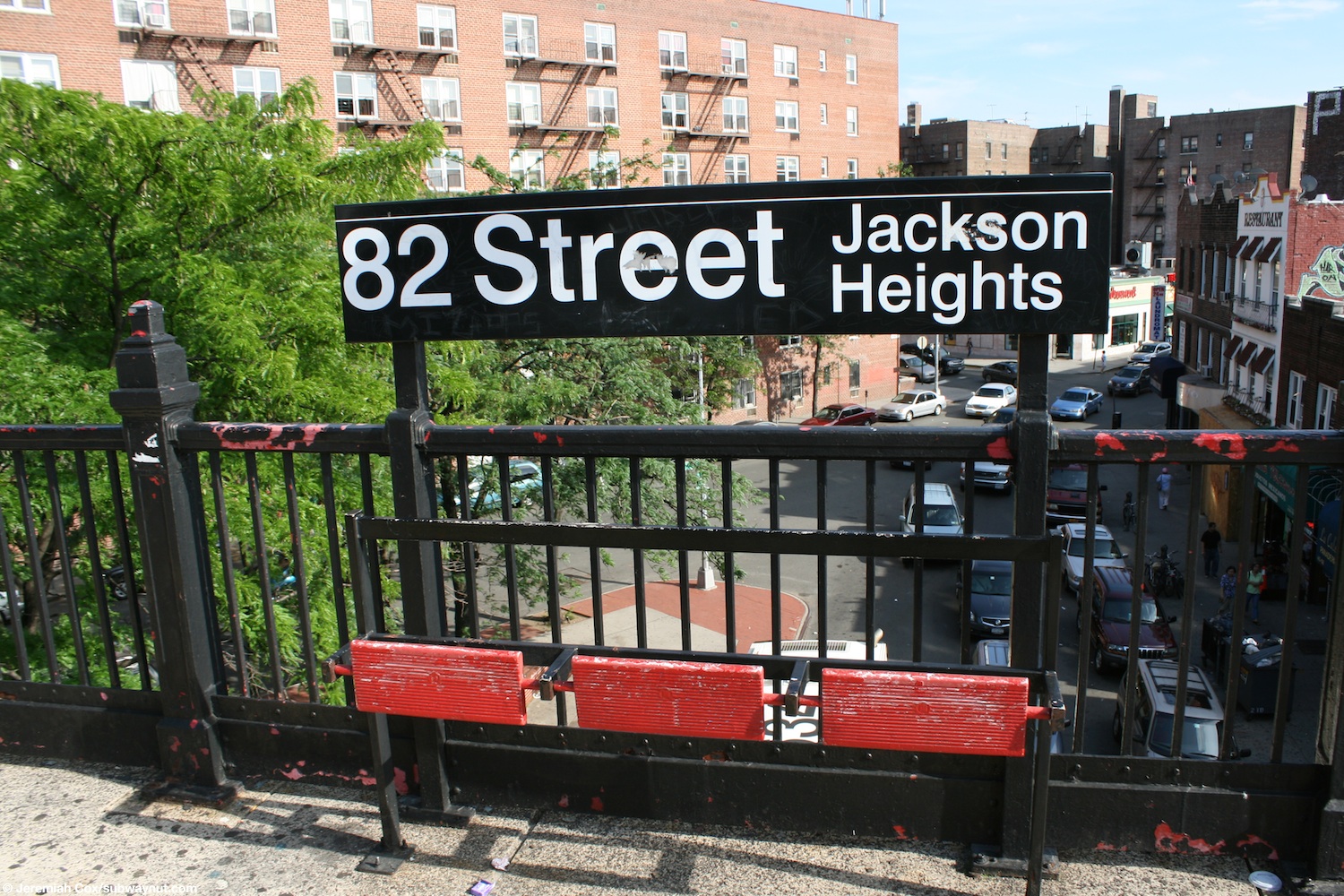
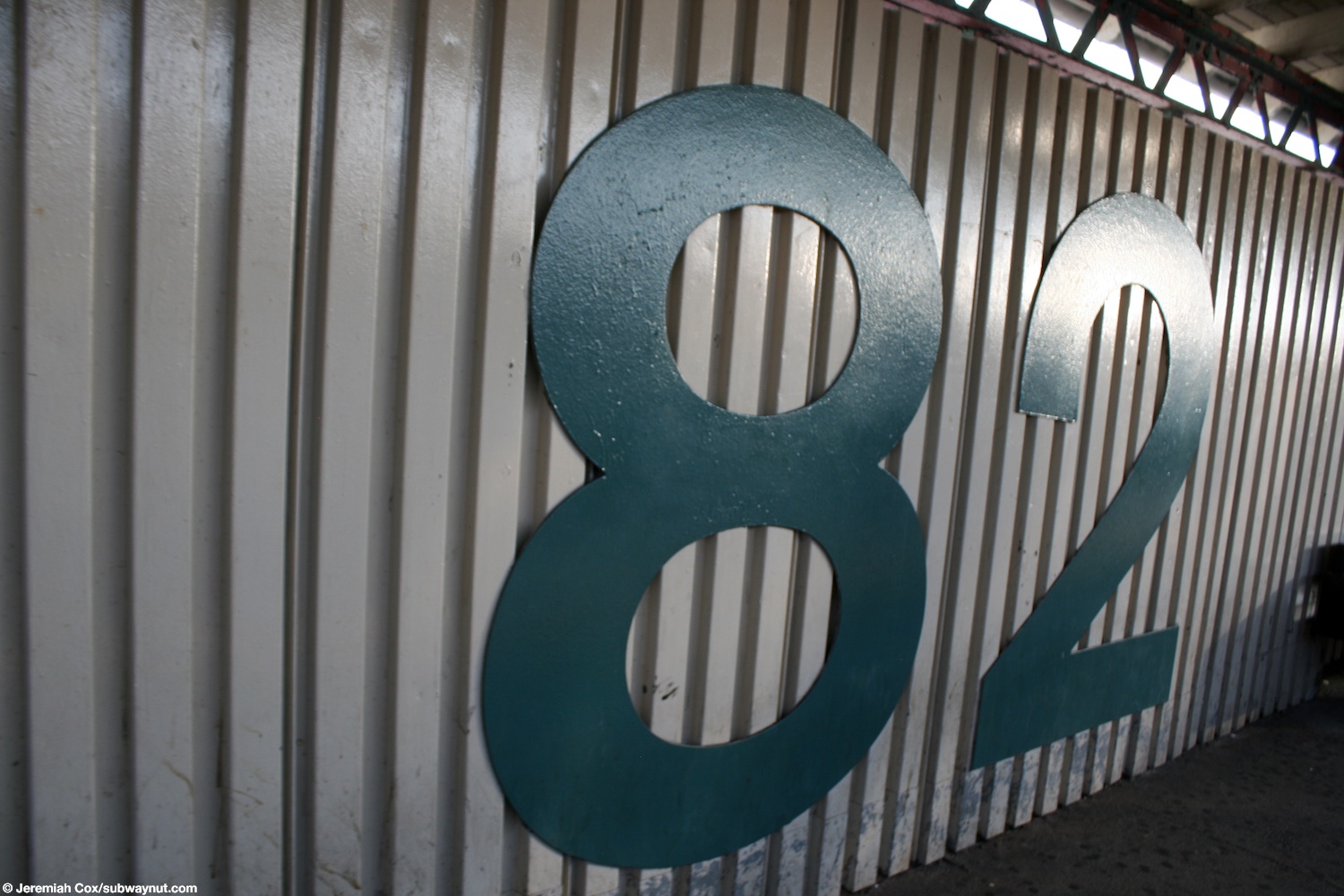
This elevated station has three tracks and two side platforms. The center track is used by the peak direction rush hour express service. Both platforms have beige windscreens and brown canopies supported by green frames and columns in the center and black waist-high steel fences at either ends. The station signs are in the standard black name plate in white lettering. Prior to the station's rehabilitation in the 2020s, each platform had a large "82" sign between the two staircases to the mezzanine below.
Exits

This station's one entrance/exit is an elevated station house beneath the tracks. It is built of wood and bricks and has a concrete flooring. It has three staircases from all corners of 82nd Street and Roosevelt Avenue except the southeast one and a token booth in the center. Two turnstile banks at either ends lead to a waiting area/crossunder and one staircase to each platform at the center.
References
References
- {{NYCS const. timetable. 7
- {{Cite Routes Not Taken
- (December 2, 1909). "Move for Rapid Transit". Newtown Register.
- (April 22, 1917). "Transit Service on Corona Extension of Dual Subway System Opened to the Public". The New York Times.
- (March 11, 1921). "Changes Station Name". The Evening Telegram.
- (April 3, 1925). "New Subway Station Name". The New York Telegram and Evening Mail.
- (February 20, 1925). "Hearing on Change of "L" Station Name". The Daily Star.
- (1940-06-13). "City Transit Unity Is Now a Reality; Title to I.R.T. Lines Passes to Municipality, Ending 19-Year Campaign". The New York Times.
- (June 13, 1940). "Transit Unification Completed As City Takes Over I. R. T. Lines: Systems Come Under Single Control After Efforts Begun in 1921; Mayor Is Jubilant at City Hall Ceremony Recalling 1904 Celebration". New York Herald Tribune.
- Brown, Nicole. (May 17, 2019). "How did the MTA subway lines get their letter or number? NYCurious".
- (April 1960). "A Summary of Services on the IRT Division, NYCTA". Electric Railroaders' Association.
- (October 15, 1949). "Direct Subway Runs To Flushing, Astoria". The New York Times.
- Bennett, Charles G.. (November 20, 1949). "Transit Platforms On Lines In Queens To Be Lengthened; $3,850,000 Program Outlined for Next Year to Care for Borough's Rapid Growth New Links Are To Be Built 400 More Buses to Roll Also — Bulk of Work to Be on Corona-Flushing Route Transit Program In Queens Outlined". The New York Times.
- (November 20, 1949). "37 Platforms On Subways To Be Lengthened: All Stations of B. M. T. and I.R.T.in Queens Included in $5,000,000 Program". New York Herald Tribune.
- (1955). "Minutes and Proceedings of the New York City Transit Authority". New York City Transit Authority.
- (December 1962). "R17s to the Flushing Line". Electric Railroaders' Association.
- (August 31, 1963). "TA to Show Fair Train". Long Island Star – Journal.
- (June 1, 1964). "A First-class Rapid Ride".
- (June 11, 1981). "Agency Lists Its 69 Most Deteriorated Subway Stations". [[The New York Times]].
- Goldman, Ari L.. (April 28, 1983). "M.T.A. Making Major Addition to Capital Plan". The New York Times.
- Moses, Charles T.. (October 3, 1983). "TA Gets Funds to Fix Subways". Newsday.
- Gargan, Edward A.. (October 3, 1983). "City Speeding Its Subway Repairs". The New York Times.
- Murray, Christian. (November 19, 2019). "MTA To Overhaul Six Stations on the 7 Line, Currently in Design Phase".
- Gannon, Michael. (April 27, 2023). "No. 7 train station work begins May 12".
- (April 19, 2024). "MTA Announces Manhattan-Bound Service Has Resumed at 82 St–Jackson Heights and 111 St Stations in Queens".
- (April 21, 2023). "MTA Announces Service Changes on 7 Line Beginning May 12".
- (March 9, 2023). "Improving the 7 Line".
- {{NYCS const. trackref. trackbook3
- Cox, Jeremiah. (June 19, 2011). "Walking down the platform".
- Cox, Jeremiah. (June 19, 2011). "An 82 St-Jackson Heights platform sign above little leaning benches".
- Cox, Jeremiah. (June 19, 2011). "Large metal 82s are on each platform between the two staircases".
- (2015). "MTA Neighborhood Maps: Corona". [[Metropolitan Transportation Authority]].
- Wong, Kevin. (February 22, 2014). "82nd Street–Jackson Heights Token Booth".
This article was imported from Wikipedia and is available under the Creative Commons Attribution-ShareAlike 4.0 License. Content has been adapted to SurfDoc format. Original contributors can be found on the article history page.
Ask Mako anything about 82nd Street–Jackson Heights station — get instant answers, deeper analysis, and related topics.
Research with MakoFree with your Surf account
Create a free account to save articles, ask Mako questions, and organize your research.
Sign up freeThis content may have been generated or modified by AI. CloudSurf Software LLC is not responsible for the accuracy, completeness, or reliability of AI-generated content. Always verify important information from primary sources.
Report