From Surf Wiki (app.surf) — the open knowledge base
81st Street–Museum of Natural History station
New York City Subway station in Manhattan
New York City Subway station in Manhattan
| Field | Value | ||||
|---|---|---|---|---|---|
| name | 81 Street– | ||||
| Museum of Natural History | |||||
| image | 81stindjeh.JPG | ||||
| caption | Northwest entrance | ||||
| address | West 81st Street & Central Park West | ||||
| New York, New York | |||||
| borough | Manhattan | ||||
| locale | Upper West Side | ||||
| coordinates | |||||
| division | IND | ||||
| line | IND Eighth Avenue Line | ||||
| service | Eighth center local | ||||
| service_header | Eighth center local header | ||||
| accessible | construction | ||||
| other | NYCT Bus: | ||||
| MTA Bus: | |||||
| platforms | 2 side platforms (1 on each level) | ||||
| tracks | 4 (2 on each level) | ||||
| levels | 2 | ||||
| structure | Underground | ||||
| opened | |||||
| services | {{Adjacent stations | system=New York City Subway | |||
| line1 | Eighth local | left1=86th Street | right1=72nd Street | note-left1= | note-right1= |
| note-row2 | does not stop here}} | ||||
| footnotes | |||||
| route_map | {{Routemap | inline=y | |||
| legend | track |
Museum of Natural History
New York, New York
MTA Bus:
|note-row2= does not stop here}}
utvSTR!~MFADEg\d\SEP!~MFADEg\d\uvSTR!~MFADEg ~~ ~~ ~~ to
numN330\utvSTRf\d\SEP\d\uvSTRg
cPLT\utvSTR\d\SEP\c\cPLT\uvSTR\c ~~ ~~ ~~ Superimposed tracks
cPLT\utvSTR\d\SEP\c\cPLT\uvSTR\c ~~ ~~ ~~ (right tracks above left)
cPLT\utvSTR\d\SEP\c\cPLT\uvSTR\c
cPLT\utvSTR\d\SEP\c\cPLT\uvSTR\c
utv-SPLa\utvSPLa-\SEP\uv-SPLa\uvSPLa-
utdSTR\utvSTR\c\SEP\c\udSTR\uvSTR
utdSTR\utvSTR\c\SEP\c\udSTR\uvSTR
utdSTR\utvSTR\c\SEP\c\udSTR\uvSTR
utv-SPLe\utvSPLe-\SEP\uv-SPLe\uvSPLe-
utvSTRf\d\SEP\d\uvSTRg
utvSTR!~MFADEf\d\SEP!~MFADEf\d\uvSTR!~MFADEf ~~ ~~ ~~ to
uSTRq ~~ Upper level
utSTRq ~~ Lower level
The 81st Street–Museum of Natural History station is a local station on the IND Eighth Avenue Line of the New York City Subway. It is served by the B on weekdays, the C train at all times except nights, and the A train during late nights only.
History
New York City mayor John Francis Hylan's original plans for the Independent Subway System (IND), proposed in 1922, included building over 100 mi of new lines and taking over nearly 100 mi of existing lines. The lines were designed to compete with the existing underground, surface, and elevated lines operated by the Interborough Rapid Transit Company (IRT) and BMT. On December 9, 1924, the New York City Board of Transportation (BOT) gave preliminary approval for the construction of the IND Eighth Avenue Line. This line consisted of a corridor connecting Inwood, Manhattan, to Downtown Brooklyn, running largely under Eighth Avenue but also paralleling Greenwich Avenue and Sixth Avenue in Lower Manhattan. The BOT announced a list of stations on the new line in February 1928, with a local station at 79th Street (corresponding to the American Museum of Natural History's main entrance).
The finishes at the five stations between 81st Street and 110th Street were 18 percent completed by May 1930. By that August, the BOT reported that the Eighth Avenue Line was nearly completed and that the five stations from 81st to 110th Street were 99 percent completed. The entire line was completed by September 1931, except for the installation of turnstiles. A preview event for the new subway was hosted on September 8, 1932, two days before the official opening. The 81st Street station opened on September 10, 1932, as part of the city-operated IND's initial segment, the Eighth Avenue Line between Chambers Street and 207th Street. Construction of the whole line cost $191.2 million (equivalent to $ million in . While the IRT Broadway–Seventh Avenue Line already provided parallel service, the new Eighth Avenue subway via Central Park West provided an alternative route.
The station was renovated in 1998–2000, in coordination with the building of the new Hayden Planetarium, within the Rose Center for Earth and Space. The floors were replaced, new lighting was installed, the token booth was upgraded, and the walls and staircases were re-tiled. Structural improvements were also made during the renovation. In 2019, the Metropolitan Transportation Authority announced that the station would become ADA-accessible as part of the agency's 2020–2024 Capital Program.
A request for proposals was put out on May 18, 2023 for the contract for a project bundle to make 13 stations accessible, including 81st Street. The contract to add one elevator (street-to-northbound platform-to southbound platform outside fare control) at the station was awarded in December 2023.
The work would include upgrades to electrical systems and the removal or relocation of some artwork. By mid-2024, the work was expected to be completed by 2026.
Station layout
This underground station has four tracks and two side platforms. On this section of the line, the local tracks are stacked, uptown above downtown, and the express tracks are stacked in the same order to the east of them, so both platforms are on the west side, one above the other. The station is at Central Park West and 81st Street, rather than the major crosstown 79th Street, in order to accommodate the American Museum of Natural History, which largely fills the area of what was once called the Manhattan Square. The 79th Street Transverse Road, through Central Park, exits the park here.
South of this station are storage/lay up tracks between the local and express tracks on each level. Both ends of the tracks merge with the express tracks, with switches to the local tracks.
Exits
There are two fare control areas, both on the upper platform. One is at the station's extreme south end, on Central Park West midblock between 77th and 81st Streets. From this fare control, a passageway leads to a staircase on the west side of Central Park West, just south of the American Museum of Natural History's front entrance. The other is at the station's north end, at Central Park West and West 81st Street. There is one staircase each to the northwest and southwest corners of the intersection.
Artwork
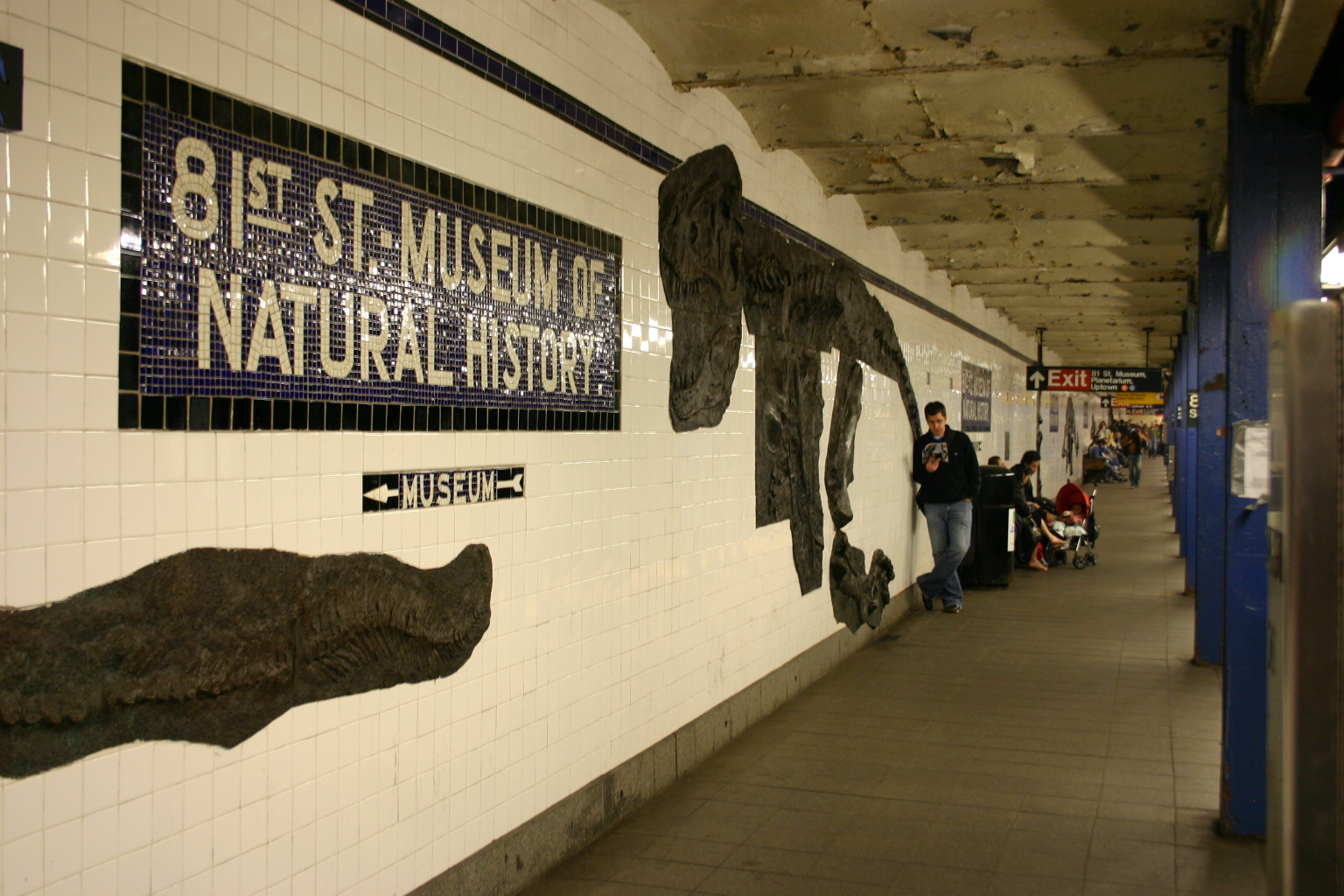
In 1976, with funding from the Exxon Corporation, this station, as well as three others citywide, received new "artfully humorous graffiti" murals and artwork. Local designer Mayers and Schiff received $5,000 to add murals of dinosaurs such as "Thesaurus Rex, the dinosaur that had a vocabulary of a thousand words" and "Elongatomus, an elongated critter that stretched from coast to coast whose pelvic remains support a highway interchange in Missouri."
As part of the 1998–2000 station renovation, a program of tile mosaics was undertaken, covering the stairs and platforms, extending to floor inlays. Stairwells evoke descending into the geological strata of the Earth (at 81st Street) or into the Ocean (79th Street). Many creatures are evoked in mosaic vignettes that punctuate the stretches of white tiled wall. Fossil casts seem to emerge from the tiles as though the subway platform itself were an excavation, which it actually is. Under the Metropolitan Transportation Authority (MTA)'s Arts for Transit program, a mixed-media installation was created in 2000. Entitled "For Want of a Nail", named after the old proverb, it addresses the interconnections of entities that are as vast as a galaxy and as small as a single cell. Using ceramic tile, glass tile, glass mosaic, bronze relief, and granite as primary materials, the design team depicted the evolution of extinct, existing, and endangered life forms, from single-celled organisms to the towering T. rex dinosaur.
In media
The station has been featured in the 2002 film Men in Black II. The station was also mentioned in Night at the Museum.
References
References
- (September 10, 1932). "List of the 28 Stations on the New 8th Av. Line". [[The New York Times]].
- (August 4, 1923). "Two Subway Routes Adopted by City". The New York Times.
- (March 12, 1924). "Plans Now Ready to Start Subways". The New York Times.
- (December 10, 1924). "Hylan Subway Plan Links Four Boroughs at $450,000,000 Cost". The New York Times.
- {{Cite Routes Not Taken
- (5 Feb 1928). "Express and Local Stations For New Eighth Avenue Line". New York Herald Tribune.
- (1930-05-26). "Progress is Rapid on 8th Av. Subway; Board's Engineers Report Spurt in Building Is Likely to Open the Line in July, 1930". The New York Times.
- (1930-08-24). "Eighth Av. Subway Nearly Completed; Basic Construction Work From Chambers to 207th St. Done Except on Few Short Stretches". The New York Times.
- O'Brien, John C.. (9 Sep 1931). "8th Ave. Line Being Rushed For Use Jan. 1: Turnstile Installation on Subway Begins Monday; Other Equipment Ready for Start of Train Service City Has Yet to Find Operating Company Transit Official on Trip, 207th to Canal Street, Inspects Finished Tube". New York Herald Tribune.
- (September 9, 1932). "Sightseers Invade New Subway When Barricade Is lifted". The New York Times.
- (September 9, 1932). "8th Av. Subway Gets First 5c. by Woman's Error: She Peers Into a Station, Hears Train, Pays for Ride, but Is Day Too Early Preparing for Tomorrow's Rush on 8th Ave. Subway". New York Herald Tribune.
- (September 10, 1932). "Gay Midnight Crowd Rides First Trains In The New Subway: Throngs at Station an Hour Before Time, Rush Turnstiles When Chains are Dropped". [[The New York Times]].
- Sebring, Lewis B.. (10 Sep 1932). "Midnight Jam Opens City's New Subway: Turnstiles Click Into Action at 12:01 A. M. as Throngs Battle for Places in 'First' Trains Boy, 7, Leads Rush At 42d St. Station City at Last Hails 8th Ave. Line After 7-Year Wait; Cars Bigger, Clean Transit Commissioner Officially Opening New Subway at Midnight". New York Herald Tribune.
- Duffus, R. l. (September 9, 1932). "NEW LINE FIRST UNIT IN CITY-WIDE SYSTEM; 8th Av. Tube to Ease West Side Congestion at Once -- Branches to Link 4 Boroughs Later. LAST WORD IN SUBWAYS Run From 207th to Chambers St. Cut to 33 Minutes -- 42d St. Has World's Largest Station. COST HAS BEEN $191,200,000 Years of Digging Up City Streets, Tunneling Rock and Building Road Finally Brought to Completion.". The New York Times.
- Siegal, Nina. (September 13, 1998). "NEIGHBORHOOD REPORT: UPPER WEST SIDE/UPPER MANHATTAN; At This Stop, B and C Spell Walk".
- (December 19, 2019). "MTA Announces 20 Additional Subway Stations to Receive Accessibility Improvements Under Proposed 2020-2024 Capital Plan". Metropolitan Transportation Authority.
- (May 18, 2023). "A37758 Design-Build Services for ADA Upgrades Package 5: Accessibility Upgrades at 13 Stations in the City of New York". Metropolitan Transportation Authority.
- (20 Dec 2023). "December 2023 MTA Board Action Items".
- Mishkin, Mike. (May 15, 2024). "Major ADA Upgrades Planned at Two UWS Subway Stations".
- (May 1, 2014). "American Museum of Natural History".
- "NYC Subway Track Map (Midtown Manhattan) (Zoom to section by clicking)". www.nycsubway.org.
- {{NYCS const. trackref. 468
- (2015). "MTA Neighborhood Maps: Upper West Side". [[Metropolitan Transportation Authority]].
- (May 1, 2014). "Directions and Transportation".
- Burks, Edward C.. (November 18, 1976). "A Subway Elongatomus? Why, It's Preposterous!".
- "81st Street-Museum of Natural History: ARTS FOR TRANSIT COLLABORATIVE: For Want of a Nail, 2000".
- "81st Street Museum of Natural History Station Reopening". [[American Museum of Natural History.
- (December 11, 2015). "Review of the A and C Lines". [[Metropolitan Transportation Authority]].
- Kennedy, Randy. (June 15, 2000). "Where Stepping Off the Subway Means Stepping Into the Wild". [[The New York Times]].

This article was imported from Wikipedia and is available under the Creative Commons Attribution-ShareAlike 4.0 License. Content has been adapted to SurfDoc format. Original contributors can be found on the article history page.
Ask Mako anything about 81st Street–Museum of Natural History station — get instant answers, deeper analysis, and related topics.
Research with MakoFree with your Surf account
Create a free account to save articles, ask Mako questions, and organize your research.
Sign up freeThis content may have been generated or modified by AI. CloudSurf Software LLC is not responsible for the accuracy, completeness, or reliability of AI-generated content. Always verify important information from primary sources.
Report