From Surf Wiki (app.surf) — the open knowledge base
2nd Cavalry Division (United Kingdom)
Inactive British Army formation
Inactive British Army formation
| Field | Value |
|---|---|
| unit_name | 2nd Cavalry Division |
| image | 2nd cav div WW1.svg |
| caption | Division insignia |
| dates | 13 September 1914 – 31 March 1919 |
| country | UKGBI |
| branch | |
| type | Cavalry |
| size | Division |
| command_structure | Cavalry Corps |
| battles | World War I |
| notable_commanders | Hubert Gough |
| Charles Kavanagh | |
| Philip Chetwode |
:First Battle of the Aisne (1914) :Second Battle of Ypres (1915) :Battle of Arras (1917) :Battle of Cambrai (1917) :Operation Michael (Somme, 1918) :Battle of Amiens (1918) :Second Battle of the Somme (1918) :Hindenburg Line (1918) :Advance in Picardy (1918) Charles Kavanagh Philip Chetwode
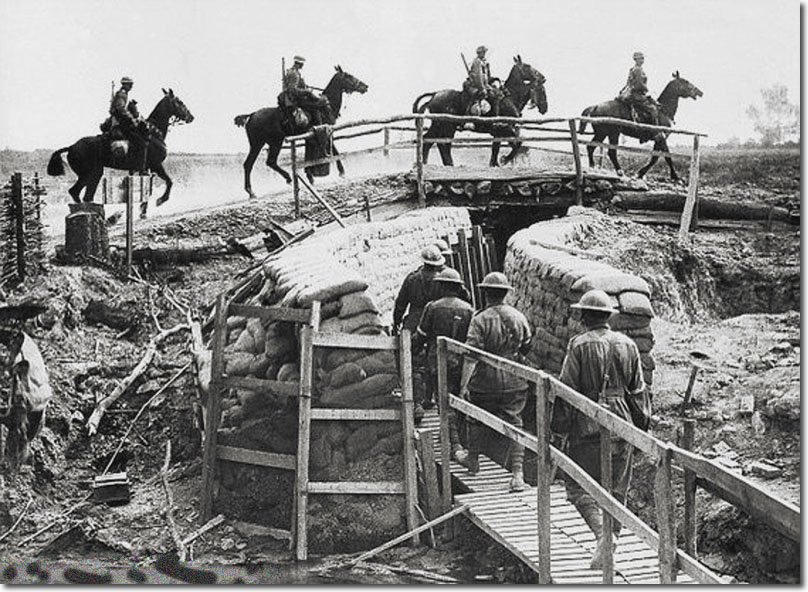
The 2nd Cavalry Division was a division of the regular British Army that saw service in the Peninsular War and in World War I, when it also known as Gough's Command, after its commanding general. It was part of the British Expeditionary Force that served in France in from 1914 to 1918. It was involved in most of the major actions where cavalry were used as a mounted mobile force, and also many where the troops were dismounted and effectively served as infantry.
On 11 November 1918 units of the division were east and north-east of Mons, in Belgium. Orders were received that the division would lead the advance of Fourth Army into Germany, a move that was to begin on 17 November 1918. On 1 December it crossed the frontier south of St. Vith. The winter was spent south of Liège, and demobilisation commenced. The division ceased to exist on 31 March 1919.
After the war the division was reformed in the Territorial Army.
History
Napoleonic Wars
During the Peninsular War, Wellington organized his cavalry into one, later two, cavalry divisions. They performed a purely administrative, rather than tactical, role; the normal tactical headquarters were provided by brigades commanding two, later usually three, regiments. On 19 June 1811, the cavalry was reorganized as two divisions and the existing Cavalry Division was redesignated as 1st Cavalry Division with the formation of the 2nd Cavalry Division.
Major General Sir William Erskine took command on formation. He resumed command briefly, but committed suicide in Lisbon on 13 February 1813.
Assigned Brigades
The division was formed on 19 June 1811 with De Grey's and Long's Brigades; Long's Brigade was to remain with the division throughout its existence. Between 8 November 1811 and 23 March 1812 it commanded just one brigade and it never exceed three brigades in strength.
| Brigade | From | To |
|---|---|---|
| De Grey's | 19 June 1811 | 5 October 1811 |
| Long's | 19 June 1811 | 21 April 1813 |
| Le Marchant's | 30 August 1811 | 8 November 1811 |
| von Bock's | 23 March 1812 | 14 April 1812 |
| Slade's | 14 April 1812 | 21 April 1813 |
| Rebow's | 25 January 1813 | 5 February 1813 |
| Grant's | 15 April 1813 | 21 April 1813 |
First World War
Gough's Command
On 6 September, the formerly independent 5th Cavalry Brigade was joined with the 3rd Cavalry Brigade from the Cavalry Division as Gough's Command. Named for the commander of 3rd Cavalry Brigade, Brigadier-General Hubert Gough, it took part in the First Battle of the Aisne (12–15 September). On 13 September, the command was re-designated as the 2nd Cavalry Division, with the addition of divisional troops from the Royal Horse Artillery, Royal Engineers etc.
The 4th Cavalry Brigade joined the division on 14 October from 1st Cavalry Division to bring it up to the standard three brigade strength. The division remained on the Western Front until the end of the war.
1914–1917
In 1914, the division took part in First Battle of Ypres, notably the battle of Gheluvelt (29–31 October). In 1915, the division was in action at the Battle of Neuve Chapelle (10–12 March 1915) and the Second Battle of Ypres notable the Battle of St Julien (26 April–3 May) and the Battle of Bellewaarde Ridge (24–25 May).
1916 saw no notable actions, but in 1917 the division saw action in the Battle of Arras (First Battle of the Scarpe, 9–11 April). and the Battle of Cambrai (the Tank Attack of 20 and 21 November, the Capture of Bourlon Wood of 24–28 November and the German Counter-Attack of 30 November–3 December).
War of movement
1918 saw the return of the war of movement and the division took part in the First Battle of the Somme notably the Battle of St Quentin (21–23 March), the Battle of the Lys (Battle of Hazebrouck of 14–15 April), the Battle of Amiens (8–11 August) and the Second Battle of the Somme (Battle of Albert of 21–23 August and the Second Battle of Bapaume of 31 August–3 September).
The division was then split up with the 3rd Cavalry Brigade serving with First Army, 4th Cavalry Brigade with Third Army and 5th Cavalry Brigade with Fourth Army. Two Subsections formed a Section and in a six gun battery these would be designated as Left, Centre and Right Sections.}} of D Battery, RHA).
Armistice
At the Armistice, units of the division had reached Clairfayts (5th Cavalry Brigade with Fourth Army), Erquelinnes (4th Cavalry Brigade with Third Army) and Havré and St. Denis (3rd Cavalry Brigade with First Army). On 15 November, the division was re-assembled near Maubeuge and ordered to advance into Germany as an advance screen for Fourth Army and form part of the Occupation Force. The move began on 17 November, Ciney and Rochefort were reached five days later and the 5th Cavalry Brigade crossed the German border south of St. Vith on 1 December.
In late December, the division moved to winter quarters south and south-east of Liège. It remained here until 30 January 1919 when it exchanged regiments with 1st and 3rd Cavalry Divisions then gradually moved back to England. The Division ceased to exist at midnight 31 March / 1 April 1919.
Order of battle
3rd Cavalry Brigade
Main article: 3rd Cavalry Brigade (United Kingdom)
The brigade joined Gough's Command on 6 September from The Cavalry Division and remained with the division until the end of the war.
| Unit | From | To |
|---|---|---|
| [4th (Queen’s Own) Hussars](4th-queen-s-own-hussars) | Mobilization | |
| [5th (Royal Irish) Lancers](5th-royal-irish-lancers) | Mobilization | |
| [16th (Queen’s) Lancers](16th-queen-s-lancers) | Mobilization | |
| 1/1st Leicestershire Yeomanry | 4 April 1918 | |
| D Battery, RHA | 17 September 1914 | |
| [3rd Signal Troop, Royal Engineers](3rd-signal-troop-royal-engineers) | Mobilization | |
| 3rd Cavalry Brigade Field Ambulance | Mobilization | 13 September 1914 |
| 3rd Cavalry Brigade Machine Gun Squadron, MGC | 29 February 1916 |
4th Cavalry Brigade
Main article: 4th Cavalry Brigade (United Kingdom)
The brigade joined the division on 14 October from 1st Cavalry Division and remained with the division until the end of the war.
| Unit | From | To |
|---|---|---|
| Household Cavalry Composite Regiment | Mobilization | 11 November 1914 |
| [6th Dragoon Guards (Carabiniers)](6th-dragoon-guards-carabiniers) | Mobilization | |
| [3rd (King's Own) Hussars](3rd-king-s-own-hussars) | Mobilization | |
| 1/1st Queen's Own Oxfordshire Hussars | 11 November 1914 | |
| J Battery, RHA | 16 September 1914 | |
| [4th Signal Troop, Royal Engineers](4th-signal-troop-royal-engineers) | Mobilization | |
| 4th Cavalry Brigade Field Ambulance | Mobilization | 16 October 1914 |
| 4th Cavalry Brigade Machine Gun Squadron, MGC | 28 February 1916 |
5th Cavalry Brigade

Main article: 5th Cavalry Brigade (United Kingdom)
The brigade, formerly independent, joined Gough's Command on 6 September and remained with the division until the end of the war.
| Unit | From | To |
|---|---|---|
| [2nd Dragoons (Royal Scots Greys)](2nd-dragoons-royal-scots-greys) | Mobilization | |
| [12th Royal Lancers (Prince of Wales's)](12th-royal-lancers) | Mobilization | |
| [20th Hussars](20th-hussars) | Mobilization | |
| J Battery, RHA | Mobilization | 16 September 1914 |
| E Battery, RHA | 17 September 1914 | |
| 4th Field Troop, Royal Engineers | Mobilization | 15 October 1914 |
| 5th Signal Troop, Royal Engineers | Mobilization | |
| 5th Cavalry Brigade Field Ambulance | Mobilization | 13 September 1914 |
| 5th Cavalry Brigade Machine Gun Squadron, MGC | 28 February 1916 |
Divisional Artillery
:III Brigade, Royal Horse Artillery
Ask Mako anything about 2nd Cavalry Division (United Kingdom) — get instant answers, deeper analysis, and related topics.
Research with MakoFree with your Surf account
Create a free account to save articles, ask Mako questions, and organize your research.
Sign up freeThis content may have been generated or modified by AI. CloudSurf Software LLC is not responsible for the accuracy, completeness, or reliability of AI-generated content. Always verify important information from primary sources.
Report