From Surf Wiki (app.surf) — the open knowledge base
2009 Giro d'Italia, Stage 1 to Stage 11
Stage 1 to Stage 11 of the 2009 Giro d'Italia

Stage 1 to Stage 11 of the 2009 Giro d'Italia
The 2009 Giro d'Italia began on 9 May, with Stage 11 occurring on 20 May. The first stage, like it had been since 2007, was a team time trial, a stage where each member of the team raced together against the clock. Like most cycling Grand Tours do, the beginning of the 2009 Giro included a string of flat stages that were contested by sprinters. These stages were contested by Alessandro Petacchi and Mark Cavendish, among others, with Petacchi in victory becoming one of the only riders to defeat Cavendish in a sprint in the 2009 season.
At the end of the race's first week and beginning of its second were three hilly medium-mountain stages. These stages took the Giro through Austria and Switzerland before returning to Italy. Each of these stages took more than five hours to complete, and the rain that fell each day combined with the difficulties presented by the numerous ascents and descents made the courses potentially unsafe in the riders' opinion. This opinion was perhaps validated by the life-threatening injuries sustained by Pedro Horrillo in the eighth stage after he crashed while descending a mountain. While the ninth stage was meant to be a showy criterium in celebration of this being the 100th anniversary of the Giro d'Italia, the riders collectively protested the safety conditions of that stage and the ones before it. This meant it would be neutralized, with every rider receiving the same finishing time as the stage winner regardless of when they finished.
The tenth stage was the longest of this year's Giro, and one of its most mountainous. It, along with a stage later in the race, were both called the race's queen stage, its most difficult stage. Danilo Di Luca won this stage to pad his overall lead going into the second half of the Giro.
| Legend | ||
|---|---|---|
| [[Image:Jersey pink.svg | 20px | alt=A pink jersey]] |
| [[Image:Jersey violet.svg | 20px | alt=A violet jersey]] |
Stage 1

9 May 2009 — Lido (Venice), 20.5 km (team time trial)
The 2009 Giro began, as it had since 2007, with a team time trial (TTT). The 20.5 km ride over a perfectly flat course in Venice decided who would wear the first pink jersey.{{cite web |access-date=2009-05-09
was the first team to ride the course, and wound up being the stage winners. They all finished together, which is relatively uncommon (especially for a winning team: only , which took the course nearly a minute slower, managed to also have all nine riders cross the finish line together). , who had said previously it was their goal to replicate their TTT victory from the 2008 Giro d'Italia, finished officially 6 seconds back of , but they had only the minimum of 5 riders finishing together (the team's time is taken for the fifth rider to cross the line). As the first rider to cross the line, Mark Cavendish was awarded the first pink jersey as general classification (GC) leader; he was also awarded the white jersey as youth classification leader.{{cite web |access-date=2009-05-09 |archive-url=https://web.archive.org/web/20090621002900/http://autobus.cyclingnews.com/road/2009/giro09/?id=results%2Fgiro091 |archive-date=21 June 2009 |url-status=live
| Team | Time |
|---|---|
| 1 | |
| 2 | |
| 3 | |
| 4 | |
| 5 | |
| 6 | |
| 7 | |
| 8 | |
| 9 | |
| 10 |
|| |General classification after stage 1
| Rider | Team | Time | ||||
|---|---|---|---|---|---|---|
| 1 | Mark Cavendish [[Image:Jersey pink.svg | 20px | Pink jersey]][[Image:Jersey white.svg | 20px | White jersey]] | |
| 2 | Marco Pinotti | |||||
| 3 | Edvald Boasson Hagen | |||||
| 4 | Michael Rogers | |||||
| 5 | Thomas Lövkvist | |||||
| 6 | Mark Renshaw | |||||
| 7 | Kanstantsin Sivtsov | |||||
| 8 | Morris Possoni | |||||
| 9 | Michael Barry | |||||
| 10 | David Zabriskie |
|}
Stage 2
10 May 2009 — Jesolo to Trieste, 156 km
This stage was very flat. It had only one categorized climb, at low elevation, near the end. This climb award the first points in the mountains classification and thus, the first green jersey awarded to its leader. The riders took three laps of an 11 km finishing circuit in Trieste, with the points for the climb taken on their second time over the hill at Montebello.{{cite web |access-date=2009-05-09
Leonardo Scarselli was free of the main field for most of the stage after escaping early in the morning. The bunch caught him with 31 km to race, though. David García won the climb in Trieste to become the first wearer of the green jersey, and Alessandro Petacchi won the group sprint to the line, narrowly edging out race leader Mark Cavendish.{{cite web |access-date=2009-05-10 |archive-url=https://web.archive.org/web/20090618003206/http://autobus.cyclingnews.com/road/2009/giro09/?id=results%2Fgiro092 |archive-date=18 June 2009 |url-status=live
A crash on the third pass over the Montebello hill meant the field was broken, with only 51 riders together for the sprint finish. The rest of the peloton finished 13 seconds back, and since this crash occurred outside 3 km from the finish line, all time lost stood as lost. Notables among those who lost 13 seconds were Levi Leipheimer and Ivan Basso.{{cite web |access-date=2009-10-15 |archive-url=https://web.archive.org/web/20090621144301/http://www.velonews.com/results/91865 |archive-date=2009-06-21 |url-status=dead
| Rider | Team | Time | ||
|---|---|---|---|---|
| 1 | Alessandro Petacchi | |||
| 2 | Mark Cavendish [[Image:Jersey pink.svg | 20px | Pink jersey]] | |
| 3 | Ben Swift | |||
| 4 | Allan Davis | |||
| 5 | Tyler Farrar | |||
| 6 | Oscar Gatto | |||
| 7 | Francesco Gavazzi | |||
| 8 | Davide Viganò | |||
| 9 | Manuele Mori | |||
| 10 | Dries Devenyns |
|| |General classification after stage 2
| Rider | Team | Time | ||||
|---|---|---|---|---|---|---|
| 1 | Mark Cavendish [[Image:Jersey pink.svg | 20px | Pink jersey]][[Image:Jersey white.svg | 20px | White jersey]] | |
| 2 | Mark Renshaw | |||||
| 3 | Michael Rogers | |||||
| 4 | Thomas Lövkvist | |||||
| 5 | Edvald Boasson Hagen | |||||
| 6 | Tyler Farrar | |||||
| 7 | Alessandro Petacchi [[Image:Jersey violet.svg | 20px | Violet jersey]] | |||
| 8 | Christian Vande Velde | |||||
| 9 | Bradley Wiggins | |||||
| 10 | Lance Armstrong |
|}
Stage 3
11 May 2009 — Grado to Valdobbiadene, 198 km
This stage was also flat, and ended in a mass sprint.{{cite web |access-date=2009-05-09 |archive-url=https://web.archive.org/web/20090505004708/http://www.cyclingnews.com/road/2009/giro09/?id=stages%2Fgiro093 |archive-date=5 May 2009 |url-status=live
A five rider breakaway, which had a maximum advantage of seven minutes, took the points at the one intermediate sprint and the one categorised climb of the day, but were caught with some 38 km remaining. A number of crashes occurred starting at the 50 km remaining mark, and a series of attempted breaks meant that the peloton was fragmented, and Alessandro Petacchi took a second successive stage from a depleted group sprint.{{cite web |access-date=2009-08-26 |archive-url=https://web.archive.org/web/20091001062109/http://autobus.cyclingnews.com/road/2009/giro09/?id=results%2Fgiro093 |archive-date=1 October 2009 |url-status=live
The biggest victim of the repeated crashes was leader Christian Vande Velde, who had to retire from the Giro with a broken rib and a hairline fracture of his pelvis.{{cite web |access-date=2009-10-15
| Rider | Team | Time | ||
|---|---|---|---|---|
| 1 | Alessandro Petacchi [[Image:Jersey violet.svg | 20px | Violet jersey]] | |
| 2 | Tyler Farrar | |||
| 3 | Francesco Gavazzi | |||
| 4 | Dario Cataldo | |||
| 5 | Damiano Cunego | |||
| 6 | Philippe Gilbert | |||
| 7 | Oscar Gatto | |||
| 8 | Michael Rogers | |||
| 9 | Anders Lund | |||
| 10 | Stefano Garzelli |
|| |General classification after stage 3
| Rider | Team | Time | ||||
|---|---|---|---|---|---|---|
| 1 | Alessandro Petacchi [[Image:Jersey pink.svg | 20px | Pink jersey]][[Image:Jersey violet.svg | 20px | Violet jersey]] | |
| 2 | Tyler Farrar [[Image:Jersey white.svg | 20px | White jersey]] | |||
| 3 | Michael Rogers | |||||
| 4 | Thomas Lövkvist | |||||
| 5 | Lance Armstrong | |||||
| DSQ | Danilo Di Luca | |||||
| 7 | Yaroslav Popovych | |||||
| 8 | Levi Leipheimer | |||||
| 9 | Andriy Hryvko | |||||
| 10 | Francesco Gavazzi |
|}
Stage 4
12 May 2009 — Padova to San Martino di Castrozza, 162 km
This was the first mountain stage of the Giro, with a high climb coming at 123 km and a mountain finish at San Martino di Castrozza.{{cite web |access-date=2009-05-09
A group of 6 riders escaped after just 5 km. This group comprised Serafín Martínez, Francesco Bellotti, Davide Viganò, Ian Stannard, Francesco De Bonis, and Jens Voigt. They attained a maximum advantage of six and a half minutes, and with a healthy pace of 45 km/h through the stage's first three hours, it appeared possible that one of them would be the stage winner. The pace caught up with the group as they reached the foot of the day's final climb, and only Voigt and Bellotti remained together as the climb began. Two kilometers into the climb, Voigt attacked again and tried to solo to victory over the last 8 km.
The top GC men in the peloton and the specialist climbers formed a chase group that overhauled Voigt in the final 3 km. The attacks of Colombian climber Mauricio Soler had been responsible for driving this group to catch the remnants of the breakaway, and he attacked again in the final 2 km, quickly getting a gap over the competition and appearing poised for the stage win. As Soler had been the one who caused the crash that kept Mark Cavendish from potentially defending the pink jersey the day before, his combativeness on this stage was described as his "redemption". 2007 Giro d'Italia winner Danilo Di Luca timed his sprint to the line just right and overtook Soler for the victory. Sixteen riders finished with the same time as Di Luca, ten more were six seconds back, and a further 26 were inside a minute of his winning time. Thomas Lövkvist, who finished in the same group as Di Luca, took a narrow lead in the overall classification after the stage.{{cite web |access-date=2009-08-26
| Rider | Team | Time |
|---|---|---|
| DSQ | Danilo Di Luca | |
| 1 | Stefano Garzelli | |
| DSQ | Franco Pellizotti | |
| 4 | Mauricio Soler | |
| 5 | Gilberto Simoni | |
| 6 | Levi Leipheimer | |
| 7 | Thomas Lövkvist | |
| 8 | Ivan Basso | |
| 9 | Denis Menchov | |
| 10 | David Arroyo |
|| |General classification after stage 4
| Rider | Team | Time | ||||
|---|---|---|---|---|---|---|
| 1 | Thomas Lövkvist [[Image:Jersey pink.svg | 20px | Pink jersey]][[Image:Jersey white.svg | 20px | White jersey]] | |
| DSQ | Danilo Di Luca [[Image:Jersey green.svg | 20px | Green jersey]] | |||
| 3 | Michael Rogers | |||||
| 4 | Yaroslav Popovych | |||||
| 5 | Levi Leipheimer | |||||
| 6 | Lance Armstrong | |||||
| DSQ | Franco Pellizotti | |||||
| 8 | Damiano Cunego | |||||
| 9 | Marzio Bruseghin | |||||
| 10 | Carlos Sastre |
|}
Stage 5
13 May 2009 — San Martino di Castrozza to Alpe di Siusi, 125 km
This was one of the shortest road race stages in the 2009 Giro, but its profile was quite unusual. It saw the riders start where they ended the previous day, on the mountaintop at San Martino di Castrozza, climb some 400 m for a categorized climb at Passo Rolle, and then descend over 1700 m before climbing most of that distance right back for another mountaintop finish at Alpe di Siusi.{{cite web |access-date=2009-05-09
A seven-man breakaway was clear over the Passo Rolle climb and took a maximum lead of four and a half minutes in the valley between peaks. Giovanni Visconti was briefly race leader on the road, as he began the stage just under three minutes behind pink jersey wearer Thomas Lövkvist in the General Classification. The peloton, paced by Liquigas, caught them without about 15 km left to race, leading the way for Sylwester Szmyd and then Ivan Basso to try to fracture the field before the finish. Six riders were able to keep his pace to the finish, with Denis Menchov the first to Alpe di Suisi for the stage win. The other six in the leading group kept close to the stage winner, with only Carlos Sastre losing more than ten seconds. Danilo Di Luca became the new race leader after his second place on the stage.
Damiano Cunego, Lance Armstrong and Stefano Garzelli, all of whom had been considered as possible favorites for overall victory in the Giro, all lost more than two minutes on this stage, being unable to take Liquigas' pace on the way up to Alpe di Suisi. As they, along with Michael Rogers, had shown weakness on the climb, one report named as the only remaining possibilities for Giro champion Menchov, Di Luca, Lövkvist, Basso, Levi Leipheimer, and Sastre.{{cite web |access-date=2009-05-18 |archive-url=https://web.archive.org/web/20090629015052/http://autobus.cyclingnews.com/road/2009/giro09/?id=results%2Fgiro095 |archive-date=29 June 2009 |url-status=live |access-date=2009-10-15 |archive-date=2016-03-03 |archive-url=https://web.archive.org/web/20160303221742/http://velonews.competitor.com/2009/05/news/menchov-wins-stage-5-di-luca-in-pink_92030 |url-status=dead
| Rider | Team | Time | ||
|---|---|---|---|---|
| 1 | Denis Menchov | |||
| DSQ | Danilo Di Luca [[Image:Jersey green.svg | 20px | Green jersey]] | |
| 3 | Thomas Lövkvist [[Image:Jersey pink.svg | 20px | Pink jersey]] | |
| 4 | Ivan Basso | |||
| 5 | Levi Leipheimer | |||
| 6 | Chris Horner | |||
| 7 | Carlos Sastre | |||
| 8 | David Arroyo | |||
| 9 | Michael Rogers | |||
| 10 | Fredrik Kessiakoff |
|| |General classification after stage 5
| Rider | Team | Time | ||||
|---|---|---|---|---|---|---|
| DSQ | Danilo Di Luca [[Image:Jersey pink.svg | 20px | Pink jersey]][[Image:Jersey green.svg | 20px | Green jersey]] | |
| 2 | Thomas Lövkvist [[Image:Jersey white.svg | 20px | White jersey]] | |||
| 3 | Michael Rogers | |||||
| 4 | Levi Leipheimer | |||||
| 5 | Denis Menchov | |||||
| 6 | Ivan Basso | |||||
| 7 | Carlos Sastre | |||||
| 8 | Chris Horner | |||||
| DSQ | Franco Pellizotti | |||||
| 10 | David Arroyo |
|}
Stage 6
14 May 2009 — Brixen to Mayrhofen (Austria), 248 km
This stage was one of the longest in the 2009 Giro. The first half of the stage was undulating, without a categorized climb. The second half featured two short climbs with a flat 22 km valley in between them. The descent from the second climb, Gerlospass, left a flat 11 km to race before the finish in Austria.{{cite web |access-date=2009-05-09 |archive-url=https://web.archive.org/web/20090618010300/http://autobus.cyclingnews.com/road/2009/giro09/?id=stages%2Fgiro096 |archive-date=18 June 2009 |url-status=live
The day's breakaway comprised five riders, and it formed after 55 km in the saddle. Their maximum advantage was just under eight minutes. Michele Scarponi and Vasil Kiryienka shed their mates on the second climb of the day, about 60 km from the finish. Scarponi dropped Kiryienka 50 km later and went it alone for the stage win. The pink jersey group absorbed all the other members of the morning breakaway and finished half a minute behind Scarponi, with six from that group gaining four seconds on race leader Danilo Di Luca at the finish. Lance Armstrong lost even more time, finishing 43 seconds behind second place man Edvald Boasson Hagen.{{cite web |access-date=2009-05-18 |archive-url=https://web.archive.org/web/20090624130221/http://autobus.cyclingnews.com/road/2009/giro09/?id=results%2Fgiro096 |archive-date=24 June 2009 |url-status=live
| Rider | Team | Time | ||
|---|---|---|---|---|
| 1 | Michele Scarponi | |||
| 2 | Edvald Boasson Hagen | |||
| 3 | Allan Davis | |||
| 4 | Filippo Pozzato | |||
| 5 | Matthew Goss | |||
| 6 | Philippe Gilbert | |||
| 7 | Enrico Gasparotto | |||
| 8 | Michael Rogers | |||
| DSQ | Danilo Di Luca [[Image:Jersey pink.svg | 20px | Pink jersey]] | |
| DSQ | Tadej Valjavec |
|| |General classification after stage 6
| Rider | Team | Time | ||||||
|---|---|---|---|---|---|---|---|---|
| DSQ | Danilo Di Luca [[Image:Jersey pink.svg | 20px | Pink jersey]][[Image:Jersey green.svg | 20px | Green jersey]][[Image:Jersey violet.svg | 20px | Violet jersey]] | |
| 2 | Thomas Lövkvist [[Image:Jersey white.svg | 20px | White jersey]] | |||||
| 3 | Michael Rogers | |||||||
| 4 | Levi Leipheimer | |||||||
| 5 | Denis Menchov | |||||||
| 6 | Ivan Basso | |||||||
| 7 | Carlos Sastre | |||||||
| 8 | Chris Horner | |||||||
| DSQ | Franco Pellizotti | |||||||
| 10 | David Arroyo |
|}
Stage 7
15 May 2009 — Innsbruck (Austria) to Chiavenna, 244 km
The race returned to Italy, after also passing through Switzerland, in another long stage. The one climb of the day occurred a little over 200 km into the stage, the Passo Maloja. The entire stage to that point was on a slight increase in elevation, while the finish was on a long and drastic descent into Chiavenna. Its profile made it seem an inviting stage for breakaway attempts.{{cite web |access-date=2009-05-09 |archive-url=https://web.archive.org/web/20090618002818/http://autobus.cyclingnews.com/road/2009/giro09/?id=stages%2Fgiro097 |archive-date=18 June 2009 |url-status=live
This stage saw numerous breakaways get away and stay away for a time. The first of them comprised four riders, coming clear after 24 km. This group attained a maximum advantage of over nine minutes, but the peloton was able to catch them before the Passo Maloja. Right at the summit, Alessandro Bertolini attacked and came free for a time. He was able to lengthen his escape somewhat by descending the Passo Maloja in an extremely aerodynamic position, out of the saddle with all his weight over the handlebars. A crucial four-man break took place 12 km from the finish line, with Bertolini able to stay with them as they caught him, making it a five-man leading group. Andriy Hryvko tried to make his way up to them after they were well away, but could not make it. Despite the presence of more experienced riders and riders noted as sprinters in the break, it was young Norwegian Edvald Boasson Hagen who made it to the line first.{{cite web |access-date=2009-05-18 |archive-url=https://web.archive.org/web/20090618005624/http://autobus.cyclingnews.com/road/2009/giro09/?id=results%2Fgiro097 |archive-date=18 June 2009 |url-status=live
Controversy had arisen before the Giro when it was revealed that many of 's sponsors in Kazakhstan had not paid their full obligations to the team, and that the riders had therefore not been paid their full salaries to that point in the season. In protest, the team wore new jerseys beginning with this stage, that had the names of those underpaying sponsors faded out to the point of being unreadable. |access-date=2009-07-06 |archive-url=https://web.archive.org/web/20090519192833/http://www.velonews.com/article/92087/ |archive-date=2009-05-19 |url-status=dead
| Rider | Team | Time |
|---|---|---|
| 1 | Edvald Boasson Hagen | |
| 2 | Robert Hunter | |
| 3 | Pavel Brutt | |
| 4 | Davide Viganò | |
| 5 | Alessandro Bertolini | |
| 6 | Andriy Hryvko | |
| 7 | Matthew Goss | |
| 8 | Allan Davis | |
| 9 | Robert Förster | |
| 10 | Ben Swift |
|| |General classification after stage 7
| Rider | Team | Time | ||||||
|---|---|---|---|---|---|---|---|---|
| DSQ | Danilo Di Luca [[Image:Jersey pink.svg | 20px | Pink jersey]][[Image:Jersey green.svg | 20px | Green jersey]][[Image:Jersey violet.svg | 20px | Violet jersey]] | |
| 2 | Thomas Lövkvist [[Image:Jersey white.svg | 20px | White jersey]] | |||||
| 3 | Michael Rogers | |||||||
| 4 | Levi Leipheimer | |||||||
| 5 | Denis Menchov | |||||||
| 6 | Ivan Basso | |||||||
| 7 | Carlos Sastre | |||||||
| 8 | Chris Horner | |||||||
| DSQ | Franco Pellizotti | |||||||
| 10 | David Arroyo |
|}
Stage 8
16 May 2009 — Morbegno to Bergamo, 209 km
There were two categorized climbs on this course, including a fairly tall and steep one at Culmine di San Pietro after 64 km. However, the amount of flat racing after the descent suggested that the type of finish this stage would see was far from certain.{{cite web |access-date=2009-05-09
Between the 30 km and 40 km marks in this stage, a ten-man breakaway slowly formed. Their maximum advantage was just over four minutes as they neared the day's second climb, the Colle del Gallo. A group of GC favorites and domestiques from their teams were first over this climb, with race leader Danilo Di Luca not among them at first, almost a minute back. As the leading group seemed unwilling to work together, Di Luca was able to bridge the gap and make it to them. Kanstantsin Sivtsov made the decisive attack of the day, coming clear some 15 km from the line, and though he never held even half a minute's advantage, he managed to stay away for the stage win.
This stage also saw a dramatic and life-threatening crash from Pedro Horrillo, on the Culmine di San Pietro. His bike skidded on wet leaves during the descent, causing him to lose control of his machine, slide into a guardrail, and tumble head over heels down the mountainside. Horrillo fell 60 m and sustained fractures to his thighbones, kneecaps, and T12 and C3 vertebrae, as well as a punctured lung and internal bleeding. He was airlifted off the mountain and was then taken by ambulance to a nearby hospital. Horrillo woke up in the ambulance, but was put in a chemically induced coma to aid his treatment.{{cite web |access-date=2009-05-18 |archive-url=https://web.archive.org/web/20090620015825/http://autobus.cyclingnews.com/road/2009/giro09/?id=results%2Fgiro098 |archive-date=20 June 2009 |url-status=live |access-date=2009-07-14 | archive-url= https://web.archive.org/web/20090621063251/http://www.velonews.com/article/92165/rabobank-s-pedro-horrillo-is-brought-out-of-his-coma-no| archive-date= 21 June 2009 | url-status= dead}} The peloton's protest of Stage 9 the next day was largely in reaction to Horrillo's serious injury.
After spending some five weeks in hospitals both in Italy and his native Spain, Horrillo eventually recovered.{{cite web |access-date=2009-10-10 | archive-url= https://web.archive.org/web/20090930043703/http://www.cyclingnews.com/news/horrillo-set-to-leave-hospital| archive-date= 30 September 2009 | url-status= live}}
| Rider | Team | Time | ||
|---|---|---|---|---|
| 1 | Kanstantsin Sivtsov | |||
| 2 | Edvald Boasson Hagen | |||
| DSQ | Danilo Di Luca [[Image:Jersey pink.svg | 20px | Pink jersey]] | |
| 4 | Michael Rogers | |||
| DSQ | Franco Pellizotti | |||
| 6 | Stefano Garzelli | |||
| 7 | Damiano Cunego | |||
| 8 | Jackson Rodríguez | |||
| 9 | Marzio Bruseghin | |||
| 10 | Thomas Rohregger |
|| |General classification after stage 8
| Rider | Team | Time | ||||||
|---|---|---|---|---|---|---|---|---|
| DSQ | Danilo Di Luca [[Image:Jersey pink.svg | 20px | Pink jersey]][[Image:Jersey green.svg | 20px | Green jersey]][[Image:Jersey violet.svg | 20px | Violet jersey]] | |
| 2 | Thomas Lövkvist [[Image:Jersey white.svg | 20px | White jersey]] | |||||
| 3 | Michael Rogers | |||||||
| 4 | Levi Leipheimer | |||||||
| 5 | Denis Menchov | |||||||
| 6 | Ivan Basso | |||||||
| 7 | Carlos Sastre | |||||||
| 8 | Chris Horner | |||||||
| DSQ | Franco Pellizotti | |||||||
| 10 | David Arroyo |
|}
Stage 9
17 May 2009 — Milan, 165 km (Milano Show 100)
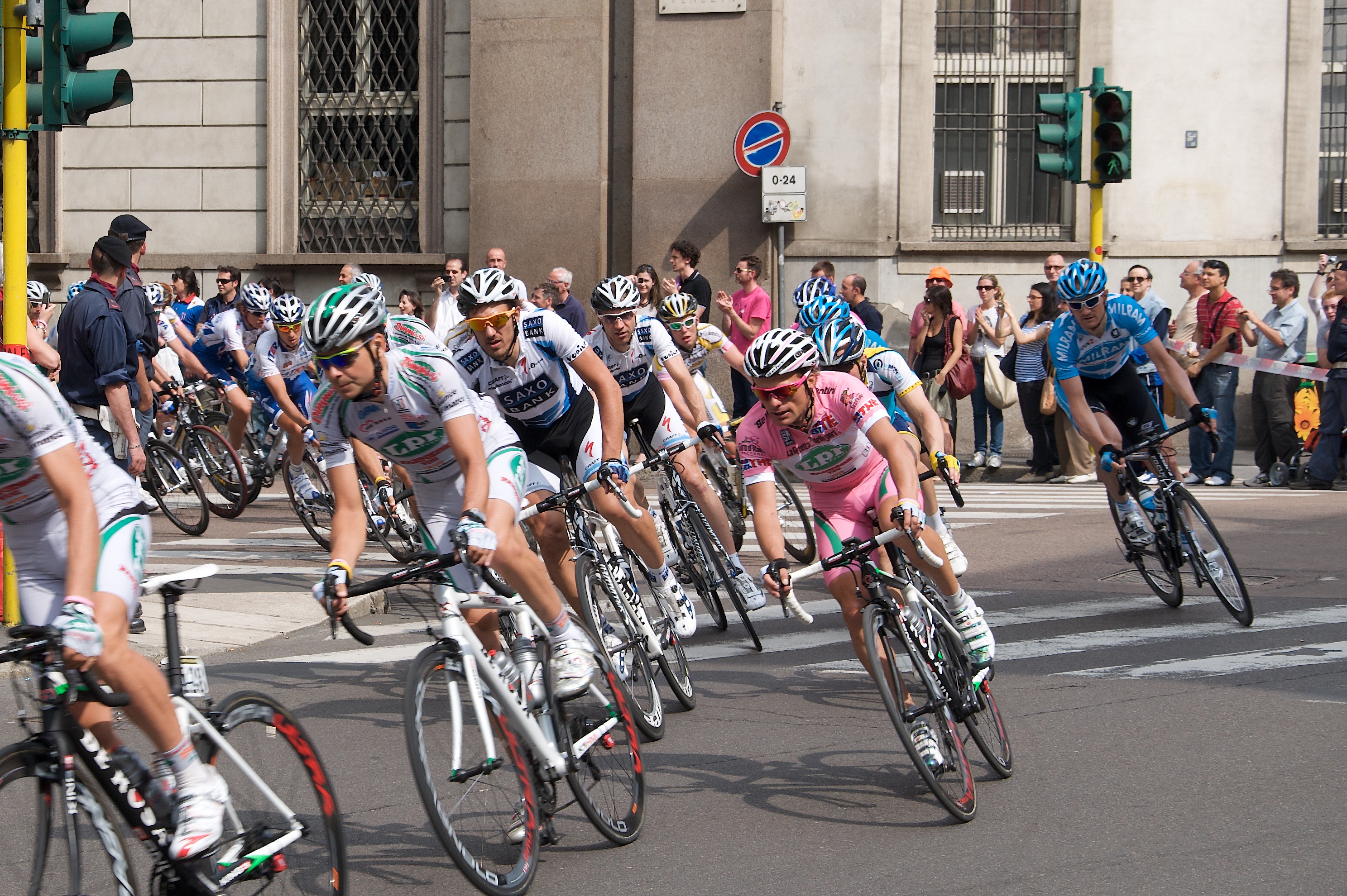
This stage was a circuit race. The field took 10 laps of a 16 km course in Milan (there was a 5 km run-in before the circuits began). The course was flat, and the stage figured to be a major sprinters' battle.{{cite web |access-date=2009-05-09
The character of this stage changed drastically after the dramatic injury sustained by Pedro Horrillo the day before brought attention to safety conditions on this and other courses in the Giro. With the course passing over numerous different surfaces, including tram tracks and cobblestones, the peloton collectively protested racing this course, and as such it was neutralized, with everyone receiving the same time as the stage winner and no points were awarded for the points classification as had been planned. There were also parked cars at the side of the road in many places, forcing the riders into narrow tunnels to get through them.{{cite web |access-date=2009-08-28
Originally, the result of the riders' protest was only that the stage times would not count.{{cite web |access-date=2009-10-10 |access-date=2009-10-10 |access-date=2009-10-10 |access-date=2009-10-10
The pace did eventually pick up, on the last lap, and the finish was contested in a bunched sprint, won by Mark Cavendish.{{cite web |access-date=2009-05-18 |archive-url=https://web.archive.org/web/20090621001914/http://autobus.cyclingnews.com/road/2009/giro09/?id=results%2Fgiro099 |archive-date=21 June 2009 |url-status=live
| Rider | Team | Time |
|---|---|---|
| 1 | Mark Cavendish | |
| 2 | Allan Davis | |
| 3 | Tyler Farrar | |
| 4 | Matthew Goss | |
| 5 | Alessandro Petacchi | |
| 6 | Robert Förster | |
| 7 | Robert Hunter | |
| 8 | Davide Viganò | |
| 9 | Saïd Haddou | |
| 10 | Markus Fothen |
|| |General classification after stage 9
| Rider | Team | Time | ||||||
|---|---|---|---|---|---|---|---|---|
| DSQ | Danilo Di Luca [[Image:Jersey pink.svg | 20px | Pink jersey]][[Image:Jersey green.svg | 20px | Green jersey]][[Image:Jersey violet.svg | 20px | Violet jersey]] | |
| 2 | Thomas Lövkvist [[Image:Jersey white.svg | 20px | White jersey]] | |||||
| 3 | Michael Rogers | |||||||
| 4 | Levi Leipheimer | |||||||
| 5 | Denis Menchov | |||||||
| 6 | Ivan Basso | |||||||
| 7 | Carlos Sastre | |||||||
| 8 | Chris Horner | |||||||
| DSQ | Franco Pellizotti | |||||||
| 10 | David Arroyo |
|}
Stage 10
19 May 2009 — Cuneo to Pinerolo, 262 km
After the rest day, the riders were faced with the Giro's longest stage, with numerous high mountain climbs along the course and the distinction of being the race's queen stage. It was originally scheduled to include the Col d'Izoard, which has been featured numerous times in the Tour de France as an hors catégorie climb. Race officials later decided to alter the course, staying on the Italian side of the Alps, believing the stretches that were to take place in France were too remote and that radio communication in the area could not be assured. The course as it originally was designed mimicked exactly a course used in the 1949 Giro d'Italia.{{cite web |access-date=2009-09-15
The resulting alterations caused the course to be even longer than first planned, 262 km rather than 250 km, with a small categorized climb just under 10 km from the finish. This came after a 50 km long descent from what became the course's principal climb, Sestrière. The race's overall contenders were expected to distinguish themselves on this stage.{{cite web |access-date=2009-05-09
A surprisingly fast beginning to the stage, with a first hour that covered over 50 km, managed to keep any breakaways from going clear for over two hours. Twelve eventually came ahead of the peloton, with seven in the lead and five chasing between the leaders and the peloton. The third group on the road eventually dwindled to a select contingent of overall favorites, which included race leader Danilo Di Luca. Former Giro champion Stefano Garzelli attacked from this group on the day's first climb and got to the leading group of five before the summit, claiming maximum points on it and on Sestrière to gain leadership of the mountains classification at the end of the day. Garzelli's maximum advantage, at the summit of Sestrière, was just over six minutes.
A group of most of the top riders in the GC, paced by the race leader himself, caught every one of the twelve initial leaders, and subsequently Garzelli just before the day's last climb, Prà Martino. Di Luca's aggressive descent of Prà Martino gave him a gap over the elite group of riders who had been able to hold his wheel to that point, and the stage win. The day saw a big winner in time gains and a big loser: Lance Armstrong finished 29 seconds behind Di Luca in the same group as the man finishing sixth on the stage, gaining seven places in the GC, while Thomas Lövkvist lost over a minute and fell from second to eighth in the GC.{{cite web |access-date=2009-05-29 |archive-url=https://web.archive.org/web/20090625183912/http://autobus.cyclingnews.com/road/2009/giro09/?id=results%2Fgiro0910 |archive-date=25 June 2009 |url-status=live
| Rider | Team | Time | ||
|---|---|---|---|---|
| DSQ | Danilo Di Luca [[Image:Jersey pink.svg | 20px | Pink jersey]] | |
| DSQ | Franco Pellizotti | |||
| 1 | Denis Menchov | |||
| 4 | Carlos Sastre | |||
| 5 | David Arroyo | |||
| 6 | Mauricio Soler | |||
| 7 | Ivan Basso | |||
| 8 | Levi Leipheimer | |||
| 9 | Joaquim Rodríguez | |||
| 10 | Michael Rogers |
|| |General classification after stage 10
| Rider | Team | Time | ||||
|---|---|---|---|---|---|---|
| DSQ | Danilo Di Luca [[Image:Jersey pink.svg | 20px | Pink jersey]][[Image:Jersey violet.svg | 20px | Violet jersey]] | |
| 2 | Denis Menchov | |||||
| 3 | Michael Rogers | |||||
| 4 | Levi Leipheimer | |||||
| DSQ | Franco Pellizotti | |||||
| 6 | Carlos Sastre | |||||
| 7 | Ivan Basso | |||||
| 8 | Thomas Lövkvist [[Image:Jersey white.svg | 20px | White jersey]] | |||
| 9 | David Arroyo | |||||
| 10 | Gilberto Simoni |
|}
Stage 11
20 May 2009 — Turin to Arenzano, 214 km
The Passo del Turchino, famous for its use every year in the classic one-day race Milan–San Remo, was visited 19 km from the end of this stage. The climb is not difficult enough to be at all selective, so pre-stage analysis led to expectations that either a mass sprint would occur or a breakaway of riders deep down in the GC would finish first on this stage.{{cite web |access-date=2009-05-09 |archive-url=https://web.archive.org/web/20090620015316/http://autobus.cyclingnews.com/road/2009/giro09/?id=stages%2Fgiro0911 |archive-date=20 June 2009 |url-status=live
Astana rider Chris Horner did not start the stage due to a leg injury sustained in a fall in Stage 10, leaving Levi Leipheimer and Lance Armstrong without their usual support rider. At the 56 km mark, Caisse d'Epargne rider Joaquim Rodríguez dropped out after a 9th-place finish in the previous stage.
A break formed after 65 km, including Gustavo César, Cameron Meyer, Dmytro Grabovskyy and Alessandro Donati. Soon after, Levi Leipheimer crashed, but was unhurt. The break was caught, and a solo break was formed by Vladimir Isaichev. Astana drove the peloton up the Turchino, the day's lone climb, with Armstrong leading the descent and race leader Danilo Di Luca somewhat surprisingly coming forward to hold Armstrong's wheel. Some riders tried to escape for victory on the way into Arenzano, but the sprinters' teams worked to keep the field together, and Mark Cavendish took another bunched sprint win over Tyler Farrar and Alessandro Petacchi.{{cite web |access-date=2009-05-20 |archive-url=https://web.archive.org/web/20090618005618/http://autobus.cyclingnews.com/road/2009/giro09/?id=results%2Fgiro0911 |archive-date=18 June 2009 |url-status=live
It was after this stage, on the eve of the Cinque Terre time trial, that Danilo Di Luca gave his first of two positive tests for continuous erythropoiesis receptor activator (CERA),{{cite web |access-date=2009-07-22}} the results of which became public after the Giro was over.
| Rider | Team | Time |
|---|---|---|
| 1 | Mark Cavendish | |
| 2 | Tyler Farrar | |
| 3 | Alessandro Petacchi | |
| 4 | Allan Davis | |
| 5 | Sébastien Hinault | |
| 6 | Davide Viganò | |
| 7 | Edvald Boasson Hagen | |
| 8 | Alexander Serov | |
| 9 | Oscar Gatto | |
| 10 | Robert Förster |
|| |General classification after stage 11
| Rider | Team | Time | ||||
|---|---|---|---|---|---|---|
| DSQ | Danilo Di Luca [[Image:Jersey pink.svg | 20px | Pink jersey]][[Image:Jersey violet.svg | 20px | Violet jersey]] | |
| 2 | Denis Menchov | |||||
| 3 | Michael Rogers | |||||
| 4 | Levi Leipheimer | |||||
| DSQ | Franco Pellizotti | |||||
| 6 | Carlos Sastre | |||||
| 7 | Ivan Basso | |||||
| 8 | Thomas Lövkvist [[Image:Jersey white.svg | 20px | White jersey]] | |||
| 9 | David Arroyo | |||||
| 10 | Gilberto Simoni |
|}
References
References
- Jerseys appearing in the table on the left of the page indicate those worn by the cyclist during the particular stage, while those appearing in the table on the right of the page indicate those awarded to the cyclist after the stage.
- Andrew Hood. (2009-05-11). "Petacchi wins stage and jersey as Cavendish gets gapped by a crash.". Competitor Group, Inc.
- Andrew Hood. (2009-05-12). "Di Luca wins Giro stage 4". Competitor Group, Inc.
- Di Luca tested positive for EPO during the Giro. Subsequently, all his results were declared void.
- Andrew Dampf. (2009-05-06). "Lance Armstrong's Astana cycling team in financial crisis".
- Eurosport. (2009-05-17). "Giro d'Italia – Cavendish wins farcical stage". Yahoo!.
- Andrew Hood. (2009-05-19). "Race leader Danilo Di Luca stomps, wins the Giro's 'Queen Stage' with a solo attack.". Competitor Group, Inc.
- (2009-04-08). "Giro d'Italia – Organisers re-arrange Giro stage". Yahoo! Sport.
This article was imported from Wikipedia and is available under the Creative Commons Attribution-ShareAlike 4.0 License. Content has been adapted to SurfDoc format. Original contributors can be found on the article history page.
Ask Mako anything about 2009 Giro d'Italia, Stage 1 to Stage 11 — get instant answers, deeper analysis, and related topics.
Research with MakoFree with your Surf account
Create a free account to save articles, ask Mako questions, and organize your research.
Sign up freeThis content may have been generated or modified by AI. CloudSurf Software LLC is not responsible for the accuracy, completeness, or reliability of AI-generated content. Always verify important information from primary sources.
Report