From Surf Wiki (app.surf) — the open knowledge base
2008 Iran–United States naval dispute
Naval dispute

Naval dispute
| Field | Value |
|---|---|
| place | Strait of Hormuz |
| result | Resolved peacefully |
| combatant1 | United States |
| combatant2 | Iran |
| units1 | United States Navy |
| units2 | Navy of the Islamic Revolutionary Guard Corps |
| Border Guard Command | |
| strength1 | 3 warships |
| strength2 | 5 patrol boats |
Border Guard Command The 2008 Iran–United States naval dispute refers to a series of naval stand-offs between Iranian speedboats and U.S. Navy warships in the Strait of Hormuz in December 2007 and January 2008.
Incident
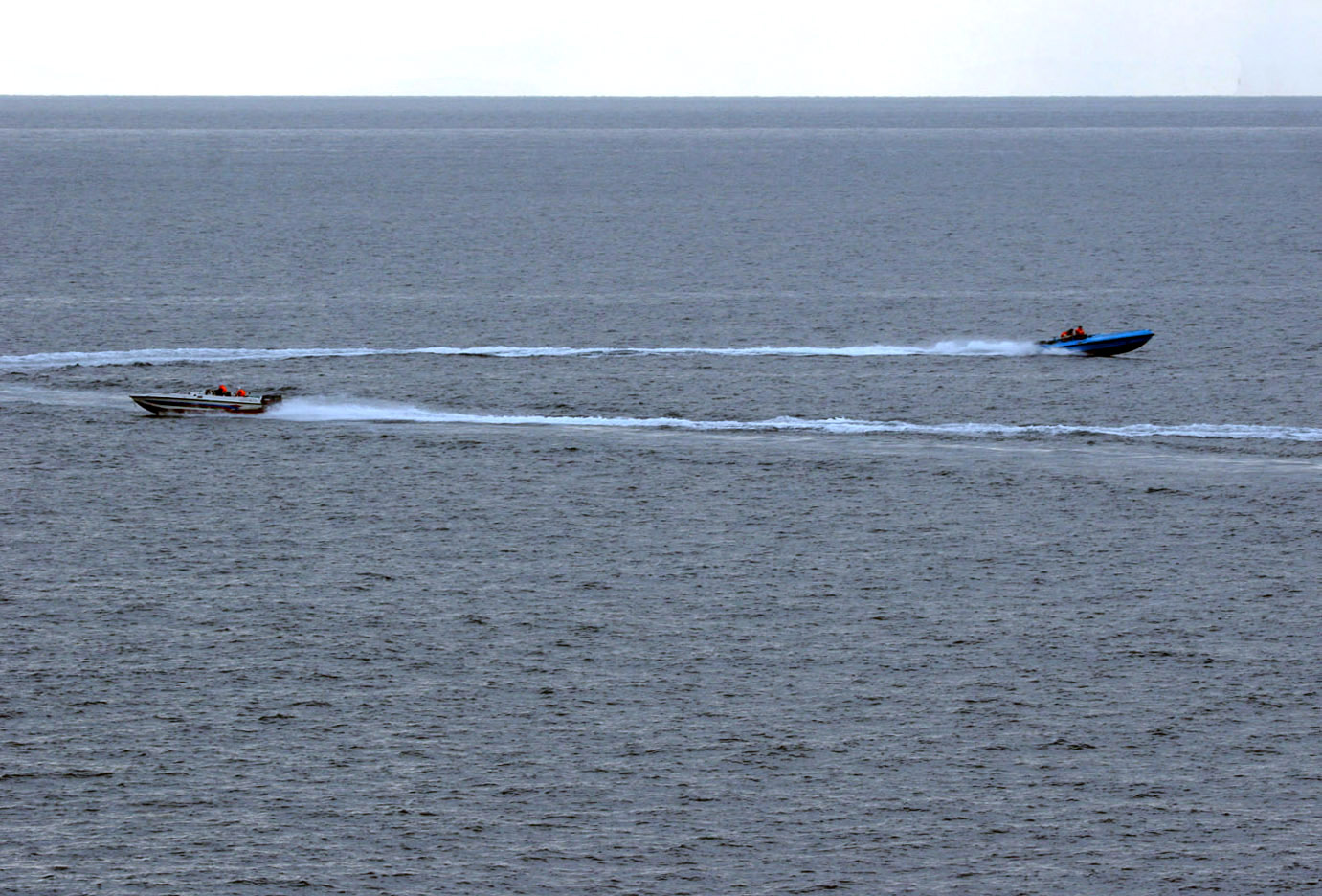
On 6 January 2008, five Iranian patrol boats crewed by the Revolutionary Guard approached three United States Navy warships in the Strait of Hormuz: the cruiser , the destroyer and the frigate . In a compilation of video and audio released by the Pentagon of the most provocative moments of the encounter, the radio officer of USS Hopper is seen and heard attempting to make radio contact with the Iranian vessels. A few moments later, another voice radioed Hopper saying, "I am coming at you. You will explode [in or after] [static] minutes."
Early United States reports indicated that because the Iranian boats continued to circle the United States warships and had been seen to drop several packages into the water, the United States ships had no choice but to take the threats seriously and maintain a defensive posture. Pentagon officials said the American ships were about to open fire when the Iranian boats withdrew. The commander of Hopper publicly denied that the American ships were about to open fire.{{cite journal
United States officials said the Iranians "harassed and provoked" their naval vessels, coming within 200 yd of one warship. Iranian officials responded by calling the incident a routine contact of a sort that happens all the time in the crowded waters of the Persian Gulf.{{cite news |title=US doubts over Iran boat 'threat' |url=https://news.bbc.co.uk/2/hi/middle_east/7181929.stm |doi=10.1002/bdra.20327 |author=Källén, Bengt A. J.
There has been confusion as to the source of the threatening radio transmissions. Persian speakers and Iranians have told The Washington Post that the accent in the American recording does not sound Iranian. The New York Times pointed out that the United States-released audio includes no ambient noise of the kind that might be expected if the broadcast had come from one of the speedboats. The Navy Times wrote that the incident could have been caused by a locally famous heckler known as the "Filipino Monkey", noting that the threatening voice sounds different from that of the Iranian officer. Several media outlets reported that the Navy spliced the audio recording of the alleged Iranian threat onto to a videotape of the incident.{{cite journal |first=Gareth |last=Porter |date=17 January 2008 |title=How the Pentagon planted a false story
The Pentagon spokesman who described the Iranian boats as "highly maneuverable patrol craft" that was "visibly armed" did not note that such boats usually only carry a two- or three-man crew and that they are normally armed only with machine guns. The only boat that was close enough to be visible to the United States ships was unarmed, as an enlarged photo of the boat from the navy video shows.
On 12 January 2008, it was revealed that, contrary to previous reports, the packages the Iranian boats had dropped into the water posed no threat to the United States vessels. The leading United States vessels observed that they were harmless light floating objects and did not report them to follow United States vessels as a danger.
On 12 January 2008, two earlier incidents during December 2007 were revealed by United States Navy officials, one in which fired warning shots in response to a small Iranian boat that was approaching it on 19 December. The Iranian boat reportedly then retreated after the shots were fired.
In an 8 July speech to the Revolutionary Guards, Ali Shirazi, a mid-level clerical aide to Iran's Supreme Leader Ali Khamenei, "The Zionist regime is pressuring White House officials to attack Iran. If they commit such a stupidity, Tel Aviv and U.S. shipping in the Persian Gulf will be Iran's first targets and they will be burned," according to the student news agency ISNA.
Historical context
The presence of United States warships in the strait has been a sensitive issue for Iran since 3 July 1988, when the U.S. Navy cruiser shot down an Iranian commercial flight in Iranian airspace over the strait, killing 290 civilians, an incident for which the United States never apologized, though it did provide monetary compensation.
Territorial context
To travel through the Strait of Hormuz, which at its narrowest is 21 nmi wide, ships pass through the territorial waters of Iran and Oman under the transit passage provisions of the United Nations Convention on the Law of the Sea. Neither Iran or the United States have ratified the convention, but the United States accepts the traditional navigation rules as reflected in the convention. Iran has stated that it reserves "the right to require prior authorization for warships to exercise the right of innocent passage through its territorial sea." It is unclear if the incident happened in the territorial waters of Iran or Oman.
References
References
- (12 January 2008). "US-Iranian naval dispute deepens". BBC.
- Barbara Starr. (7 January 2008). "Iranian ships 'harass' U.S. Navy, officials say". CNN.
- Ivan Watson. (14 January 2008). "Did a Radio Prank Escalate Iran-U.S. Confrontation?". NPR.
- (9 January 2008). "Iran says US video was fabricated". BBC News.
- Porter, Gareth. (16 January 2008). "How the Pentagon Planted a False Hormuz Story". Inter Press Service.
- Pauline Jelinek. (7 January 2008). "Pentagon Says Ships Harassed by Iran". FOX News.
- (7 January 2008). "Three U.S. Navy Ships Approached by Iranian Boats (video 080107-D-6570C-001)". U.S. Department of Defense.
- (10 January 2008). "Iran releases own video of U.S. Gulf incident". Reuters.
- (14 January 2008). "Politics-US: Official Version of Naval Incident Starts to Unravel".
- Baldor, Lolita C.. (12 January 2008). "Navy releases longer video of Iranian incident". The Statesman (Associated Press).
- [http://www.navytimes.com/news/2008/01/navy_hormuz_iran_radio_080111/ ‘Filipino Monkey’ behind threats? – Navy News, opinions, editorials, news from Iraq, photos, reports – Navy Times]
- (15 January 2008). "Prankster linked to US-Iran incident". Television New Zealand.
- [https://www.npr.org/templates/story/story.php?storyId=18086931&ft=1&f=1004 Did a Radio Prank Escalate Iran-U.S. Confrontation?]
- (14 January 2008). "POLITICS-US: Official Version of Naval Incident Starts to Unravel".
- Lolita C., Baldor. (9 January 2008). "Ship video shows U.S. encounter with Iran". The News Tribune.
- Abdullah, Ahmed. (12 January 2008). "U.S.-Iran stand-off: Mere propaganda or prelude to war?". Al Jazeera.
- Robin Wright and Ann Scott Tyson. (12 January 2008). "Objects From Iranian Boats Posed No Threat, Navy Says". The Washington Post.
- (8 July 2008). "Iran to "hit Tel Aviv, U.S. ships" if attacked". Yahoo! News.
- Wright, Robin. (11 January 2008). "Iranian Boats May Not Have Made Radio Threat, Pentagon Says". The Washington Post.
- "The United Nations Convention on the Law of the Sea (A historical perspective)". UN.
- "Chronological lists of ratifications of, accessions and successions to the Convention and the related Agreements as at 26 October 2007". UN.
- U.S. President [[Ronald Reagan]]. (10 March 1983). "Presidential Proclamation 5030".
- U.S. Department of State. (25 May 2000). "Limits in the Sea, National Claims to Maritime Restrictions".
This article was imported from Wikipedia and is available under the Creative Commons Attribution-ShareAlike 4.0 License. Content has been adapted to SurfDoc format. Original contributors can be found on the article history page.
Ask Mako anything about 2008 Iran–United States naval dispute — get instant answers, deeper analysis, and related topics.
Research with MakoFree with your Surf account
Create a free account to save articles, ask Mako questions, and organize your research.
Sign up freeThis content may have been generated or modified by AI. CloudSurf Software LLC is not responsible for the accuracy, completeness, or reliability of AI-generated content. Always verify important information from primary sources.
Report