From Surf Wiki (app.surf) — the open knowledge base
1943–44 NHL season
Professional ice hockey league season
Professional ice hockey league season
| Field | Value |
|---|---|
| title | 1943–44 NHL season |
| league | National Hockey League |
| sport | Ice hockey |
| duration | October 30, 1943 – April 13, 1944 |
| season | Regular season |
| no_of_games | 50 |
| no_of_teams | 6 |
| season_champ_name | Season champion |
| season_champs | Montreal Canadiens |
| MVP | Babe Pratt (Maple Leafs) |
| MVP_link | Hart Memorial Trophy |
| top_scorer | Herb Cain (Bruins) |
| finals | Stanley Cup |
| finals_link | 1944 Stanley Cup Finals |
| finals_champ | Montreal Canadiens |
| finals_runner-up | Chicago Black Hawks |
| nextseason_link | 1944–45 NHL season |
| prevseason_link | 1942–43 NHL season |
| nextseason_year | 1944–45 |
| prevseason_year | 1942–43 |
| seasonslistnames | NHL |
| finals_runner-up = Chicago Black Hawks The 1943–44 NHL season was the 27th season of the National Hockey League. Six teams played 50 games each. The Montreal Canadiens were the top team of the regular season and followed it up with the team's fifth Stanley Cup championship.
League business
In memory of Frank Calder, the former NHL President who died in 1943, the league's Board of Governors donated the Calder Memorial Trophy to be awarded to the NHL's top rookie.
Due to World War II, 75 per cent of the amateurs signed by the NHL ended up in the armed services. In April 1943, Canadian Amateur Hockey Association past-president George Dudley recommended that payments from the NHL for signing amateurs be deferred until players lost due to the wartime enlistments return to professional hockey. The NHL negotiated with W. G. Hardy and the International Ice Hockey Association to sign more junior-aged players than usual, due to World War II travel restrictions. The Canadian Press reported that Hardy was rumored to be appointed president of the NHL, to replace Red Dutton who had been acting president since the death of Calder.
Rule changes
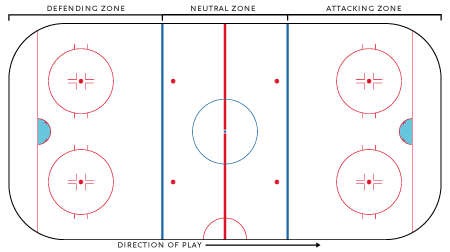
NHL rules committee chairman Frank Boucher and Ottawa District Hockey Association executive Cecil Duncan collaborated to experiment with then introduce the centre ice red line to the hockey rink, in an effort to open up the game and allow the defending team to pass the puck out of their own zone and counter-attack quicker.
"This rule is considered to mark the beginning of the modern era in the NHL", according to the NHL's Guide and Record Book. In 2005, 62 years later, the two-line pass would be legalized for similar reasons.
Regular season
The Montreal Canadiens had turned the corner and now Tommy Gorman and Dick Irvin had a team to make the fans happy. Bill Durnan solved the goaltending woes, but not before Gorman had all kinds of problems signing him. Durnan knew his worth, and wanted a handsome sum. Just before the first game, Gorman agreed to his contract demands. He was worth every penny, as he ran away with the Vezina Trophy and the Canadiens lost only five games all year, finishing first by a wide margin. The new and more familiar "Punch line" of Elmer Lach, Toe Blake, and Maurice Richard dominated the offence and Richard had 32 goals. He replaced Joe Benoit, who did his duty to his country by joining the armed forces. Richard, in fact, was dubbed by teammate Ray Getliffe the nickname that would be his legend "The Rocket".
When Paul Bibeault came back from the Army, he found his job lost to the best goaltender in the NHL, Bill Durnan. Montreal agreed to loan him to Toronto, where he played very well, leading the Leafs to third place and leading the NHL with five shutouts. Gus Bodnar, a crack centre, was the top rookie, and for the first time, a team produced Calder Memorial Trophy winners in consecutive years. In fact, Bodnar scored the fastest goal by a rookie in his very first game. It took him only 15 seconds to score on Ken McAuley, Ranger goaltender, in a 5–2 win over the war-weakened Rangers.
The Rangers had plunged to last place the previous year and Lester Patrick was so discouraged that he wanted to suspend operations for the year. This year the Rangers lost Clint Smith, Lynn Patrick, Phil Watson, and Alf Pike. The most unbelievably inept team iced for the Rangers this year. Things were so desperate that coach Frank Boucher had to come out of retirement to play some. But the Rangers set a modern-day record of 6.20 goals against, giving up 310 goals in 50 games. One night when Lester Patrick went behind the bench to coach the team with Frank Boucher attending a brother's funeral, the Rangers were demolished 15–0 by Detroit as the Red Wings set a modern-day record of most goals by a team in a single game. It was a horrifying experience for Patrick. Only a week later Syd Howe set a modern-day record of 6 goals in a game in a 12–2 conquest of the hapless Rangers. The Rangers won only 6 games all year and finished a distant last, 26 points behind fifth-place Boston.
Chicago started with sub-par goaltending, but then president and general manager Bill Tobin decided to bring back Mike Karakas, who had been demoted to the minors in 1939–40 for his lackluster play. Karakas was just what the Black Hawks needed, as he played well and recorded three shutouts and got the team into the playoffs.
In Boston, the Bruins lost star forward Bill Cowley to injury after the first 36 games. At that point in the season Cowley was on pace to set a new standard in scoring for the NHL. After the first 36 games he had scored 30 goals – 41 assists – 71 points before going down to injury. However, the scoring title would still eventually end up in Boston as linemate Herb Cain picked up the slack, scoring 82 points over the course of the 50-game schedule and setting a new record for points in the regular season.
Final standings
Playoffs
Playoff bracket
The top four teams in the league qualified for the playoffs. In the semifinals, the first-place team played the third-place team, while the second-place team faced the fourth-place team, with the winners advancing to the Stanley Cup Finals. In both rounds, teams competed in a best-of-seven series (scores in the bracket indicate the number of games won in each best-of-seven series).
| RD1-seed1=1 | RD1-team1=Montreal | RD1-score1=4 | RD1-seed2=3 | RD1-team2=Toronto | RD1-score2=1 | RD1-seed3=2 | RD1-team3=Detroit | RD1-score3=1 | RD1-seed4=4 | RD1-team4=Chicago | RD1-score4=4 | RD2-seed1=1 | RD2-team1=Montreal | RD2-score1=4 | RD2-seed2=4 | RD2-team2=Chicago | RD2-score2=0
Semifinals
(1) Montreal Canadiens vs. (3) Toronto Maple Leafs
The Montreal Canadiens finished first in the league with 83 points. The Toronto Maple Leafs finished third in the league with 50 points. This was the third playoff meeting between these two teams with the teams splitting the two previous series. They last met in the 1925 NHL Championship where Montreal won a two-game total goals series 5–2. Montreal won this year's ten game regular season series earning fifteen of twenty points. Maurice "Rocket" Richard was named first, second, and third Star of the game after scoring all 5 Montreal goals in game two, the first player to have this honour.
|1-1-1 =Moe Morris (1) – pp – 06:07 George Boothman (1) – pp – 18:35 |1-1-2 =No scoring |1-2-1 =Jackie Hamilton (1) – 12:24 |1-2-2 =No scoring |1-3-1 =No scoring |1-3-2 =02:49 – sh – Toe Blake (1) |goalie1-1 =Paul Bibeault |goalie1-2 =Bill Durnan
|2-1-1 =No scoring |2-1-2 =No scoring |2-2-1 =Reg Hamilton (1) – pp – 08:30 |2-2-2 =01:48 – Maurice Richard (1) 02:03 – Maurice Richard (2) 16:46 – Maurice Richard (3) |2-3-1 =No scoring |2-3-2 =01:00 – pp – Maurice Richard (4) 08:51 – Maurice Richard (5) |goalie2-1 =Paul Bibeault |goalie2-2 =Bill Durnan
|3-1-1 =No scoring |3-1-2 =Glen Harmon (1) – 09:57 |3-2-1 =08:06 – George Boothman (2) |3-2-2 =No scoring |3-3-1 =No scoring |3-3-2 =Ray Getliffe (1) – 09:43 |goalie3-1 =Paul Bibeault |goalie3-2 =Bill Durnan
|4-1-1 =No scoring |4-1-2 =No scoring |4-2-1 =No scoring |4-2-2 =Gerry Heffernan (1) – 15:55 Toe Blake (2) – 18:45 |4-3-1 =09:53 – pp – Ted Kennedy (1) |4-3-2 =Murph Chamberlain (1) – pp – 12:57 Murph Chamberlain (2) – 19:48 |goalie4-1 =Paul Bibeault |goalie4-2 =Bill Durnan
|5-1-1 =No scoring |5-1-2 =16:02 – Ray Getliffe (2) 17:39 – Phil Watson (1) |5-2-1 =No scoring |5-2-2 =00:27 – Maurice Richard (6) 10:33 – sh – Murph Chamberlain (3) |5-3-1 =No scoring |5-3-2 =02:27 – Butch Bouchard (1) 07:58 – Toe Blake (3) 08:37 – Toe Blake (4) 09:17 – Maurice Richard (7) 10:33 – Ray Getliffe (3) 11:34 – Buddy O'Connor (1) 15:41 – pp – Murph Chamberlain (4) |goalie5-1 =Paul Bibeault |goalie5-2 =Bill Durnan
(2) Detroit Red Wings vs. (4) Chicago Black Hawks
The Detroit Red Wings finished second in the league with 58 points. The Chicago Black Hawks finished fourth with 49 points. This was the third playoff meeting between these two teams with the teams splitting the two previous series. They last met in the 1941 Stanley Cup Semifinals where Detroit won in two games. The teams split this year's ten-game regular season series.
|1-1-1 =No scoring |1-1-2 =12:18 – pp – Syd Howe (1) |1-2-1 =No scoring |1-2-2 =No scoring |1-3-1 =Bill Mosienko (1) – 07:12 Doug Bentley (1) – 07:56 |1-3-2 =No scoring |goalie1-1 =Mike Karakas |goalie1-2 =Connie Dion
|2-1-1 =No scoring |2-1-2 =No scoring |2-2-1 =No scoring |2-2-2 =03:00 – Joe Carveth (1) 19:10 – pp – Syd Howe (2) |2-3-1 =George Allen (1) – 11:18 Mud Bruneteau (1) – 16:06 |2-3-2 =00:21 – Don Grosso (1) |goalie2-1 =Mike Karakas |goalie2-2 =Connie Dion
|3-1-1 =11:06 – Joe Cooper (1) |3-1-2 =No scoring |3-2-1 =No scoring |3-2-2 =No scoring |3-3-1 =11:30 – Clint Smith (1) |3-3-2 =No scoring |goalie3-1 =Mike Karakas |goalie3-2 =Connie Dion
|4-1-1 =04:44 – Doug Bentley (2) 11:09 – pp – Bill Mosienko (2) 16:54 – Clint Smith (2) |4-1-2 =Carl Liscombe (1) – 06:00 |4-2-1 =01:42 – Clint Smith (3) 15:30 – Doug Bentley (3) 19:18 – Doug Bentley (4) |4-2-2 =No scoring |4-3-1 =19:57 – Fido Purpur (1) |4-3-2 =No scoring |goalie4-1 =Mike Karakas |goalie4-2 =Connie Dion
|5-1-1 =Doug Bentley (5) – pp – 18:23 |5-1-2 =06:59 – Bill Quackenbush (1) |5-2-1 =No scoring |5-2-2 =No scoring |5-3-1 =Johnny Gottselig (1) – 03:37 Doug Bentley (6) – 08:10 Doug Bentley (7) – 12:30 George Allen (2) – 18:56 |5-3-2 =08:40 – Joe Carveth (2) |goalie5-1 =Mike Karakas |goalie5-2 =Connie Dion
Stanley Cup Finals
Main article: 1944 Stanley Cup Finals
This was the sixth playoff meeting between these two teams with Chicago winning three of the five previous series. They last met in the 1941 Stanley Cup Quarterfinals where Chicago won in three games. Montreal won this year's ten game regular season series earning eighteen of twenty points.
|1-1-1 =No scoring |1-1-2 =08:37 – Phil Watson (2) |1-2-1 =Clint Smith (4) – pp – 10:11 |1-2-2 =06:35 – pp – Toe Blake (5) 10:58 – Ray Getliffe (4) |1-3-1 =No scoring |1-3-2 =04:47 – Murph Chamberlain (5) 18:07 – Ray Getliffe (5) |goalie1-1 =Mike Karakas |goalie1-2 =Bill Durnan
|2-1-1 =No scoring |2-1-2 =No scoring |2-2-1 =No scoring |2-2-2 =Maurice Richard (8) – 13:00 |2-3-1 =19:59 – John Harms (1) |2-3-2 =Maurice Richard (9) – 12:16 Maurice Richard (10) – 15:33 |goalie2-1 =Mike Karakas |goalie2-2 =Bill Durnan
|3-1-1 =05:14 – George Allen (3) |3-1-2 =No scoring |3-2-1 =No scoring |3-2-2 =Toe Blake (6) – 02:02 |3-3-1 =04:19 – John Harms (2) |3-3-2 =Mike McMahon (1) – 05:47 Phil Watson (3) – 06:42 |goalie3-1 =Mike Karakas |goalie3-2 =Bill Durnan
|4-1-1 =George Allen (4) – 05:12 |4-1-2 =08:48 – Elmer Lach (1) |4-2-1 =John Harms (3) – pp – 07:30 George Allen (5) – pp – 09:12 Doug Bentley (8) – 10:09 |4-2-2 =No scoring |4-3-1 =No scoring |4-3-2 =10:02 – Elmer Lach (2) 16:05 – Maurice Richard (11) 17:20 – Maurice Richard (12) |4-4-1 =No scoring |4-4-2 =09:12 – Toe Blake (7) |goalie4-1 =Mike Karakas |goalie4-2 =Bill Durnan
Awards
| Vezina Trophy: | |
|---|---|
| (Fewest goals allowed) | Bill Durnan, Montreal Canadiens |
| First team | Position | Second team |
|---|---|---|
| Bill Durnan, Montreal Canadiens | G | Paul Bibeault, Toronto Maple Leafs |
| Earl Seibert, Chicago Black Hawks | D | Emile "Butch" Bouchard, Montreal Canadiens |
| Babe Pratt, Toronto Maple Leafs | D | Dit Clapper, Boston Bruins |
| Bill Cowley, Boston Bruins | C | Elmer Lach, Montreal Canadiens |
| Lorne Carr, Toronto Maple Leafs | RW | Maurice Richard, Montreal Canadiens |
| Doug Bentley, Chicago Black Hawks | LW | Herb Cain, Boston Bruins |
| Dick Irvin, Montreal Canadiens | Coach | Hap Day, Toronto Maple Leafs |
Player statistics
Scoring leaders
Note: GP = Games played, G = Goals, A = Assists, PTS = Points, PIM = Penalties in minutes
| Player | Team | GP | G | A | PTS | PIM |
|---|---|---|---|---|---|---|
| Herb Cain | Boston Bruins | 48 | 36 | 46 | 82 | 4 |
| Doug Bentley | Chicago Black Hawks | 50 | 38 | 39 | 77 | 22 |
| Lorne Carr | Toronto Maple Leafs | 50 | 36 | 38 | 74 | 9 |
| Carl Liscombe | Detroit Red Wings | 50 | 36 | 37 | 73 | 17 |
| Elmer Lach | Montreal Canadiens | 48 | 24 | 48 | 72 | 23 |
| Clint Smith | Chicago Black Hawks | 50 | 23 | 49 | 72 | 4 |
| Bill Cowley | Boston Bruins | 36 | 30 | 41 | 71 | 12 |
| Bill Mosienko | Chicago Black Hawks | 50 | 32 | 38 | 70 | 10 |
| Art Jackson | Boston Bruins | 49 | 28 | 41 | 69 | 8 |
| Gus Bodnar | Toronto Maple Leafs | 50 | 22 | 40 | 62 | 18 |
Source: NHL
Leading goaltenders
Note: GP = Games played; Mins = Minutes played; GA = Goals against; GAA = Goals against average; W = Wins; L = Losses; T = Ties; SO = Shutouts
| Player | Team | GP | Mins | GA | GAA | W | L | T | SO |
|---|---|---|---|---|---|---|---|---|---|
| Bill Durnan | Montreal Canadiens | 50 | 3000 | 109 | 2.18 | 32 | 5 | 7 | 2 |
| Paul Bibeault | Toronto Maple Leafs | 29 | 1740 | 87 | 3.00 | 13 | 14 | 2 | 5 |
| Mike Karakas | Chicago Black Hawks | 26 | 1560 | 79 | 3.04 | 12 | 9 | 5 | 3 |
| Connie Dion | Detroit Red Wings | 26 | 1560 | 80 | 3.08 | 17 | 7 | 2 | 1 |
| Jimmy Franks | Detroit Red Wings | 17 | 1020 | 69 | 4.06 | 6 | 8 | 3 | 1 |
| Benny Grant | Toronto Maple Leafs | 20 | 1200 | 83 | 4.15 | 9 | 9 | 2 | 0 |
| Hec Highton | Chicago Black Hawks | 24 | 1440 | 108 | 4.50 | 10 | 14 | 0 | 0 |
| Bert Gardiner | Boston Bruins | 46 | 2460 | 212 | 5.17 | 17 | 19 | 5 | 1 |
| Ken McAuley | New York Rangers | 50 | 2980 | 310 | 6.24 | 6 | 39 | 5 | 0 |
Coaches
- Boston Bruins: Art Ross
- Chicago Black Hawks: Paul Thompson
- Detroit Red Wings: Jack Adams
- Montreal Canadiens: Dick Irvin
- New York Rangers: Frank Boucher
- Toronto Maple Leafs: Hap Day
Debuts
The following is a list of players of note who played their first NHL game in 1943–44 (listed with their first team, asterisk(*) marks debut in playoffs):
- Harry Lumley, Detroit Red Wings
- Bill Durnan, Montreal Canadiens
- Don Raleigh, New York Rangers
- Gus Bodnar, Toronto Maple Leafs
Last games
The following is a list of players of note who played their last game in the NHL in 1943–44 (listed with their last team):
- Buzz Boll, Boston Bruins
- Busher Jackson, Boston Bruins
- Frank Boucher, New York Rangers
References
- {{cite book |last1=Fischler |first1=Stan |last2=Fischler |first2=Shirley
;Notes
References
- "Calder Memorial Trophy". Hockey Hall of Fame.
- Young, Scott. (1989). "100 Years of Dropping the Puck". McClelland & Stewart Inc..
- (April 26, 1943). "$38,000 Profit In Puck Series". Winnipeg Tribune.
- (October 29, 1943). "Halt Concessions To Major League". Winnipeg Tribune.
- (April 24, 1943). "Rumor Hardy To Boss N.H.L.". Winnipeg Free Press.
- Shea, Kevin. (2011-11-19). "Spotlight – One on One with Frank Boucher". Hockey Hall of Fame.
- "Historical Rule Changes". NHL Enterprises, L. P..
This article was imported from Wikipedia and is available under the Creative Commons Attribution-ShareAlike 4.0 License. Content has been adapted to SurfDoc format. Original contributors can be found on the article history page.
Ask Mako anything about 1943–44 NHL season — get instant answers, deeper analysis, and related topics.
Research with MakoFree with your Surf account
Create a free account to save articles, ask Mako questions, and organize your research.
Sign up freeThis content may have been generated or modified by AI. CloudSurf Software LLC is not responsible for the accuracy, completeness, or reliability of AI-generated content. Always verify important information from primary sources.
Report