From Surf Wiki (app.surf) — the open knowledge base
1931 Transcontinental & Western Air Fokker F-10 crash
1931 passenger aircraft crash in Chase County, Kansas, USA

1931 passenger aircraft crash in Chase County, Kansas, USA
| Field | Value |
|---|---|
| name | Transcontinental & Western Air flght 599 |
| image | NC999E Transcontinental & Western Air.jpg |
| caption | NC999E, the aircraft involved in the accident, in front of the control tower of Alhambra Airport, in March 1930 |
| date | March 31, 1931 |
| type | Structural failure |
| occurrence_type | Accident |
| site | Bazaar Township, |
| Chase County, Kansas, U.S. | |
| coordinates | |
| mapframe | yes |
| origin | Kansas City, Missouri |
| stopover | Wichita, Kansas |
| destination | Los Angeles, California |
| Fatalities | 8 |
| Aircraft Type | Fokker F-10 |
| Operator | Transcontinental |
| and Western Air | |
| Tail Number | NC999E |
| Passengers | 6 |
| Crew | 2 |
| Survivors | 0 |
Chase County, Kansas, U.S. and Western Air](trans-world-airlines)
On March 31, 1931, a Fokker F-10 belonging to Transcontinental and Western Air crashed near Bazaar, Kansas after taking off from Kansas City Municipal Airport, Kansas City, Missouri.
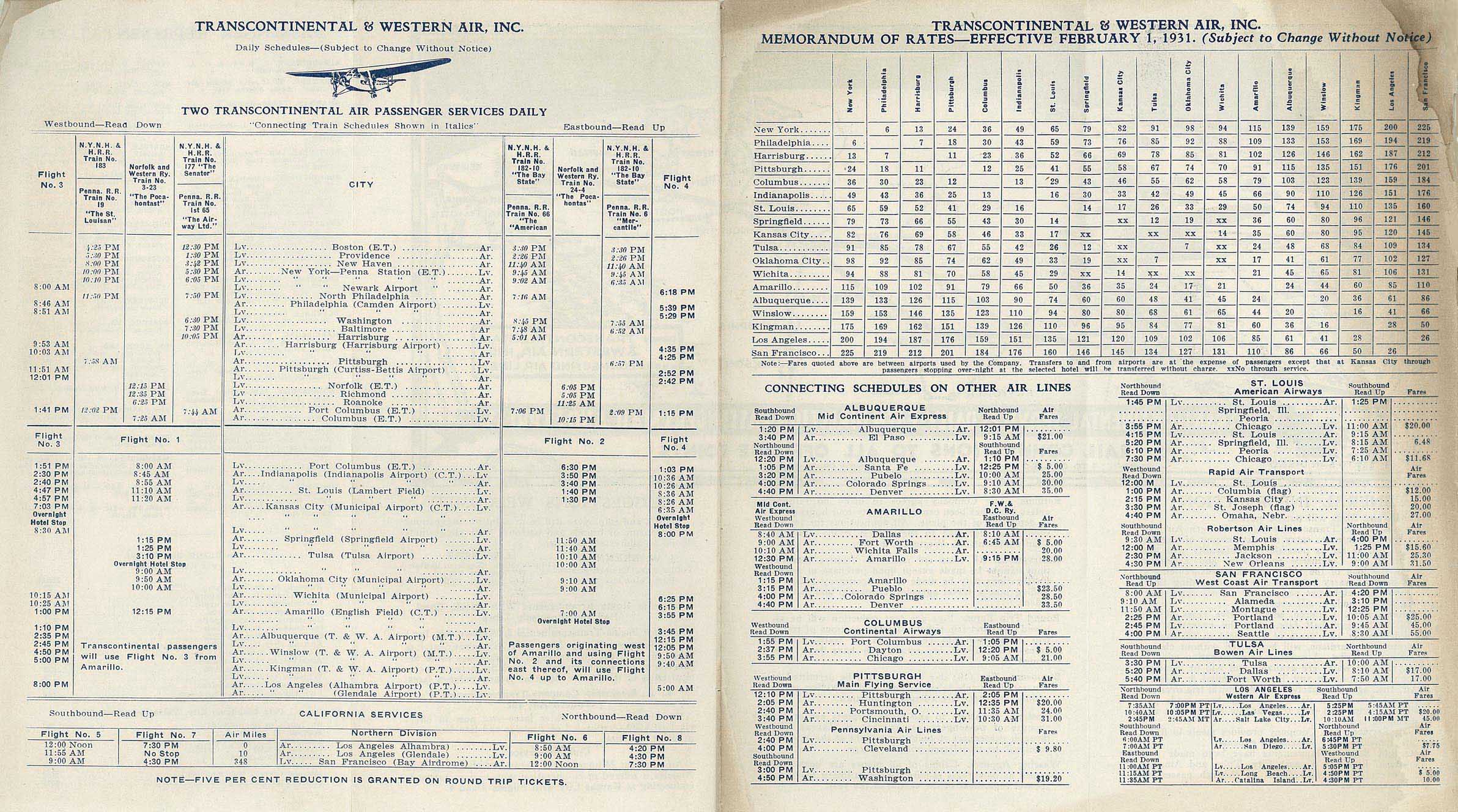
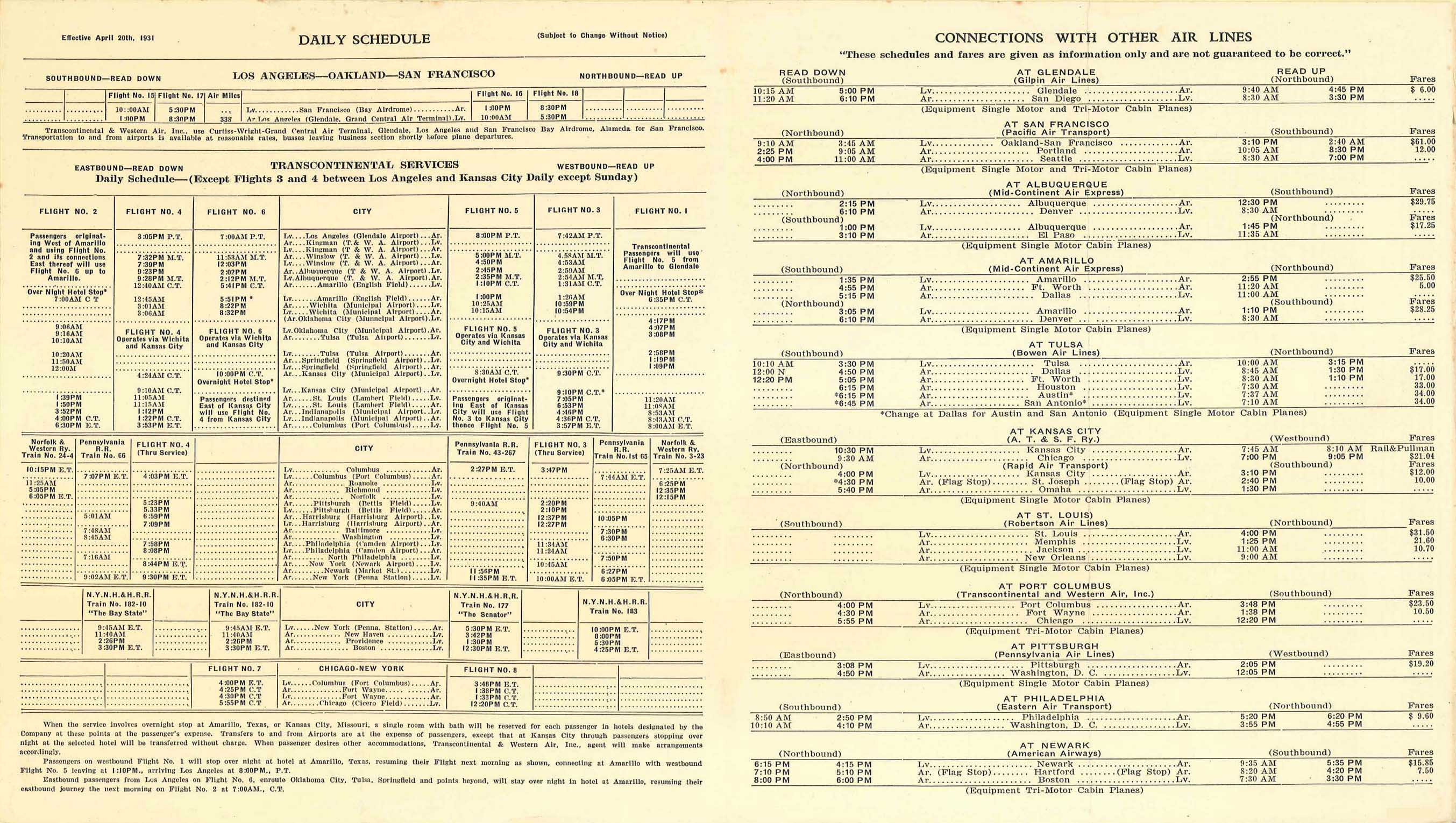
The scheduled flight was from Kansas City to Los Angeles, with a stopover in Wichita.Although many recent sources refer to this as "Flight 599" (for example, page 35 of College Football's Great Dynasties: Notre Dame by Roland Lazenby, published in 1991), this seems to be a corruption; older sources, along with other recent sources, refer to it as "Flight 5" (an older example is page 127 of The Only Way to Fly: the Story of Western Airlines, America's Senior Air Carrier by Robert J. Serling, published in 1976). Transcontinental & Western Air's own timetables from this period have no "Flight 599" or any flight numbers with more than two digits, and its transcontinental flights all have one-digit numbers, as can be seen in Airline Timetable Images' scans of T&WA's February 1, 1931 and April 20, 1931 timetables. The latter timetable includes a "Flight No. 5" with the same route and schedule as the flight which crashed. On this first leg, the wooden structure of one wing failed, causing the plane to crash, killing all eight people on board, including Notre Dame football coach Knute Rockne.
The investigation found that the wooden wing became moist over time, causing the glue connecting the wing to the fuselage to weaken, allowing the wing to separate. The crash brought about significant changes in airplane safety and the airplane industry. The death of Rockne and the crash's effect on the public perception of the safety of aircraft contributed to its cultural significance.
The crash
The Transcontinental and Western Air flight was a Fokker F.10 Trimotor en route from Kansas City to Los Angeles on March 31, 1931. a few miles southwest of Bazaar; all eight on board died, including famed football coach Knute Rockne, of the University of Notre Dame.
Questions have been raised about the exact sequence of events in the crash, and eyewitness accounts raise further questions about the exact sequence of events and the associated technical analysis.
Numerous factors complicated the subsequent investigation, resulting in difficulty establishing, with certainty, the cause of the crash. The investigation was initially undermined by a severe shortage of evidence: When government investigators first arrived at the crash site, they found that most of the wreckage had been taken by souvenir hunters and scavengers, leaving only engines, wings and propeller.
Among the issues speculated is that the craft may have been dealing with turbulence, or icing on the aircraft, or both—which could have resulted in flying conditions that may have led to control difficulty, and an overstressing of the wing. (As evidence, some cite the co-pilot's radio call to Wichita, an hour into the flight, saying, "The weather here is getting tough. We're going to turn around and go back to Kansas City.") Later theories conclude that the pilots thought their difficulty controlling the plane was due to clear-air turbulence, and the transmission was sent before they were aware of the wing's deficiency, if indeed they ever knew before the wing failed.
It is often claimed that the flight went down in or shortly after a thunderstorm, but meteorological records show that there was no significant convective activity at the time.
The late morning accident was arguably caused by the composition of the aircraft. The wings of Fokker Trimotors were manufactured out of wood laminate; in this instance, moisture had leaked into the interior of one wing over a period and had weakened the glue bonding the structure. One spar finally failed; the wing developed uncontrolled flutter and separated from the aircraft. In any case, the structural condition of the wooden wing is widely agreed to have been at least a significant contributory factor.
Public impact and aviation legacy
Although the accident is best known for causing the death of Rockne, it also led to major changes in American aviation that radically transformed airline safety worldwide. Other comparable crashes had occurred before, but this one, which killed a popular national hero, brought a national outcry for getting "answers to the mystery" as the public demanded solutions that might prevent such disasters in the future.
Rockne mourned and questions raised
The most notable person aboard was Knute Rockne, head football coach at the University of Notre Dame and a national hero. Revered as more than simply the football coach with the most wins to his credit of all time, Rockne—famed for coaching his players towards both victory and morality—was a beloved figure at the start of the Great Depression. Despite his Norwegian immigrant origins, he was regarded as the "All-American" icon of virtuous strength and honorable success.
Rockne, 43, was on his way to Los Angeles to participate in the production of the Hollywood motion picture The Spirit of Notre Dame (released October 13, 1931). A father of four, Rockne had stopped over in Kansas City to visit his two eldest children, sons Bill and Knute, Jr., in boarding school there at Pembroke Hill.
The sudden, dramatic death of Rockne startled the nation, and triggered a national outpouring of grief, comparable to the deaths of presidents. President Herbert Hoover called Rockne's death "a national loss." Thousands from around the world gathered at the funeral,
Driven by the public feeling for Rockne, the crash story played out at length in nearly all of the nation's newspapers and gradually evolved into national demand for a public inquiry into the causes and circumstances of the crash.
Airline regulation and operations
At first, the crash brought changes to the operations of both TWA and the Aeronautics Branch of the US Department of Commerce, forerunner of the American Federal Aviation Administration (FAA).
All Fokker Trimotors in U.S. airline service were temporarily grounded, and they were henceforth required to undergo more frequent and rigorous inspections and maintenance. The expense of this, compounded with the bad publicity associated with Rockne's death, almost sank TWA, while aircraft manufacturer Fokker suffered a serious blow to its reputation and sales.
The intense public interest in the cause of the accident forced the Department of Commerce to abandon its policy of keeping the results of aircraft crash investigations secret.
Many references claim that the accident was also the impetus for the formation of the Civil Aeronautics Board (CAB), an independent investigative organization and the predecessor of the National Transportation Safety Board, but the CAB was not formed until 1940, five years after an accident involving US Senator Bronson M. Cutting underlined the department's conflicts of interest with respect to their associations with airlines and their provision and maintenance of navigational aids.
Nevertheless, the Rockne crash created a public expectation for the U.S. government to provide objective reviews of crashes and public release of the findings, beginning the tradition of public air crash investigation reports, which began to pinpoint and publicize blame for accidents, forcing safety improvements by both government and industry.
Aircraft design and technology
The disaster discredited wood-framed aircraft, and it effectively forced airlines to adopt all-metal aircraft. The result was a leap forward in aircraft design quality and safety, as manufacturers developed advanced all-metal designs under pressure from the airlines. Various aircraft safety innovations were proposed and promoted, largely in response to the crash. Overall, the success and/or development of three key aircraft in aviation history were driven largely by the Rockne crash:
-
Ford Trimotor :Airlines first turned to the all-metal Ford Trimotor—a slow, boxy three-engined aircraft similar to the Fokker but all-metal and already available and in use at the time. Though slower than the Fokker and far more costly to build, the Ford offered sturdy all-metal construction and (in some cases) greater capacity.
-
Boeing 247 :Boeing developed the first truly modern airliner, the Boeing 247, which ushered in key design features now common in most airliners:
:*hollow-shell ("monocoque") all-metal design (aluminum), for light and streamlined aircraft structure, :*retractable landing gear (significant streamlining, and greater speed/efficiency), :*NACA engine cowling (significant streamlining, and greater speed/efficiency), :*supercharged engines, forcing pressurized air into the engines thereby increasing power, and enabling operation in thinner air at higher altitudes, above some weather, :*sufficient reserve engine power to allow safe takeoff with a full load on only one engine (of multiple engines), in the event of an engine failure at takeoff (time of highest likelihood for engine failure), :*controllable-pitch propellers (like a continuously-variable transmission on an automobile, allowing a wider range of flying speeds, more thrust for takeoff, and more efficient propulsion, improving performance), on later models, starting with 247D, and :*de-icing equipment.
- Douglas DC-2/Douglas DC-3: :The Boeing 247 would soon be utterly eclipsed by another plane designed in response to the Rockne crash, the Douglas DC-2/Douglas DC-3. The most important commercial aircraft of all time, the Douglas DC-3 was developed initially as the Douglas DC-1/Douglas DC-2 to fill TWA's demand for an all-metal replacement for their suddenly-obsolete trimotor aircraft.
:United Airlines (under United Aircraft, which was also the parent company of Boeing, at the time) had monopolized all Boeing 247 production, forcing TWA to look elsewhere to modernize their fleet from the wooden Fokkers and clunky Fords; the Douglas DC-2 was the result. The DC-2 took all the advances of the Boeing 247 a step further with greater speed, range, and payload which evolved with the rounding of its fuselage into the wider 21-seat DC-3, which became the first airliner to truly make airlines profitable. The DC-3 revolutionized the affordability, availability and safety of air travel — triggering an "explosion" in airline travel to seven times the volume within a few years of the Rockne crash. Most of the world's air travel was in DC-3s by the start of World War II (in which the DC-3 became the most successful military transport). The DC-3 launched regional airlines in the postwar years, and it remained a powerful force in spreading aviation's benefit for the rest of the century, with some still flying today.
Airline safety revolution
With these superior, safer aircraft matched to greatly increased and more public government inspection and regulation of aviation, crash rates plummeted to a tiny fraction of those of the wooden airliner years.
Today, the legacy of the crash is simply that the most dangerous way to travel in 1931—airlines—radically transformed into what has now become the safest way to travel.
Memorials and commemorations
The Knute Rockne Memorialmemorial at the crash site near Bazaar, Kansas, memorializes Rockne and the 7 others who died with him. The tall, engraved-granite marker, a memorial dedicated to the victims and topped with the name "Rockne", stands surrounded by a wire fence with wooden posts; it was maintained for many years by James Easter Heathman, who died in 2008, who, at age 13 in 1931, was one of the first people to arrive at the site of the crash.
Now part of the Heathman family estate, the memorial and crash site are on private property, off-road, and accessible only by arrangementarrangement with the landowners, or during memorial commemorations. A memorial ceremony is held at the crash site memorial (and at a nearby schoolhouse) every five years since the crash, drawing relatives of the victims, and Rockne / Notre Dame fans, from around the world. In 2011, on the 80th anniversary of the crash, over 150 people gathered, including former Football Hall of Fame director Bernie Kish. Speeches were made, a bagpipe played, and a small plane flew over the crowd at the crash site, on the exact minute of the crash.
The Matfield Green rest stop and travel plaza on the Kansas Turnpike near Bazaar and the crash site used to have a large, glassed-in exhibit on the west side of its center foyer commemorating Rockne (chiefly), as well as the other crash victims, and the crash.
The passengers and crew of the flight were K. Rockne, H. J. Christansen (Chicago), J. H. Hooper (Chicago), W. B. Miller (Hartford, Conn.), F. Goldthwaite (New York), C. A. Lobrech (Chicago), Pilot Robert Fry, and Co-Pilot Jess Mathias.
Notes
References
References
- (March 31, 1931). "Rockne killed in air crash". Lawrence Daily Journal-World.
- (March 31, 1931). "Report Knute Rockne killed in plane crash". Spokane Daily Chronicle.
- (April 1, 1931). "Rockne's tragic death". Milwaukee Sentinel.
- (April 1, 1931). "Sorrow shrouds Notre Dame faculty and students with passing of Knute Rockne". Spokane Daily Chronicle.
- (31 March 2001). "The Legacy of the Rockne Crash". [[Aeroplane (magazine).
- Harris, Richard. (2011). "Fans, Family Remember the Crash Heard 'Round the World".
- Sumwalt, Robert L. (former Chairman, [[National Transportation Safety Board. NTSB]]), [https://www.ntsb.gov/news/speeches/RSumwalt/Pages/Sumwalt_070822.aspx "Remarks To The Chief Aircraft Accident Investigators Programme Of Air Accident Investigation Bureau of Singapore And Singapore Aviation Academy, Singapore, Republic Of Singapore,"], August 22, 2007, as transcribed at [[National Transportation Safety Board]], retrieved April 10, 2019
- link. (2014-02-23 satellite-sightseer.com)
- Schatzberg, Eric. (1999). "Wings of Wood, Wings of Metal: culture and technical choice in American airplane materials, 1914-1945". Princeton University Press.
- (April 5, 1931). "Bury Rockne near scene of triumphs". Pittsburgh Press.
- [http://www.knuterockne.com/index.php The Official Knute Rockne Web Site] {{Webarchive. link. (2013-08-24 . URL accessed 03:54, 29 January 2006 (UTC))
- Hoover, Herbert, President of the United States, message to Mrs. Knute Rockne, 119 - [http://www.presidency.ucsb.edu/ws/index.php?pid=22587#axzz1IRLvgIhD "Message of Sympathy on the Death of Knute Rockne"], April 1, 1931, Washington, D.C., cited on the web site of The American Presidency Project
- Mickelson, Paul. (April 5, 1931). "Throngs escort Rockne to grave". Milwaukee Sentinel.
- which was broadcast around the globe.[http://125.nd.edu/moments/the-last-flight-of-knute-rockne/ "The Last Flight of Knute Rockne"] web page, in "Moments" section of "125 Football" website, University of Notre Dame: photos of funeral, newspaper clippings, video of Irish coach Ara Parseghian's boyhood reminiscence about the tragedy.
- Lindquist, Sherry C.M., "[https://www.jstor.org/discover/10.1086/665045 Memorializing Knute Rockne at the University of Notre Dame: Collegiate Gothic Architecture and Institutional Identity]", in ''Winterthur Portfolio, '' Vol_ 46, No_ 1 (Spring 2012), pp_ 1-24 on JSTOR.org
- Johnson, Randy, M.A. (Ph.D. candidate, Ohio Univ., Athens, OH; certified airline transport pilot and flight instructor), "The 'Rock': The Role of the Press in Bringing About Change in Aircraft Accident Policy.", ''Journal of Air Transportation World Wide,'' Vol. 5, No. 1, 2000, Aviation Institute, University of Nebraska at Omaha.
- O'Leary, Michael, "The Plane that Changed the World", Part 1., ''Air Classics'', vol.46, no.10, Nov.2010, pp.28-48, including sidebar: "Effects of the Rockne Crash".
- [http://blog.modernmechanix.com/rockne-plane-crash-inspires-safety-inventions/ "Rockne Plane Crash Inspires Safety Inventions"] {{Webarchive. link. (2012-05-30 ,''Modern Mechanix'', July 1931)
- Eckert William G. . (March 1982). "The Rockne crash: American commercial air crash investigation in the early years". American Journal of Forensic Medicine and Pathology.
- [http://www.tc.faa.gov/its/worldpac/techrpt/ar0839.pdf ''History of Aviation Safety Oversight in the United States''], DOT/FAA/AR-08/39, Air Traffic Organization, Operations Planning, Office of Aviation Research and Development, Federal Aviation Administration, U.S. Department of Transportation, Washington, DC 20591, Final Report July 2008
- Bryan, C.D.B., ''The National Air and Space Museum, 5th printing'', the Smithsonian Institution—National Air and Space Museum, Washington, DC / Harry N. Abrams, Inc., NY - 1985/1979
- Schatzberg, Eric, (b.1956) [http://digicoll.library.wisc.edu/cgi-bin/HistSciTech/HistSciTech-idx?type=turn&entity=HistSciTech.WingsWood.p0133&id=HistSciTech.WingsWood&isize=text ''Wings of wood, wings of metal : culture and technical choice in American airplane materials, 1914-1945,''] (c1999), Chapter 5: "Metal and commercial aviation i: Henry Ford takes flight," pp.96-113, on the ''History of Science and Technology'' website of the University of Wisconsin, USA
- Mansfield, Harold, ''VISION: The Story of Boeing,'' Popular Library, NY, 1966
- Redding, Robert and Bill Yenne, "The Flying Pullmans" in ''Boeing: Planemaker to the World,'' Bison/Crescent/Crown, Greenwich, Connecticut, USA, 1983
- Allen, Frederick, [http://industrialarticles.industrialartifactsreview.com/1988_I&T_Fall_DC3.htm "The Letter that Changed the Way We Fly"],{{Dead link. (September 2018)
- Sudekum Fisher, Maria. (2008-02-01). "J. E. Heathman; found crash that killed Rockne". [[Boston Globe]].
- Stu Beitler. (November 3, 2007). "Knute Rockne and others Killed in Plane Crash, Mar 1931".
This article was imported from Wikipedia and is available under the Creative Commons Attribution-ShareAlike 4.0 License. Content has been adapted to SurfDoc format. Original contributors can be found on the article history page.
Ask Mako anything about 1931 Transcontinental & Western Air Fokker F-10 crash — get instant answers, deeper analysis, and related topics.
Research with MakoFree with your Surf account
Create a free account to save articles, ask Mako questions, and organize your research.
Sign up freeThis content may have been generated or modified by AI. CloudSurf Software LLC is not responsible for the accuracy, completeness, or reliability of AI-generated content. Always verify important information from primary sources.
Report