From Surf Wiki (app.surf) — the open knowledge base
1926 Soviet census
none
none
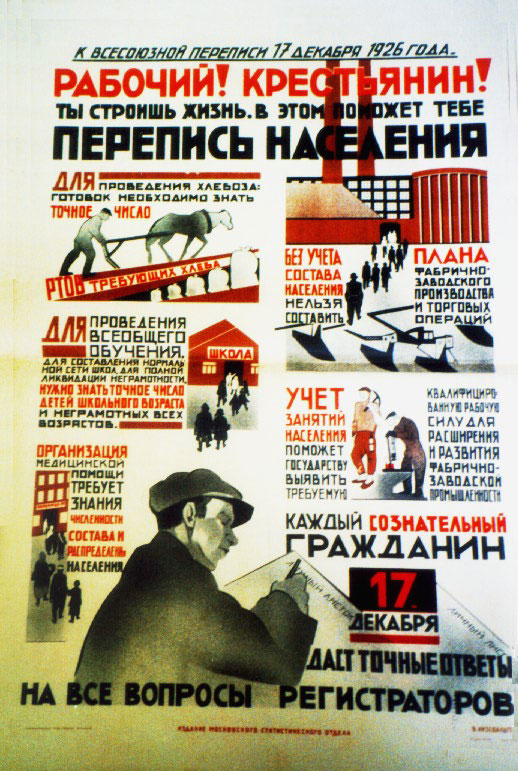
The 1926 Soviet census (, All-Union census), conducted in December 1926, was the first comprehensive all-Union census in the Soviet Union. It served as a critical instrument in the nation-building efforts of the USSR, furnishing the government with vital ethnographic data. This census played a significant role in the societal shift from the Imperial Russian era to the Soviet period. The methodologies employed by ethnographers in defining individual ethnicity (narodnost), particularly in creating the "List of Ethnicities of the USSR" and delineating borders in ethnically mixed regions, profoundly shaped Soviet policies. Ethnographers, statisticians, and linguists not only designed questionnaires and ethnicity lists but also aimed to actively reshape identities according to Marxism–Leninism. As Anastas Mikoyan stated, the Soviet Union was engaged in "creating and organising new nations".
Previous Censuses
Prior to the 1926 all-Union census, the Bolsheviks had conducted two partial censuses after their rise to power in Russia. The first, the general census of 1920, occurred amidst the Civil War and the Soviet-Polish War. Consequently, it could not cover the Crimea, substantial parts of Transcaucasia, the Ukraine, the Byelorussia, as well as Far Eastern, Siberian, Central Asian, and Far Northern territories. Notably, there was a population increase of only 15,000,000 between 1920 and 1926, reaching approximately 131,304,931 people according to TIME magazine, a figure still not widely disclosed in Russian historical accounts. The 1923 Census was limited to urban areas. Before the Russian Revolution, the sole Russian Empire Census was conducted in 1897.
Methodology
The census classified the population by narodnosti (nationalities), a departure from categories like tribe or clan. This classification, combined with policies that allocated land, resources, and rights to these defined nations, led to interference in data collection by experts and local elites.
Delegations from the Georgian SSR and Ukrainian SSR raised concerns about the census's formulation of narodnosti. The Georgian delegation advocated for classifying the population by natsionalʹnosti, believing it more appropriate for developed nations like Georgians. Ukrainian representatives favored using native language as the basis for classification instead of nationality. However, these objections did not result in changes to the methodology.
Responses regarding nationality were sometimes altered by census takers or later by state analysts to ensure "correctness." It was believed that individuals might "confuse" nationality with other categories such as place of residence, native language, or clan.
Census Results
Composition of the USSR
The following table provides an overview of the population and territory of the Soviet Republics in 1926:
| No. | Soviet | ||||||||||||||
|---|---|---|---|---|---|---|---|---|---|---|---|---|---|---|---|
| Republic | Territory (km2) | Population | Urban Population | Male Population | Ethnic Russians | Ethnic Ukrainians | Titular Ethnicity | Total | 21 176 187 | 147 027 915 | 26 314 114 | 71 043 352 | 77 791 124 | 31 194 976 | |
| 1 | RSFSR | 19 651 446 | 100 891 244 | 17 442 655 | 48 170 635 | 74 072 096 | 7 873 331 | ||||||||
| 2 | UkSSR | 451 584 | 29 018 187 | 5 373 553 | 14 094 592 | 2 677 166 | 23 218 860 | ||||||||
| 3 | BSSR | 126 792 | 4 983 240 | 847 830 | 2 439 801 | 383 806 | 34 681 | 4 017 301 | |||||||
| 4 | Transcaucasian SFSR | 185 191 | 5 861 529 | 1 410 876 | 3 009 046 | 336 178 | 35 423 | 1 797 960 | |||||||
| 5 | Uzbek SSR | 311 476 | 5 272 801 | 1 102 218 | 2 797 420 | 246 521 | 25 804 | 3 475 340 | |||||||
| 6 | Turkmen SSR | 449 698 | 1 000 914 | 136 982 | 531 858 | 75 357 | 6877 | 719 792 |
For the Transcaucasian Socialist Federative Soviet Republic, Georgians were considered the Titular Nationality.
Population of the USSR by Republics
- Russian SFSR – 100,891,244 (urban 17,442,655)
- Kazakh ASSR – 6,503,006 (urban 539,249)
- Kirghiz ASSR – 993,004 (urban 121,080)
- Ukrainian SSR – 29,018,187 (urban 5,373,553)
- Moldavian ASSR – 572,114
- Uzbek SSR – 5,272,801 (urban 1,102,218)
- Tajik ASSR – 827,200
- Byelorussian SSR – 4,983,240 (urban 847,830)
- Transcaucasian SFSR
- Georgian SSR – 2,666,494 (urban 594,221)
- Azerbaijan SSR – 2,314,571 (urban 649,557)
- Armenian SSR – 880,464 (urban 167,098)
- Turkmen SSR – 1,000,914 (urban 136,982)
- Total in the Soviet Union – 147,027,915 (urban 26,314,114)
Population of the USSR Sorted by Most Common Nationalities in 1926
| USSR | RSFSR | Ukrainian SSR | Byelorussian SSR | TSFSR | Uzbek SSR | Turkmen SSR | ||||||||
|---|---|---|---|---|---|---|---|---|---|---|---|---|---|---|
| Total | ||||||||||||||
| Russians | ||||||||||||||
| Ukrainians | ||||||||||||||
| Belorussians | ||||||||||||||
| Georgians | ||||||||||||||
| Armenians | ||||||||||||||
| Turks | ||||||||||||||
| Uzbeks | ||||||||||||||
| Turkmen | ||||||||||||||
| Kazakhs | ||||||||||||||
| Kirghiz | ||||||||||||||
| Tatars | ||||||||||||||
| Chuvash | ||||||||||||||
| Bashkirs | ||||||||||||||
| Yakuts | ||||||||||||||
| Karakalpaks | ||||||||||||||
| Tajiks | ||||||||||||||
| Ossetians | ||||||||||||||
| Talysh | ||||||||||||||
| Tats | ||||||||||||||
| Kurds | ||||||||||||||
| Mordva | ||||||||||||||
| Mari | ||||||||||||||
| Karelians | ||||||||||||||
| Udmurts | ||||||||||||||
| Komi | ||||||||||||||
| Permyaks | ||||||||||||||
| Buryats | ||||||||||||||
| Kalmyks | ||||||||||||||
| Germans | ||||||||||||||
| Jews | ||||||||||||||
| Poles | ||||||||||||||
| Greeks | ||||||||||||||
| Vainakhs | ||||||||||||||
| Moldavians | ||||||||||||||
| Bulgarians | ||||||||||||||
| Latvians | ||||||||||||||
| Lithuanians | ||||||||||||||
| Abkhazians |
List of Ethnicities
This list, officially titled ru, vol. 7, ru, Moscow 1927, was compiled by the Central Statistical Administration of the USSR in preparation for the census.
- Russian – 77 791 124
- Ukrainian – 31 194 976
- Belarusian – 4 738 923
- Polish – 782 334
- Czech
- Slovak
- Serb
- Bulgarian – 111 296
- Latvian – 151 410
- Lithuanian – 41 463
- Latgalian
- Samogitian (Zhmud)
- German – 1 238 549
- British
- Swedish
- Dutch
- Italian
- French
- Romanian – 278 903
- Moldavians – 278 903
- Greek – 213 765
- Albanian (Arnaut)
- Jewish (Ashkenazi) – 2,599,973
- Crimean Jewish – 6,383
- Mountain Jewish (Dag Chufut) – 25,974
- Georgian Jewish – 21,471
- Bukharan Jewish (Dzhugur) – 18,698
- Karaim – 8,324
- Finnish
- Leningrad Finnish (Chukhontsy)
- Karelian
- Tavastian
- Estonian – 154 666
- Vepsian (Chud)
- Vod (Vote)
- Izhorian (Ingrian)
- Kven
- Lopars (Sami people)
- Zyrian
- Permyak
- Udmurt (Votiak)
- Besermyan
- Mari (Cheremis)
- Mordva (Moksha, Erzya, Teryukhan, Karatai)
- Magyar (Hungarian)
- Gagauz
- Chuvash – 1 117 419
- Tatar – 2 916 536
- Mishar (Meshcheriak)
- Bashkir – 713 693
- Nagaybak
- Nogai
- Gypsy
- Kalmyk
- Mongol
- Buryat
- Sart-Kalmyk
- Mansi (Vogul)
- Khanty (Ostyak)
- Selkup (Ostyak-Samoyed)
- Nenets (Samoyed)
- Yurak
- Soyot (Uriankhai)
- Barabin (Barbara Tartar)
- Bukharan (Bukharlyk)
- Chernevyy Tatar (Tubalar, Tuba-Kizhi)
- Altai (Altai-Kizhi, Mountain or White Kalmyk)
- Teleut
- Telengit (Telengut)
- Kumandin (Lebedin, Ku-Kohzi)
- Shors
- Kharagas (Tuba, Kharagaz)
- Kızıl (Kyzyl)
- Kachin
- Sagai
- Koybal
- Beltir
- Dolgan (Dolgan-Iakut)
- Yakut (Sakha, Urangkhai-Sakha) – 240 709
- Tungus (Ovenk, Murchen)
- Lamut
- Orochon
- Golds (Nanai people)
- Olchi (Mangun, Ulchi)
- Negidal (Negda, Eleke Beye)
- Orochi
- Udegei (Ude)
- Orok
- Manegir - 59 persons. A former division of Evenks. They lived along the Kumara River, hence an alternative designation, "Kumarchen"
- Samogir (Самогиры), Nanai people Tungusic people
- Manchurian
- Chukchi
- Koryaks
- Kamchadal (Itel'men)
- Gilyak (Nivkhi)
- Yukagir
- Chuvan
- Aleut
- Eskimo
- Enisei (Ket, Enisei Ostiak)
- Aino (Ainu, Kuchi)
- Chinese
- Korean
- Japanese
- Georgian (Kartvelian) – 1 821 184
- Ajar
- Megeli (Mingrelian)
- Laz (Chan)
- Svan (Svanetian)
- Abkhaz (Abkhazian) – 56 957
- Cherkess (Adyghe)
- Beskesek-Abaza (Abazin)
- Kabard
- Ubykh
- Chechen (Nakh, Nakhchuo)
- Ingush (Galgai, Kist)
- Batsbi (Tsova-Tish, Batswa)
- Maistvei (Майствеи), combined into Chechen people
- Lezgin
- Tabasaran
- Agul
- Archi
- Rutul (Mykhad)
- Tsakhur
- Khinalug
- Dzhek (Dzhektsy)
- Khaput (Gaputlin, Khaputlin)
- Kryz
- Budukh (Budug)
- Udin
- Dargin
- Kubachin (Ughbug)
- Lak (Kazi-Kumukh)
- Avar (Avartsy, Khunzal)
- Andi (Andiitsy, Kwanally)
- Botlog (Buikhatli)
- Godoberi
- Karatai
- Akhvakh
- Bagulal (Kvanandin)
- Chamalal
- Tindi (Tindal, Idera)
- Didoi (Tsez)
- Kvarshi
- Kapuchin (Bezheta)
- Khunzal (Enzebi, Nakhad)
- Armenian – 1 567 568
- Hemshin
- Arab
- Aisor (Assyrian)
- Kaytak (Karakaitak)
- Bosha (Karachi, Armenian Gypsy)
- Ossetian – 272 272
- Kurd
- Yazid
- Talysh
- Tat
- Persian
- Karachai
- Kumyk
- Balkar (Mountain Tartar, Malkar)
- Karakalpak
- Turk
- Ottoman Turk (Osmanli)
- Samarkand and Fergana Turk
- Turkmen – 763 940
- Kirgiz (Kyrgyz, Kara-Kirgiz)
- Karakalpak – 146 317
- Kypchak
- Kashgar
- Taranchi
- Kazakh (Kirgiz-Kazakh, Kirgiz-Kaisak) – 3 968 289
- Kurama
- Uzbek – 3 904 622
- Dungan
- Afghan
- Tajik – 978 680
- Vakhan
- Shugnan
- Yagnob
- Yazgul
- Iranian
- Jemshid
- Beludji
- Berber
- Khazara (Hazaras)
- Hindu (Indian)
- Other ethnicities
- Ethnicities not noted or noted inexactly
Ask Mako anything about 1926 Soviet census — get instant answers, deeper analysis, and related topics.
Research with MakoFree with your Surf account
Create a free account to save articles, ask Mako questions, and organize your research.
Sign up freeThis content may have been generated or modified by AI. CloudSurf Software LLC is not responsible for the accuracy, completeness, or reliability of AI-generated content. Always verify important information from primary sources.
Report