From Surf Wiki (app.surf) — the open knowledge base
1926 Lithuanian coup d'état
1926 military coup d'état in Lithuania
1926 military coup d'état in Lithuania
| Field | Value |
|---|---|
| date | 17 December 1926 |
| place | Kaunas |
| coordinates | |
| result | Coup successful |
| combatant1 | Lithuania Government of Lithuania |
| combatant2 | Flag of the Lithuanian Armed Forces (obverse).png Lithuanian Armed Forces |
| commander1 | Mykolas Sleževičius |
| Kazys Grinius | |
| commander2 | Povilas Plechavičius |
| Antanas Smetona | |
| polstrength1 | Social Democratic Party of Lithuania |
| Lithuanian Popular Peasants' Union | |
| polstrength2 | Lithuanian Nationalist Union |
| Lithuanian Christian Democratic Party | |
| casualties1 | Hundreds arrested; four communists executed |
- President Kazys Grinius replaced by Antanas Smetona
- Prime Minister Mykolas Sleževičius replaced by Augustinas Voldemaras
- Third Seimas dissolved and constitution suspended in March 1927
- Lithuanian Nationalist Union gains power Kazys Grinius Antanas Smetona Lithuanian Popular Peasants' Union Lithuanian Christian Democratic Party
The 1926 Lithuanian coup d'état (Lithuanian: 1926-ųjų perversmas) was a military coup d'état in Lithuania that replaced the democratically elected government with a authoritarian regime led by Antanas Smetona. The coup took place on 17 December 1926 and was largely organized by the military; Smetona's role remains the subject of debate. The coup brought the Lithuanian Nationalist Union, the most conservative party at the time, to power. Previously it had been a fairly new and insignificant nationalistic party. By 1926, its membership reached about 2,000 and it had won only three seats in the parliamentary elections.
Background
Lithuania was incorporated into the Russian Empire in 1795. It was occupied by Germany during World War I, and declared itself independent on 16 February 1918. The next two years were marked by the Lithuanian Wars of Independence, which delayed international recognition and the establishment of political institutions. The newly formed army fought the Bolsheviks, the Bermontians, and Poland. In October 1920, Poland annexed Vilnius, the historic and modern capital of Lithuania, and the area surrounding it; known as Żeligowski's Mutiny, this action caused ongoing tension between the two powers in the interwar period. Lithuania's second-largest city, Kaunas, was designated the interim capital.
The Constituent Assembly of Lithuania elected in April 1920 adopted a constitution in August 1922; elections to the First Seimas took place in October 1922. The most-disputed constitutional issue was the role of the presidency. Eventually, the powers of government were heavily weighted in favor of the unicameral parliament (Seimas). Members of the Seimas were elected for three-year terms. Each new Seimas directly elected the president, who was authorized to appoint a prime minister. The prime minister then confirmed a cabinet of ministers. The presidential term was limited to no more than two three-year terms in succession. |access-date=4 March 2008 |url-status=dead
The principal political actors at the time of the coup had been active in the independence movement and the republic's first few years. Antanas Smetona was Lithuania's first president from April 1919 to June 1920; he then withdrew from formal political involvement, although he published political criticism, for which he served a brief prison term in 1923. |access-date=9 March 2008 |archive-url= https://web.archive.org/web/20080330021611/http://www.president.lt/institution/istorija/1 |archive-date= 30 March 2008 |url-status= live |access-date=10 March 2008 |archive-date=23 April 2017 |archive-url=https://web.archive.org/web/20170423015346/http://www.lituanus.org/1984_3/84_3_06.htm |url-status=dead |access-date=9 March 2008 |archive-url= https://web.archive.org/web/20080330021624/http://www.president.lt/institution/istorija/3 |archive-date= 30 March 2008 |url-status= live |access-date=9 March 2008
1926 parliamentary election
| Results of the [1926 parliamentary election](1926-lithuanian-parliamentary-election) | Party | Seats | Total | 85 |
|---|---|---|---|---|
| last=Eidintas | first=Alfonsas | title=Lietuvos Respublikos prezidentai | year=1991 | publisher=Šviesa |
| Christian Democratic Bloc (*krikdemai*) | 30 | |||
| Peasant Popular Union (*liaudininkai*) | 22 | |||
| Social Democrats (*socdemai*) | 15 | |||
| National Union (*tautininkai*) | 3 | |||
| Farmers' Party | 2 | |||
| Minorities (Germans, Jews, and Poles) | 13 |
Between 8 and 10 May 1926, regular elections to the Third Seimas took place. For the first time since 1920, the bloc led by the Lithuanian Christian Democratic Party, which strongly supported the Roman Catholic Church and its clergy, did not win a majority. The Lithuanian people were disillusioned with this party, whose members had been involved in several financial scandals: Juozas Purickis had used his diplomatic privileges in Moscow to deal in cocaine and saccharin; Eliziejus Draugelis and purchased cheap low-quality smoked pig fat from Germany instead of from Lithuanian farmers; and the minister of finance, Vytautas Petrulis, transferred a large sum of money from the state budget to his personal account. | access-date=23 February 2008 | chapter-url=http://mkp.emokykla.lt/gimtoji/?id=10114 | archive-url=https://web.archive.org/web/20080226131025/http://mkp.emokykla.lt/gimtoji/ | archive-date=26 February 2008 | url-status=dead
An additional tension arose when the Concordat of 1925 between Poland and the Holy See unilaterally recognized Vilnius as an ecclesiastical province of Poland, despite Lithuanian requests to govern Vilnius directly from Rome. It was not traditionally a Vatican policy to establish an arrangement of this type, but the decision was objected to strongly by many Lithuanians. |access-date= 19 June 2010
The Popular Peasants' Union and the Social Democrats formed a left-wing coalition opposing the Christian Democrats. But the coalition still did not constitute a majority, and went on to add representatives of minorities in Lithuania – Germans from the Klaipėda Region, Poles, and Jews. On 7 June, Kazys Grinius was elected the third president of Lithuania and Mykolas Sleževičius became the prime minister. Both were members of the Popular Peasants' Union.
Causes
The reasons for the coup remain the subject of debate.{{cite book |url-access=registration |url=https://archive.org/details/lithuaniarebelna00vard/page/34 |access-date= 19 June 2010
After the May elections, the Grinius/Sleževičius government lifted martial law, still in effect in Kaunas and elsewhere, restored democratic freedoms, and granted broad amnesty to political prisoners. For the first time, Lithuania was truly democratic. However, the change did not meet with universal approval. Many released prisoners were communists who quickly used the new freedoms of speech to organize a protest attended by approximately 400 people in Kaunas on 13 June, a day after the acquittal of 92 members of the Workers' Group of Lithuania.{{cite thesis |access-date=30 October 2023 |archive-date=14 October 2022 |archive-url=https://web.archive.org/web/20221014051947/https://gs.elaba.lt/object/elaba:15956719/15956719.pdf |url-status=dead
Further allegations of "Bolshevization" came after Lithuania signed the Soviet–Lithuanian Non-Aggression Treaty of 28 September 1926. The treaty had been conceived by a previous government dominated by Christian Democrats. However, the Christian Democrats voted against the treaty and Antanas Smetona strongly supported it. It drew sharp criticism, as Lithuania exchanged Soviet recognition of its rights to the Vilnius for international isolation; the treaty demanded that Lithuania make no alliances with other countries. At the time, the Soviet Union was not a member of the League of Nations. France and the United Kingdom were looking for reliable partners in Eastern Europe, and the Baltic states were contemplating a union of their own.
Another public outcry arose when the government, seeking the support of ethnic minorities, allowed the opening of over 80 Polish schools in Lithuania. At the time, the Polish government was closing Lithuanian schools in the fiercely contested Vilnius Region. The coalition government directly confronted the Christian Democrats when it proposed a 1927 budget that reduced salaries to the clergy and subsidies to Catholic schools. Further controversies were created when the government's military reform program was revealed as careless downsizing. Some 200 conservative military officers were fired. The military began planning the coup.
Preparations
Academics have debated the involvement of Antanas Smetona in planning the coup. In 1931 Augustinas Voldemaras, since ousted from the government and forced into exile, wrote that Smetona had planned the coup since 1925. Historian asserted that the idea of a coup had been raised as early as 1923. However, the time frame is disputed, since the military did not take action until the autumn of 1926. Smetona's personal secretary, , held that Smetona knew about the coup, but neither inspired nor organized it.
On 20 September 1926, five military officers led by Captain organized a committee which included generals Vladas Nagevičius and Jonas Bulota among its members. About a month later, another group, the so-called Revolutionary General Headquarters (Lithuanian: revoliucinis generalinis štabas) was formed. The two groups closely coordinated their efforts. By 12 December, the military had already planned detailed actions, scouted the areas where the action was to take place, and informed the leaders of the Lithuanian National Union and Christian Democratic parties. Rumors of the plan reached the Social Democrats, but they took no action. Just before the coup, disinformation about movements of the Polish army in the Vilnius Region was disseminated; its purpose was to induce troops in Kaunas that could potentially have opposed the coup to move towards Vilnius.
The coup
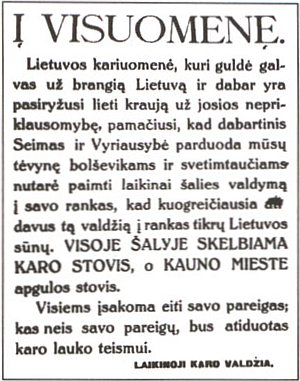
Late in the evening of 16 December, the Soviet consul informed Sleževičius about a possible coup the following night, but Sleževičius did not pay much attention to this warning.
Smetona and Voldemaras, both representing the Lithuanian National Union, invited the Christian Democrats to join them in forming a new government that would restore some degree of constitutional legitimacy. The party agreed reluctantly; they were worried about their prestige. Looking toward the near future, the Christian Democrats reasoned that they could easily win any upcoming Seimas elections and regain power by constitutional means and avoid direct association with the coup. In keeping with this strategy, they allowed members of the Lithuanian National Union to take the most prominent posts.
Initially, President Grinius refused to resign, but he was eventually persuaded that a Polish invasion was imminent and Smetona had sworn to uphold the constitution. On 19 December 42 delegates of the Seimas met (without the Social Democrats or the Peasant Popular Union) and elected Aleksandras Stulginskis as Speaker of the Seimas. Stulginskis was the formal head of state for a few hours before Smetona was elected president (38 deputies voted for, two against, and two abstained). The Seimas also passed a vote of confidence in the new cabinet formed by Voldemaras. Constitutional formalities were thereby observed. The Lithuanian National Union secured other major roles: Antanas Merkys assumed office as minister of defense and Ignas Musteikis as minister of the interior.
Aftermath
The military claimed that their actions had prevented an imminent Bolshevik coup, allegedly scheduled for 20 December. Martial law was declared. About 350 communists were arrested, and four leaders (Karolis Požela, Juozas Greifenbergeris, Kazys Giedrys and Rapolas Čarnas) were executed on 27 December. This was a serious blow to the Communist Party of Lithuania and it was inactive for a time. No concrete evidence was ever found that the communists had planned any coups. Other political parties and organizations were not brutalized and, according to the military, no casualties were associated with the coup, apart from the four executions. However, other sources cite Captain Vincas Jonuška, allegedly shot by the guards of the Presidential Palace, who died a day later in a hospital.
International recognition of the new government did not prove difficult. Western powers were not pleased with the Third Seimas, which had ratified the non-aggression treaty with the Soviet Union in September. They were looking for a change in the priorities of Lithuanian foreign policy. It was therefore not surprising that the British, in The Daily Telegraph, the French, in Le Matin, and the United States, in The New York Times wrote that the coup was expected to curtail friendly relations with the Soviet Union and normalize relations with Poland; the anti-democratic and unconstitutional nature of the coup was not emphasized. |chapter-url=https://books.google.com/books?id=olpKYhgrS48C&pg=PA299 |first=Algimantas | access-date= 19 June 2010
Christian Democrats, believing that the coup was merely a temporary measure, demanded that new elections to the Seimas be held, but Smetona stalled. He predicted that his party would not be popular and that he would not be re-elected president.
The 1926 coup was a major event in interwar Lithuania; the dictatorship went on for 14 years. In 1935, the Smetona government outlawed all other political parties. The coup continued to be a difficult issue for Lithuanians, since the Soviet Union went go on to describe its subsequent occupation of Lithuania as a liberation from fascism. Encyclopædia Britannica, however, describes the regime as authoritarian and nationalistic rather than fascist, |access-date=20 March 2008 |archive-url=https://archive.today/20120630094141/https://edit.britannica.com/getEditableToc?tocId=37259 |archive-date=30 June 2012 |url-status=dead |(In Lithuanian) Mindaugas, Tamošaitis The coup's apologists have described it as a corrective to an extreme form of parliamentarianism, justifiable in light of Lithuania's political immaturity. |access-date= 19 June 2010
References
References
This article was imported from Wikipedia and is available under the Creative Commons Attribution-ShareAlike 4.0 License. Content has been adapted to SurfDoc format. Original contributors can be found on the article history page.
Ask Mako anything about 1926 Lithuanian coup d'état — get instant answers, deeper analysis, and related topics.
Research with MakoFree with your Surf account
Create a free account to save articles, ask Mako questions, and organize your research.
Sign up freeThis content may have been generated or modified by AI. CloudSurf Software LLC is not responsible for the accuracy, completeness, or reliability of AI-generated content. Always verify important information from primary sources.
Report