Zaslavskii map
Dynamical system that exhibits chaotic behavior
title: "Zaslavskii map" type: doc version: 1 created: 2026-02-28 author: "Wikipedia contributors" status: active scope: public tags: ["chaotic-maps"] description: "Dynamical system that exhibits chaotic behavior" topic_path: "general/chaotic-maps" source: "https://en.wikipedia.org/wiki/Zaslavskii_map" license: "CC BY-SA 4.0" wikipedia_page_id: 0 wikipedia_revision_id: 0
::summary Dynamical system that exhibits chaotic behavior ::
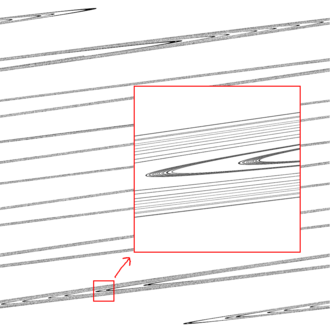
::figure[src="https://upload.wikimedia.org/wikipedia/commons/7/7c/Zaslavskii_map.png" caption="'''Zaslavskii map''' with parameters: \epsilon=5, \nu=0.2, r=2."] ::
The Zaslavskii map is a discrete-time dynamical system introduced by George M. Zaslavsky. It is an example of a dynamical system that exhibits chaotic behavior. The Zaslavskii map takes a point (x_n,y_n) in the plane and maps it to a new point:
:x_{n+1}=[x_n+\nu(1+\mu y_n)+\epsilon\nu\mu\cos(2\pi x_n)], (\textrm{mod},1) :y_{n+1}=e^{-r}(y_n+\epsilon\cos(2\pi x_n)),
and :\mu = \frac{1-e^{-r}}{r}
where mod is the modulo operator with real arguments. The map depends on four constants ν, μ, ε and r. Russel (1980) gives a Hausdorff dimension of 1.39 but Grassberger (1983) questions this value based on their difficulties measuring the correlation dimension.
References
::callout[type=info title="Wikipedia Source"] This article was imported from Wikipedia and is available under the Creative Commons Attribution-ShareAlike 4.0 License. Content has been adapted to SurfDoc format. Original contributors can be found on the article history page. ::