Wilen
title: "Wilen" type: doc version: 1 created: 2026-02-28 author: "Wikipedia contributors" status: active scope: public topic_path: "uncategorized" source: "https://en.wikipedia.org/wiki/Wilen" license: "CC BY-SA 4.0" wikipedia_page_id: 0 wikipedia_revision_id: 0
::data[format=table title="Infobox Swiss town"]
| Field | Value |
|---|---|
| subject_name | Wilen |
| municipality_type | municipality |
| image_photo | Wilen view.jpg |
| imagepath_coa | Wilen-blazon.svg |
| canton | Thurgau |
| iso-code-region | CH-TG |
| district | Münchwilen |
| coordinates | |
| postal_code | 9535 |
| municipality_code | 4786 |
| area | 2.27 |
| elevation | 552 |
| population | 2029 |
| website | wilen.ch |
| mayor | |
| mayor_title | |
| neighboring_municipalities | Kirchberg (SG), Rickenbach, Sirnach, Wil (SG) |
| :: |
| subject_name = Wilen | municipality_type = municipality | image_photo = Wilen view.jpg | image_caption = | imagepath_coa = Wilen-blazon.svg | canton = Thurgau | iso-code-region = CH-TG | district = Münchwilen |coordinates = | postal_code = 9535 | municipality_code = 4786 | area = 2.27 | elevation = 552|elevation_description= | population = 2029|populationof = December 2007 | popofyear = 2007 | website = wilen.ch | mayor = |mayor_asof=|mayor_party= | mayor_title = |list_of_mayors = | places = | demonym = | neighboring_municipalities= Kirchberg (SG), Rickenbach, Sirnach, Wil (SG) | twintowns = |}}
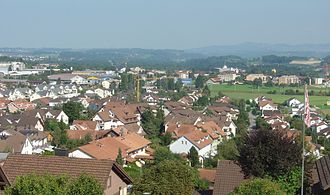
Wilen is a municipality in the district of Münchwilen in the canton of Thurgau in Switzerland. Prior to Thurgau's 1998 reorganisation, Wilen was known as Wilen bei Wil and was part of Rickenbach bei Wil, which was then broken up into the municipalities of Rickenbach and Wilen.
Geography
Wilen has an area, , of 2.27 km2. Of this area, 1.26 km2 or 55.5% is used for agricultural purposes, while 0.47 km2 or 20.7% is forested. Of the rest of the land, 0.47 km2 or 20.7% is settled (buildings or roads), 0.01 km2 or 0.4% is either rivers or lakes and 0.06 km2 or 2.6% is unproductive land.
Of the built up area, industrial buildings made up 15.0% of the total area while housing and buildings made up 0.9% and transportation infrastructure made up 0.0%. Power and water infrastructure as well as other special developed areas made up 1.3% of the area while parks, green belts and sports fields made up 3.5%. Out of the forested land, 18.9% of the total land area is heavily forested and 1.8% is covered with orchards or small clusters of trees. Of the agricultural land, 52.4% is used for growing crops, while 3.1% is used for orchards or vine crops. All the water in the municipality is flowing water.
Demographics
::figure[src="https://upload.wikimedia.org/wikipedia/commons/8/81/Dorfschur.jpg" caption="''Dorfschur'' house in the center of Wilen"] ::
Wilen has a population () of . , 8.3% of the population are foreign nationals. Over the last 10 years (1997–2007) the population has changed at a rate of %. Most of the population () speaks German (95.4%), with Italian being second most common ( 1.6%) and English being third ( 0.6%).
, the gender distribution of the population was 50.4% male and 49.6% female. The population was made up of 932 Swiss men (45.6% of the population), and 98 (4.8%) non-Swiss men. There were 940 Swiss women (46.0%), and 72 (3.5%) non-Swiss women.
In there were 24 live births to Swiss citizens and 2 births to non-Swiss citizens, and in same time span there were 9 deaths of Swiss citizens. Ignoring immigration and emigration, the population of Swiss citizens increased by 15 while the foreign population increased by 2. There were was 1 non-Swiss man who emigrated from Switzerland to another country and 3 non-Swiss women who emigrated from Switzerland to another country. The total Swiss population change in 2008 (from all sources) was an increase of 14 and the non-Swiss population change was a decrease of 2 people. This represents a population growth rate of 0.6%.
The age distribution, , in Wilen is; 281 children or 13.7% of the population are between 0 and 9 years old and 299 teenagers or 14.5% are between 10 and 19. Of the adult population, 184 people or 8.9% of the population are between 20 and 29 years old. 270 people or 13.1% are between 30 and 39, 382 people or 18.6% are between 40 and 49, and 282 people or 13.7% are between 50 and 59. The senior population distribution is 182 people or 8.9% of the population are between 60 and 69 years old, 117 people or 5.7% are between 70 and 79, there are 50 people or 2.4% who are between 80 and 89, and there are 9 people or 0.4% who are 90 and older.
, there were 659 private households in the municipality, and an average of 2.6 people per household. There were 400 (or 22.7%) people who were part of a couple without children, and 1,100 (or 62.5%) who were part of a couple with children. There were 63 (or 3.6%) people who lived in single parent home, while there are 10 people who were adult children living with one or both parents, 18 people who lived in a household made up of relatives, 7 who lived in a household made up of unrelated people, and 14 who are either institutionalized or live in another type of collective housing.
The vacancy rate for the municipality, , was 2.02%. , the construction rate of new housing units was 10.8 new units per 1000 residents.
In the 2007 federal election the most popular party was the SVP which received 34.55% of the vote. The next three most popular parties were the CVP (18.73%), the FDP (18.13%) and the Green Party (10.34%). In the federal election, a total of 658 votes were cast, and the voter turnout was 48.6%.
The historical population is given in the following table: ::data[format=table]
| year | population |
|---|---|
| 1950 | 640 |
| 1960 | 950 |
| 1980 | 1,049 |
| 1990 | 1,502 |
| 2000 | 1,760 |
| :: |
Economy
, Wilen had an unemployment rate of 1%. , there were 17 people employed in the primary economic sector and about 7 businesses involved in this sector. 83 people are employed in the secondary sector and there are 26 businesses in this sector. 161 people are employed in the tertiary sector, with 36 businesses in this sector.
there were 1,240 workers who lived in the municipality. Of these, 792 or about 63.9% of the residents worked outside Wilen while 160 people commuted into the municipality for work. There were a total of 608 jobs (of at least 6 hours per week) in the municipality. Of the working population, 16.9% used public transportation to get to work, and 50.1% used a private car.
Religion
From the , 1,088 or 61.8% were Roman Catholic, while 457 or 26.0% belonged to the Swiss Reformed Church. Of the rest of the population, there are 3 individuals (or about 0.17% of the population) who belong to the Orthodox Church, and there are 51 individuals (or about 2.90% of the population) who belong to another Christian church. There were 10 (or about 0.57% of the population) who are Islamic. There are 10 individuals (or about 0.57% of the population) who belong to another church (not listed on the census), 100 (or about 5.68% of the population) belong to no church, are agnostic or atheist, and 41 individuals (or about 2.33% of the population) did not answer the question.
Education
::figure[src="https://upload.wikimedia.org/wikipedia/commons/9/98/Türmlischulhaus_(Wilen,_Thurgau,Schweiz-_07.09.2005).jpg" caption="Old school house"] ::
In Wilen about 75.4% of the population (between age 25–64) have completed either non-mandatory upper secondary education or additional higher education (either university or a Fachhochschule).
Wilen is home to the Wilen bei Wil primary school district. It is also home to the Wilen bei Wil primary school district. In the 2008/2009 school year there were 238 students in the primary school district. There were 57 children in the kindergarten, and the average class size was 19 kindergartners. Of the children in kindergarten, 26 or 45.6% were female, 1 or 1.8% were not Swiss citizens. The lower and upper primary levels begin at about age 5–6 and last for 6 years. There were 87 children in who were at the lower primary level and 94 children in the upper primary level. The average class size in the primary school was 20.11 students. At the lower primary level, there were 47 children or 54.0% of the total population who were female, 7 or 8.0% were not Swiss citizens and 2 or 2.3% did not speak German natively. In the upper primary level, there were 34 or 36.2% who were female, 3 or 3.2% were not Swiss citizens and 3 or 3.2% did not speak German natively.
References
References
- [http://www.bfs.admin.ch/bfs/portal/de/index/themen/02/03/blank/data/gemeindedaten.html Swiss Federal Statistical Office-Land Use Statistics] 2009 data {{in lang. de Retrieved 25 March 2010
- [http://www.bfs.admin.ch/bfs/portal/de/index/infothek/onlinedb/superweb/login.html Swiss Federal Statistical Office – Superweb database – Gemeinde Statistics 1981–2008] {{in lang. de Retrieved 19 June 2010
- [http://www.bfs.admin.ch/bfs/portal/en/index/regionen/02/key.html Swiss Federal Statistical Office]. Retrieved 5 October 2010
- [http://www.statistik.tg.ch/xml_8/internet/de/application/d10460/d10631/f10493.cfm Statistical Office of Thurgau] {{Webarchive. link. (5 February 2010 , MS Excel document – ''Altersstruktur der Wohnbevölkerung nach zivilrechtlichem Wohnsitzbegriff am 31.12.2009'' {{in lang). de Retrieved 23 June 2010
- {{as of. 2000. link. (20 April 2010 , MS Excel document – ''Wohngebäude nach Anzahl Wohneinheiten und Gemeinden, Jahr 2000'' {{in lang). de Retrieved 24 June 2010
- [http://www.statistik.tg.ch/xml_8/internet/de/application/d10460/d10632/f10492.cfm Statistical Office of Thurgau] {{Webarchive. link. (30 December 2009 , MS Excel document – ''Wohnbevölkerung nach Haushaltstyp und Gemeinde, Jahr 2000'' {{in lang). de Retrieved 23 June 2010
- [http://www.bfs.admin.ch/bfs/portal/de/index/themen/17/02/blank/data/04/03.html Swiss Federal Statistical Office, ''Nationalratswahlen 2007: Stärke der Parteien und Wahlbeteiligung, nach Gemeinden/Bezirk/Canton''] {{in lang. de Retrieved 28 May 2010
- [http://www.statistik.tg.ch/xml_8/internet/de/application/d10460/d10631/f10489.cfm Statistical Office of Thurgau] {{Webarchive. link. (14 April 2010 , MS Excel document – ''Wohnbevölkerung im Kanton Thurgau nach Gemeinden, seit 1850'' {{in lang). de Retrieved 22 June 2010
- [http://www.media-stat.admin.ch/stat/pendler/pop.php Swiss Federal Statistical Office – Statweb] {{Webarchive. link. (4 August 2007 {{in lang). de Retrieved 24 June 2010
- [http://www.statistik.tg.ch/xml_8/internet/de/application/d10460/d10631/f10494.cfm Statistical Office of Thurgau] {{Webarchive. link. (18 April 2010 , MS Excel document – ''Wohnbevölkerung Gemeinden nach religiöser Zugehörigkeit, Jahr 2000'' {{in lang). de Retrieved 23 June 2010
- [http://www.bista.tg.ch/pub/TG_pu.aspx Canton Thurgau Schools] {{Webarchive. link. (7 July 2011 {{in lang). de Retrieved 23 June 2010
::callout[type=info title="Wikipedia Source"] This article was imported from Wikipedia and is available under the Creative Commons Attribution-ShareAlike 4.0 License. Content has been adapted to SurfDoc format. Original contributors can be found on the article history page. ::