W76
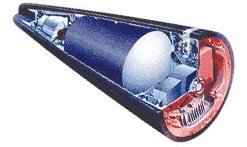
US thermonuclear warhead of the 1970s
title: "W76" type: doc version: 1 created: 2026-02-28 author: "Wikipedia contributors" status: active scope: public tags: ["nuclear-warheads-of-the-united-states", "military-equipment-introduced-in-the-1970s"] description: "US thermonuclear warhead of the 1970s" topic_path: "geography/united-states" source: "https://en.wikipedia.org/wiki/W76" license: "CC BY-SA 4.0" wikipedia_page_id: 0 wikipedia_revision_id: 0
::summary US thermonuclear warhead of the 1970s ::
::data[format=table title="Infobox weapon"]
| Field | Value |
|---|---|
| name | W76 |
| image | W76.gif |
| image_size | 300 |
| caption | The W76 warhead and Mk-4 re-entry vehicle (cutaway diagram) – Los Alamos National Labs image |
| type | Nuclear weapon |
| is_explosive | yes |
| service | 1978–present |
| used_by | United States and possibly the United Kingdom (see Trident Nuclear Program) |
| designer | Los Alamos National Laboratory |
| design_date | W76-0 1973–1978, W76-2 2018 |
| manufacturer | Pantex Plant |
| production_date | W76-0 1978–1987 (full production), W76-1 2008-2018 (LEP), W76-2 2018-FY2024 |
| number | ~3,400 |
| variants | 3 |
| weight | 95 kg |
| length | 1300 mm |
| diameter | 400 mm |
| detonation | Contact, airburst |
| yield | 100 kt (W76-0) |
| 90 kt (W76-1) | |
| 5–7 kt (W76-2) | |
| :: |
| name = W76 | image = W76.gif | image_size = 300 | caption = The W76 warhead and Mk-4 re-entry vehicle (cutaway diagram) – Los Alamos National Labs image | origin = | type = Nuclear weapon | is_explosive = yes | service = 1978–present | used_by = United States and possibly the United Kingdom (see Trident Nuclear Program) | wars = |designer = Los Alamos National Laboratory |design_date = W76-0 1973–1978, W76-2 2018 |manufacturer = Pantex Plant |unit_cost = |production_date = W76-0 1978–1987 (full production), W76-1 2008-2018 (LEP), W76-2 2018-FY2024 |number = ~3,400 |variants = 3 |spec_label = |weight = 95 kg |length = 1300 mm |part_length = |width = |height = |diameter = 400 mm |filling = |filling_weight = |detonation = Contact, airburst |yield = 100 kt (W76-0) 90 kt (W76-1) 5–7 kt (W76-2)
The W76 is an American thermonuclear warhead, designed for use on the UGM-96 Trident I submarine-launched ballistic missiles (SLBMs) and subsequently moved to the UGM-133 Trident II as Trident I was phased out of service. The first variant, the W76 mod 0 (W76-0) was manufactured from 1978 to 1987. It was gradually replaced by the W76 mod 1 (W76-1) between 2008 and 2018, completely replacing the Mod 0 in the active stockpile. In 2018, it was announced that some Mod 1 warheads would be converted to a new low-yield W76 mod 2 (W76-2) version. The first Mod 2 warheads were deployed in late 2019.
History
The warhead was initially manufactured from 1978 to 1987 and designed by Los Alamos National Laboratory. It was initially fitted to the Trident I SLBM system, but after the Rocky Flats plant where its successor the W88 was being made was shut down in 1989 after a production run of only 400 warheads, it was decided to transfer W76 warheads to Trident II.
A life extension program (LEP) for 800 warheads was approved by the US government in 2000, then later increased to 2,000. The purpose of the LEP was to extend service life by 20 years and add new safety features. In September 2008, production on the W76-1 started. In December 2018, the National Nuclear Security Administration completed updating all W76-0 warheads to the W76-1 design.
The 2018 Nuclear Posture Review announced that a new variant, the W76-2, would be manufactured. The W76-2 variant is described as a low-yield warhead, estimated at 5-7 kilotons of TNT equivalent. In January 2019, the National Nuclear Security Administration announced that it had started to manufacture the W76-2. Initial operating capability was expected in the final quarter of 2019, and manufacturing is expected to last through FY2024 at the Pantex Plant.
According to the FAS, the W76-2 warhead was first deployed with during its late 2019 operational patrol. In February 2020, the US Department of Defense confirmed that the W76-2 had been 'fielded'.
The warhead is currently the most numerous weapon in the US nuclear arsenal, having replaced the 50 kt W68 that was fitted to the Poseidon SLBM in that capacity.
The United Kingdom operates a nuclear weapon based on the W76 mod-1 design, under the name "Holbrook".{{cite news |last1=Childs |first1=Nick|last2=Barrie |first2= Douglas |date=26 March 2021 |title=The UK and nuclear warheads – stretching credibility? |url=https://www.iiss.org/blogs/military-balance/2021/03/uk-nuclear-warheads-integrated-review |work=Millitry Balance Blog |access-date=18 October 2022}}
Design
::figure[src="https://upload.wikimedia.org/wikipedia/commons/c/c3/W76-1_NNSA.jpg" caption="A W76-1"] ::
The Mk4 reentry vehicle is 130 cm long and 40 cm in diameter. The dimensions of the W76 thermonuclear warhead are unknown.
The W76-0 had a design yield of 100 kt. Its replacement, the W76-1, has a yield of 90 kt. The W76-2 has an estimated yield of 5 to 7 kt.
The W76-0 was fitted inside a Mk4 reentry vehicle (reentry body in US Navy parlance). The W76-1 and -2 are fitted inside the new Mk4A reentry vehicle. The reentry vehicle and warhead weight is estimated to be approximately 95 kg.
During the W76-1 LEP, the warhead was fitted with a new MC4700 arming, fuzing and firing (AF&F) system, the so-called "super-fuze". The MC4700 AF&F system increases warhead kill probabilities against hard targets such as silos and bunkers. It achieves this by first calculating the range to the target outside of the atmosphere (i.e. before the atmosphere can alter the warhead's trajectory) and then continuously calculates its position on a line based on acceleration.
If the contact fuze is actuated, such as falling short or striking on target, the warhead detonates. If the fuze calculates it has overshot the target, it detonates the warhead before it can leave the kill radius of the target. The kill radius is a sphere, not a circle. In comparison, a warhead without such a smart fuze would continue flying when overshooting a target, leaving the kill radius, where detonating would destroy the target, and impact the ground. This would actuate the impact fuze and detonate the warhead, outside of the kill radius.
References
References
- "Литвинов Б. В. Атомная энергия не только для военных целей. — 2002 / Просмотр издания // Электронная библиотека /// История Росатома".
- Sublette, Carey. "The W88 Warhead".
- Pincus, Walter, "Strategic Plan Extends Life Span Of Nuclear Arsenal", ''[[The Washington Post]]'', 19 May 2011, p. 17.
- [https://www.defensenews.com/space/2019/01/23/work-completed-on-navys-upgraded-nuclear-warhead/ Work completed on Navy's upgraded nuclear warhead] {{Webarchive. link. (2021-09-01 . ''Defense News''. 24 January 2019.)
- [https://media.defense.gov/2018/Feb/02/2001872886/-1/-1/1/2018-NUCLEAR-POSTURE-REVIEW-FINAL-REPORT.PDF defense.gov] {{Webarchive. link. (2019-02-08 "Nuclear Posture Review 2018")
- "Trump poised to get new low-yield nuclear weapons". Washington Post.
- (2019-01-28). "US nuclear weapons: first low-yield warheads roll off the production line".
- "NNSA Plan Shows Nuclear Warhead Cost Increases and Expanded Production".
- Mehta, Aaron. (January 28, 2019). "Trump's new nuclear weapon has entered production".
- (29 January 2020). "US Deploys New Low-Yield Nuclear Submarine Warhead". [[Federation of American Scientists.
- Rood, John. "Statement on the Fielding of the W76-2 Low-Yield Submarine Launched Ballistic Missile Warhead".
- "The W76 Warhead".
- (2011). "Nuclear weapons engineering". Sandia National Laboratories.
- "Litvinov B. V. Atomic energy not only for military purposes. - 2002 / View publication // Electronic library /// History of Rosatom".
- (29 April 2019). "United States nuclear forces, 2019". Bulletin of the Atomic Scientists.
- (21 December 2007). "Nuclear weapons safety: The case of trident". Science & Global Security.
- (March 2017). "How US nuclear force modernization is undermining strategic stability: The burst-height compensating super-fuze".
- (March 2017). "How US nuclear force modernization is undermining strategic stability: The burst-height compensating super-fuze".
::callout[type=info title="Wikipedia Source"] This article was imported from Wikipedia and is available under the Creative Commons Attribution-ShareAlike 4.0 License. Content has been adapted to SurfDoc format. Original contributors can be found on the article history page. ::