Volcanic Eifel

Region of volcanic craters in Germany
title: "Volcanic Eifel" type: doc version: 1 created: 2026-02-28 author: "Wikipedia contributors" status: active scope: public tags: ["landscapes-of-rhineland-palatinate", "pleistocene-volcanism", "holocene-volcanism", "volcanism-of-germany", "regions-of-the-eifel", "global-geoparks-network-members", "volcanic-fields-of-europe"] description: "Region of volcanic craters in Germany" topic_path: "geography/germany" source: "https://en.wikipedia.org/wiki/Volcanic_Eifel" license: "CC BY-SA 4.0" wikipedia_page_id: 0 wikipedia_revision_id: 0
::summary Region of volcanic craters in Germany ::
::figure[src="https://upload.wikimedia.org/wikipedia/commons/0/0c/Laacher_See_-_Luftaufnahme.jpg" caption="The [[Laacher See]], the largest [[volcanic crater lake]] in Central Europe near [[Andernach"] ::
::figure[src="https://upload.wikimedia.org/wikipedia/commons/e/e7/Dauner_Maar.jpg" caption="Daun"] ::
::figure[src="https://upload.wikimedia.org/wikipedia/commons/7/7a/WeibernV.JPG" caption="Brohl]] Valley"] ::
::figure[src="https://upload.wikimedia.org/wikipedia/commons/c/c4/Laacher_See,_Mofetten.jpg" caption="[[Mofetta]]s on the southeastern shore of the Laacher See"] ::
The Volcanic Eifel or Vulkan Eifel () consists of three areas of volcanic activity, known as the West Eifel, High Eifel, and East Eifel volcanic fields. Volcanic Eifel is a region in the Eifel Mountains in Germany that is defined to a large extent by its volcanic geological history. Characteristic of the volcanic fields are their typical explosion crater lakes or maars, and numerous other signs of volcanic activity such as volcanic tuffs, lava streams and volcanic craters, for example the Laacher See. The Volcanic Eifel is still volcanically active today. One sign of this activity is the escaping gases in the Laacher See.
Geographical location
::figure[src="https://upload.wikimedia.org/wikipedia/commons/a/a5/Wingertsbergwand_Laacher_See_2010.jpg" caption="The Wingertsbergwand gives an idea of the amount of volcanic ash ejected during the eruption of the Laacher See volcano."] ::
The Volcanic Eifel stretches from the Rhine to the Wittlich Depression. It is bordered in the south and southwest by the South Eifel, in the west by Luxembourg and Belgian Ardennes and in the north by the North Eifel including the Hohes Venn. To the east the Rhine forms its geographical boundary, with no volcanicity immediately beyond it.
The Volcanic Eifel is divided into three natural regions:
- Volcanic West Eifel (West Eifel Volcanic Field): Manderscheid, Daun, Gerolstein, Obere Kyll, Hillesheim (within the parish of Nohn)
- Volcanic High Eifel (High Eifel Volcanic Field): (Adenau, Kelberg, Ulmen and Nohn)
- Volcanic East Eifel (East Eifel Volcanic Field): (Brohltal, Vordereifel, Mendig, Pellenz) The centre of the Volcanic Eifel is the region around Daun and Manderscheid and the areas within the Mayen-Koblenz district.
The landscape of the Volcanic Eifel is dominated by recent volcanism. Volcanic craters, thick pumice and basalt layers and maars create a diverse landscape that clearly witnesses to very recent events in geological terms.
The entire Volcanic Eifel covers an area of about 2000 km2 and has a population of about 200,000.
Volcanoes
The following volcanoes belong to the Eifel, sorted by height in metres (m) above sea level (Normalhöhennull, NHN):
- Ernstberg (also: Erresberg), 699.9 m, county of Vulkaneifel – west
- Scharteberg, 691.4 m, county of Vulkaneifel; with the Eifel Transmitter (SWR) – west
- Prümscheid, 681 m, county of Vulkaneifel – not volcanic (eponymous quartzite ridge; other summits being the Scharteberg and Dietzenley)
- Hochkelberg, 674.9 m, county of Vulkaneifel; with a transmission mast on its south summit – Tertiary
- Nerother Kopf, 651.7 m, county of Vulkaneifel; with the castle ruins of the Freudenkoppe – west
- Dietzenley, 617.6 m, county of Vulkaneifel; with a wooden observation tower – west
- Arensberg, approximately 590 m, county of Vulkaneifel – Tertiary
- Hochsimmer, 587.9 m, county of Mayen-Koblenz – east
- Gänsehals, 573.3 m, county of Mayen-Koblenz – east
- Engelner Kopf, 575.1 m, county of Ahrweiler (near Kempenich-Engeln) – east
- Hochstein, 563 m, county of Mayen-Koblenz – east
- Steineberger Ley, 557.8 m, county of Vulkaneifel; with a Volcano Information Platform (observation tower) – Tertiary
- Rockeskyller Kopf, 554.6 m, county of Vulkaneifel – west
- Hoher List, 549.1 m, county of Vulkaneifel; with the Hoher List Observatory – west
- Wartgesberg, approximately 475 m, county of Vulkaneifel (near Strohn) – west
- Veitskopf, 428.1 m, county of Ahrweiler; near Laacher See; with an observation tower, the Lydia Tower – east
- Ettringer Bellberg, 427.5 m, county of Mayen-Koblenz (south of Ettringen) – east
- Karmelenberg, 372.5 m, county of Mayen-Koblenz – east
- Mayener Bellberg, 363.2 m, county of Mayen-Koblenz (north of Mayen) – east
- Korretsberg, 295 m, county of Mayen-Koblenz (near Kruft) – east
Laacher See
Of particular note is the volcanic caldera known as Laacher See, the site of an eruption around 12,900 years ago that had an estimated VEI of 6.
Geopark and museums
- Vulkanland Eifel National Geopark
- Volcano Museum, Daun
- Volcano House, Strohn
- German Volcano Museum, Mendig
Geology
The tephras deposited by past eruptions of the Volcanic Eifel are lithological deposits that are radiometrically dateable via argon-argon dating of K-feldspar grains. These have in turn been utilised to ascertain the ages of climatic changes such as transitions from glacial to interglacial states during the Pleistocene.
Future activity
There is thought that future eruptions may occur in the Eifel, because:
- Each year the Eifel rises by about a millimetre.
- Geophysicists found that crust under the Eifel is thinner than most continental crust, suggesting that under the Eifel is a hot zone where magma is rising.
- Persistent small earthquakes and underground heating.
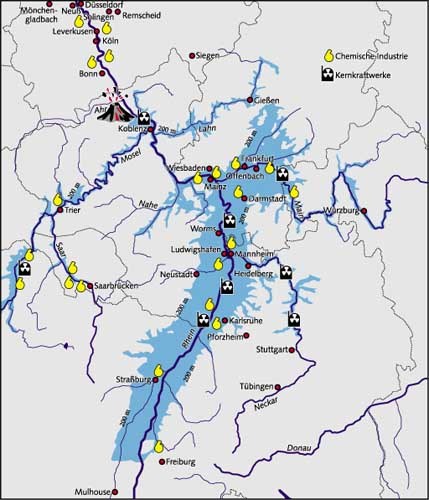
- Map of flood lake that may happen if the Rhine is blocked by a voluminous eruption in the Eifel
In 2020, Professor Kreemer noted that Eifel was the only region within an area of Europe studied where ground motion happened at significantly higher levels than expected. It is possible that such movements originate from a rising magma plume. This activity does not imply an immediate eruptive danger, but might suggest an increase in volcanic and seismic activity in the region.
References
References
- van den Bogaard, P.. (30 November 1989). "Precise single-grain 40Ar/39 Ar dating of a cold to warm climate transition in Central Europe". [[Nature (journal).
- [https://www.geopark-vulkaneifel.de/en/geo-area/faq/583-still-volcanic-activity.html Is there still volcanic activity in the Eifel?]
- [http://www.q-mag.org/germany-a-danger-of-volcanic-eruptions.html Germany: a danger of volcanic eruptions?]
- "Eifel flood danger map".
- (11 June 2020). "Volcano warning: 'Something is brewing under Europe' Geologists make incredible discovery". Express.
::callout[type=info title="Wikipedia Source"] This article was imported from Wikipedia and is available under the Creative Commons Attribution-ShareAlike 4.0 License. Content has been adapted to SurfDoc format. Original contributors can be found on the article history page. ::