Vaishno Devi
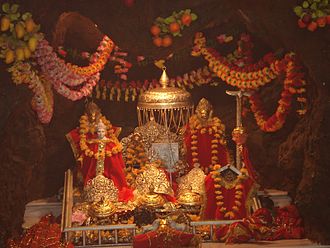
Hindu mother goddess
title: "Vaishno Devi" type: doc version: 1 created: 2026-02-28 author: "Wikipedia contributors" status: active scope: public tags: ["caves-of-jammu-and-kashmir", "hindu-cave-temples-in-india", "hindu-goddesses", "hindu-temples-in-jammu-and-kashmir", "hindu-pilgrimage-sites-in-india", "katra,-jammu-and-kashmir", "shakti-temples"] description: "Hindu mother goddess" topic_path: "geography/india" source: "https://en.wikipedia.org/wiki/Vaishno_Devi" license: "CC BY-SA 4.0" wikipedia_page_id: 0 wikipedia_revision_id: 0
::summary Hindu mother goddess ::
::data[format=table title="Infobox deity"]
| Field | Value |
|---|---|
| abode | Vaishno Devi Temple, Katra, India |
| type | hindu |
| father | King Ratnākara |
| mother | Queen Samṛddhi |
| image | File:Vaishno devi.jpg |
| name | Vaishno Devi |
| affiliation | Tridevi, Mahadevi, Durga, Mahakali, Mahalakshmi, Mahasarasvati |
| caption | Inside view of the Holy Cave, the 3 Pindis; Mahakali, Mahalakshmi and Mahasarasvati |
| mount | Lion |
| Devanagari | वैष्णो देवी |
| other_names | Vaishnavi, Mata Rani, Ambe, Trikuta, Sheravali, Jyotavali, Pahadavali, Durga, Bhagavati, Jagdamba, Lakshmi, Vishnumaya, Vishnupriya, Maniki, Sukriti |
| deity_of | Mother Goddess; Goddess of hills |
| gender | Female |
| :: |
| abode = Vaishno Devi Temple, Katra, India | type = hindu | father = King Ratnākara | mother = Queen Samṛddhi | image = File:Vaishno devi.jpg | name = Vaishno Devi | affiliation = Tridevi, Mahadevi, Durga, Mahakali, Mahalakshmi, Mahasarasvati | caption = Inside view of the Holy Cave, the 3 Pindis; Mahakali, Mahalakshmi and Mahasarasvati | mount = Lion | Devanagari = वैष्णो देवी | other_names = Vaishnavi, Mata Rani, Ambe, Trikuta, Sheravali, Jyotavali, Pahadavali, Durga, Bhagavati, Jagdamba, Lakshmi, Vishnumaya, Vishnupriya, Maniki, Sukriti | deity_of = Mother Goddess; Goddess of hills | gender = Female | birth_name =
Vaishno Devi (also known as Mata Rani, Sherawali, Trikuta, Ambe and Vaishnavi) is an unmarried form of the Hindu mother goddess Mahalakshmi, embodying the tattva of Mahasarasvati and Mahakali. Vaishno Devi is worshipped as a combined avatar of the trinity goddesses.
Origin
Purāṇa
According to Mahābhāgavata Upapurāṇa (23.44b-45.39), she is mentioned as "Viṣṇupriyā".
In the Varāha Mahāpurāṇa's Triśakti Māhātmya, she originated from the Lakṣmī bhāga (portion) of Goddess Trikalā (the goddess who was born from Trimūrtis) and slayed an asura called Mahiṣāsura on Śataśṛṅga Parvata where the current Trikūṭa Dhāma of Vaiṣṇōdēvī is situated. (Disclaimer: this event is of a separate Kalpa – Mānava Kalpa – and not of our Śvēta Varāha Kalpa). The Nārada Mahāpurāṇa (1.103.1-3) and Matsya Mahāpurāṇa (53.38-40) clarify that the Varāha Mahāpurāṇas events take place during the Mānava Kalpa.
Pāñcarātra
The Lakṣmīnārāyaṇa Saṃhitā (1.4.22-25) mentions the Triśaktis (Brāhmī, Vaiṣṇavī, and Raudrī) of the Varāha Mahāpurāṇa and when describing Vaiṣṇavī, directly calls her "Viṣṇuśakti" and "Lakṣmī". It also says that only because of her Viṣṇu is able to preserve, making it clear that she's a form of Lakṣmī. This event is directly mentioned at the beginning of creation during Kṛta Yuga, where the Tridēvas’ Prakṛtis are introduced. This is in the exact same manner as the Varāha Mahāpurāṇa notates. Vaiṣṇavī directly is stated here as Lakṣmī.
The Lakṣmīnārāyaṇa Saṃhitās Kṛtayuga Santāna (1.334.53) and Dvāparayuga Santāna (3.237.154) calls her "Māṇikī", the Śakti of Kalki, as she resides on Māṇika Parvata (another name of Trikūṭa).
She is mentioned in the Garga Saṃhitā (5.15.33b) as "Sukṛti", the Śakti and future consort of Lord Kalki.
Legends
Trikuta Rani/Vaishno devi Legend
The incarnation of Vaishno Devi took place during the Treta Yuga, when Ravana, Kumbhakarna, and other demonic forces were committing atrocities. The three great Shaktis Mahakali, Mahalakshmi, and Mahasarasvati decided to combine their respective energies (Raj, Tam, and Satvik Gunas) to give birth to a single divine power (Divya Shakti) for the preservation of Dharma. From this unified brilliance, a beautiful divine girl emerged.{{cite book | last = Sharma | first = Bala Krishna | title = Vaishno Devi Tatha Nau Deviyon Ki Amar Kahani | url = https://archive.org/details/Qavi_vaishno-devi-tatha-nau-deviyon-ki-amar-kahani-bala-krishna-sharma/mode/2up | language = hi | access-date = 25 June 2025
The Legend of Baba Jittoo
The identity of the Vaishno Devi shrine is deeply intertwined with regional Dogri folklore. A prominent example is "The Story of Baba Jittoo," described as a "long and complex myth" originating from the Jammu region in the 15th century. In this legend, Baba Jittoo is depicted as a "poor peasant" and a devout "devotee of Mata Vaishno Devi." As analyzed by scholars, the myth functions as a social charter, illustrating "how Vaishno Devi helps her devotees gain... bountiful harvests, and protection from enemies," particularly supporting "poor peasants who are exploited by kings and landlords." This narrative exemplifies a classic syncretism, where the pan-Hindu goddess assumes an immanent, socio-economic role as a protector of the oppressed in local Dogri traditions.
Pilgrimage route
::figure[src="https://upload.wikimedia.org/wikipedia/commons/8/8f/Houses_and_Shops_located_in_Katra,_Jammu_and_Kashmir.jpg" caption="A view of Vaishno Devi Bhawan" alt=""] ::
According to Hindu legend, the pilgrimage route follows the path the Goddess took while fleeing the tantric Bhairav Nath. The first major stop is Ardh Kumari, a cave where the Devi is said to have meditated for nine months. This cave is also known as Garbh Joon, or the "Womb Cave," as the shape of the cave is narrow and devotees must crawl through it, symbolizing a spiritual rebirth.
The legend states that when Bhairav Nath located her at Ardh Kumari, the Goddess used her Trishul to strike the back wall of the cave, creating a new opening. She then escaped through this passage and continued her journey to the main Holy Cave on Trikuta Mountain.
The final confrontation occurred at the entrance of the Holy Cave (now the Bhawan). After being pursued to this location, the Devi assumed the ferocious form of Mahakali and beheaded Bhairav Nath. According to the narrative, his body fell at the entrance to the Holy Cave, while the force of the blow flung his head to a distant, adjacent peak.
The legend concludes with Bhairav Nath's repentance. As his head lay on the peak, he realized the Devi's true divinity and begged for forgiveness. The Goddess granted him salvation and a boon: that no pilgrimage to her shrine would be considered complete unless the devotee also paid respects at the Bhairav Nath Temple, which now stands at the location where his head is said to have fallen. This is why pilgrims traditionally visit the Bhairav Nath temple after having darshan at the main Holy Cave.
Temple
Main article: Vaishno Devi Temple
::figure[src="https://upload.wikimedia.org/wikipedia/commons/3/34/Vaishno_Devi_Bhavan.jpg" caption="The Vaishno Devi temple in 2008"] ::
The Vaishno Devi Temple is an important Hindu temple dedicated to Vaishno Devi located in Katra at the Trikuta Mountains within the Indian Union territory of Jammu and Kashmir. It is one of the most visited pilgrimage centers of India. Every year, millions of visitors visit the temple. During festivals like Navaratri, the count even increases to one crore visitors. Vaishno Devi Temple is one of the richest temples in India. Authors Michael Barnett and Janice Gross Stein says, "Mata Vaishno Devi Shrine in Jammu has an annual income of about $16 billion, mainly from offerings by devotees".
The temple is sacred to all Hindus. Many prominent saints, such as Vivekananda, have visited the temple.
References
https://www.maavaishnavi.com/51-shakti-peethas-of-maa-durga-maa-sati-dakshayani/
References
- Veda Vyasa. "The Varaha Purana in English".
- www.wisdomlib.org. (2018-11-09). "The exalted magnificence of Gaurī and Śiva [Chapter 4]".
- (4 March 1975). "Dēvī Mahābhāgavata Purāṇa".
- J. L. Shastri, G. V. Tagare. (1952). "The Narada-Purana, Part 4". Motilal Banarsidass.
- Veda Vyasa. "Matsya Purana in English PDF - Volumes 1 and 2".
- Svetayana Vyasa. "lakShmInArAyaNasaMhitA1".
- www.wisdomlib.org. (2021-01-28). "Lakshminarayana Samhita Verse 1.4.25 [Sanskrit text]".
- www.wisdomlib.org. (2021-01-28). "Lakshminarayana Samhita Verse 1.334.53 [Sanskrit text]".
- www.wisdomlib.org. (2021-01-28). "Lakshminarayana Samhita Verse 3.237.154 [Sanskrit text]".
- www.wisdomlib.org. (2022-07-16). "Verse 5.15.33 [Garga Samhita]".
- Chaturvedi, Jwala Prasad. (2025). "Shri Vaishno Devi Ki Sampurna Kahani Janma Katha Sahit". Bhavani Pustak Mahal.
- "Shri Vaishno Devi Ki Puri Kahani". Bhavani Pustak Mahal.
- "Understanding Culture and Society in India: A Study of Sufis, Saints and Deities in Jammu Region". eBin.pub.
- "The Vaishno Devi Pilgrimage: A Study of Religious Tourism in Jammu and Kashmir". University of Nebraska-Lincoln DigitalCommons.
- Bansal, Sunita Pant. (2017). "Vaishno Devi: The Powerful Goddess". Om Books International.
- Raina, Mohini. (2007). "Cave Temple of Vaishno Devi".
- Dua, Shyam. (2005). "Vaishno Devi: The Goddess of Trikuta". S.B. Publications.
- Rindani, Kirit. (2016). "Indian Himalaya: Story of a 100 Visits". Partridge Publishing.
- S. S. Negi. (1998). "Discovering the Himalaya, Volume 1". Indus Publishing.
- Kuldip Singh Gulia. (2007). "Mountains of the God". Gyan Publishing House.
- (2 January 2020). "Vaishno Devi pilgrim footfall in 2019 lowest in 3 years: Shrine Board". Business Standard.
- (29 December 2018). "Vaishno Devi likely to receive 8.5 mn pilgrims by Dec 31; highest in 5 yrs". Business Standard.
- "Vaishno Devi-Bhairav Mandir ropeway service starts from today". The Times of India.
- (3 July 2012). "Sacred Aid: Faith and Humanitarianism". Oxford University Press.
- (2005). "Jammu and Kashmir: Charting a Future". Saṁskṛiti.
::callout[type=info title="Wikipedia Source"] This article was imported from Wikipedia and is available under the Creative Commons Attribution-ShareAlike 4.0 License. Content has been adapted to SurfDoc format. Original contributors can be found on the article history page. ::