V Aquilae
Star in the constellation Aquila
title: "V Aquilae" type: doc version: 1 created: 2026-02-28 author: "Wikipedia contributors" status: active scope: public tags: ["aquila-(constellation)", "semiregular-variable-stars", "henry-draper-catalogue-objects", "carbon-stars", "objects-with-variable-star-designations", "asymptotic-giant-branch-stars", "bright-star-catalogue-objects", "hipparcos-objects", "durchmusterung-objects", "population-i-stars"] description: "Star in the constellation Aquila" topic_path: "science/astronomy" source: "https://en.wikipedia.org/wiki/V_Aquilae" license: "CC BY-SA 4.0" wikipedia_page_id: 0 wikipedia_revision_id: 0
::summary Star in the constellation Aquila ::
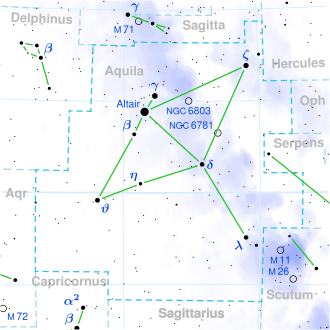
| image= |image=Aquila constellation map.svg|alt=|float=center|width=280 |label=|position=right |mark=Red circle.svg|mark_width=10|mark_link=V Aquilae |x=760|y=742 |caption=Location of V Aquilae (circled) | epoch = J2000 | constell = Aquila | ra = | dec = | appmag_v = 6.6 - 8.4 | type = AGB | class = C5,4-C6,4(N6) | b-v = +4.32 | u-b = | variable = SRb | radial_v = +37 | prop_mo_ra = | prop_mo_dec = | parallax = 2.4779 | p_error = 0.2320 | parallax_footnote = | absmag_v = −5.19 | mass = 2.5 | radius = 234 | luminosity = 6,500 | temperature = 2,800 | gravity = −0.108 | metal_fe = 0.10 | rotation = | age = | names = BD−05 4858, HD 177336, HIP 93666, HR 7220, SAO 142985
V Aquilae (V Aql) is a carbon star and semiregular variable star in the constellation Aquila. It has an apparent magnitude which varies between 6.6 and 8.4 and is located around 400 pc away.
V Aquilae is a type of star with a spectrum that is dominated by strong absorption lines of the molecules C2 and CN, hence known as carbon stars. The enhanced levels of carbon in the atmosphere originate from recently nucleosynthesized material that has been dredged up to the surface by deep convection during temporary shell burning events known as thermal pulses. Published spectral types for the star vary somewhat from C54 to C64, or N6 under an older system of classification. The subscript 4 refers to the strength of the molecular carbon bands in the spectrum, an indicator of the relatively abundances of carbon in the atmosphere.
::figure[src="https://upload.wikimedia.org/wikipedia/commons/7/70/VAqlLightCurve.png" caption="A light curve for V Aquilae, plotted from [[Hipparcos]] data"] ::
V Aquilae is a variable star of type SRb. Its variability was first announced by George Knott in 1871. It has a published period of 400 days, but other periods are found including 350 days and 2,270 days.
References
References
- (1907). "Second catalogue of variable stars". Annals of Harvard College Observatory.
- "Hipparcos Tools Interactive Data Access". ESA.
- (2014). "VizieR Online Data Catalog: Catalogue of Stellar Spectral Classifications (Skiff, 2009-2016)". VizieR On-line Data Catalog: B/Mk. Originally Published in: Lowell Observatory (October 2014).
- Wilson, Ralph Elmer. (1953). "General Catalogue of Stellar Radial Velocities". Carnegie Institute Washington D.C. Publication.
- Lambert, David L.. (October 1986). "The chemical composition of carbon stars. I - Carbon, nitrogen, and oxygen in 30 cool carbon stars in the Galactic disk". Astrophysical Journal Supplement Series.
- Nicolet, B.. (October 1978). "Catalogue of homogeneous data in the UBV photoelectric photometric system". Astronomy & Astrophysics Supplement Series.
- "V* V Aql -- Semi-regular pulsating Star". Centre de Données astronomiques de Strasbourg.
- (2007). "Validation of the new Hipparcos reduction". Astronomy and Astrophysics.
- {{cite DR2. 4206206750288121728
- (2009). "VizieR Online Data Catalog: General Catalogue of Variable Stars (Samus+ 2007-2013)". VizieR On-line Data Catalog: B/GCVS. Originally Published in: 2009yCat....102025S.
- (2013). "The abundance of HCN in circumstellar envelopes of AGB stars of different chemical type". Astronomy & Astrophysics.
- (2013). "Luminosities of carbon-rich asymptotic giant branch stars in the Milky Way". Astronomy & Astrophysics.
- (2003). "On the Origin of Long Secondary Periods in Semiregular Variables". The Astrophysical Journal.
- (2017). "Fundamental parameters and infrared excesses of Tycho-Gaia stars". Monthly Notices of the Royal Astronomical Society.
- (2019). "Photo-astrometric distances, extinctions, and astrophysical parameters for Gaia DR2 stars brighter than G = 18". Astronomy and Astrophysics.
- (2022). "Vibrationally excited HCN transitions in circumstellar envelopes of carbon-rich AGB stars". Astronomy and Astrophysics.
::callout[type=info title="Wikipedia Source"] This article was imported from Wikipedia and is available under the Creative Commons Attribution-ShareAlike 4.0 License. Content has been adapted to SurfDoc format. Original contributors can be found on the article history page. ::