Tornieria
Extinct genus of dinosaur
title: "Tornieria" type: doc version: 1 created: 2026-02-28 author: "Wikipedia contributors" status: active scope: public tags: ["diplodocidae", "dinosaur-genera", "kimmeridgian-dinosaurs", "tendaguru-formation", "taxa-named-by-richard-sternfeld", "fossil-taxa-described-in-1911", "dinosaurs-of-tanzania"] description: "Extinct genus of dinosaur" topic_path: "general/diplodocidae" source: "https://en.wikipedia.org/wiki/Tornieria" license: "CC BY-SA 4.0" wikipedia_page_id: 0 wikipedia_revision_id: 0
::summary Extinct genus of dinosaur ::
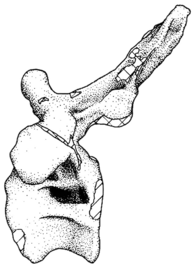
| fossil_range = | image = Tornieria_caudal.png | image_caption = Caudal vertebra of T. africana | display_parents = 3 | taxon = Tornieria | authority = Sternfeld, 1911 | type_species = Gigantosaurus africanus | type_species_authority = Fraas, 1908 | subdivision_ranks = Species | subdivision = *T. africana (Fraas, 1908)
- T. gracilis (Chure & McIntosh, 1989) | synonyms = Genus synonymy
- Gigantosaurus Fraas, 1908 (preoccupied) Species synonymy
- Gigantosaurus africanus Fraas, 1908
- Barosaurus africanus (Fraas, 1908)
- Barosaurus africanus gracilis Chure & McIntosh, 1989
- Barosaurus gracilis (Chure & McIntosh, 1989) | synonyms_ref =
Tornieria ("for Tornier") is a genus of diplodocid sauropod dinosaur from the Late Jurassic in Lindi Region of Tanzania.
Discovery and naming
::figure[src="https://upload.wikimedia.org/wikipedia/commons/9/92/500_gigantosaurus_dwdu1912cropped.jpg" caption="Historical reconstruction by [[Heinrich Harder]] (as "Gigantosaurus"), 1912"] ::
In 1907, German paleontologist Eberhard Fraas who was working the Tendaguru Beds in German East Africa (presently Tanzania), discovered two sauropod specimens at a single site ("Quarry A"). The two individuals, designated "Skeleton A" and "Skeleton B", each represented a different sauropod species. In 1908 he named these respectively Gigantosaurus africanus ("African giant lizard") and G. robustus ("Robust giant lizard"). A third, unrelated African species, "Gigantosaurus" dixeyi, was named by in 1928, and has since been reassigned to Malawisaurus.
However, the name Gigantosaurus had already been used for the European sauropod Gigantosaurus megalonyx Seeley, 1869. Fraas, not intending to place his species in the same genus as this English form, had believed that the name was available, since at the time the latter species was considered to be a junior synonym of Ornithopsis and Seeley in his opinion had not provided a sufficient description anyway. Another German paleontologist, Richard Sternfeld, renamed the Tanzanian sauropod Tornieria in 1911, making the two species Tornieria africana and T. robusta. The generic name honours the German herpetologist Gustav Tornier.
A re-evaluation of Tornieria in 1922 by Werner Janensch concluded that one species, T. africana, was actually an African species of the North American sauropod genus Barosaurus: Barosaurus africanus. The other African species, T. robusta, later turned out to belong to a titanosaur. The titanosaur species for a time was called Tornieria, but this was incorrect as T. africana had been the type species. It needed a generic name of its own and this was provided in 1991 when Rupert Wild renamed it Janenschia.
If Tornieria were the same genus as Barosaurus, then the name Tornieria would be abandoned as a junior subjective synonym. However, later researchers proposed generic distinction between the American and the African form. In the early 21st century this usage became prevalent and in 2006 Kristian Remes in a review concluded that Tornieria was indeed distinct and a valid genus.
A complication is formed by the fact that Janensch in 1961 recognised a variety of B. africanus: B. africanus var. gracilis, a morph distinguished by more gracile hind limbs. In 1980, Russell et al. informally promoted this taxon to the species level, Barosaurus gracilis; it was officially elevated to B. gracilis by John McIntosh in 1990, and was combined to as Tornieria gracilis by George Olshevsky in 1991.
In 2006, Remes suggested that B. gracilis is a nomen nudum, with neither the holotype nor diagnosis having been provided by Russell et al. (1980).
Specimens and description
::figure[src="https://upload.wikimedia.org/wikipedia/commons/6/6a/Tornieria_skull.png" caption="Skull of ''T. africana''"] ::
Elements of the original "Skeleton A" were designated by Fraas as a syntype series: SMNS 12141a, 12145a, 12143, 12140, 12142, all from the postcrania. Later some other bones from the same individual were recovered. Janensch would also refer many other fossils to B. africanus, in total 630 specimens representing at least 56 separate individuals. Of these 188 would be left after the bombardments during the Second World War. Remes, however, concluded that merely a second partial skeleton, "Skeleton k", including also some skull elements, could be reliably referred, and a series of caudal vertebrae. The remains are from the later strata of the Tendaguru, the obere Dinosauriermergel or "Upper Dinosaur Marl", dating from the Tithonian.
Tornieria was a large sauropod; according to Gregory S. Paul, it was 25 m in length, and weighed 10 metric tons. It shared elongated neck vertebrae and a rather long forelimb with Barosaurus. However, it differed from the American form by details in the anterior caudal vertebrae and from Barosaurus and Diplodocus both by its plesiomorphic hindlimb proportions with a short lower leg.
Classification
After performing a cladistic analysis, Remes (2006) concluded that Tornieria was the sister taxon of a clade formed by Barosaurus and Diplodocus. It would thus be a member of the Diplodocinae.
|label1=Diplodocidae |1={{clade |1=Apatosaurus |2={{clade |1=Supersaurus |2={{clade |1=Dinheirosaurus |2=Tornieria |3={{clade |1=Barosaurus |2=Diplodocus
References
References
- E. Fraas, 1908, "Dinosaurierfunde in Ostafrika", ''Jahreshefte des Vereins für Vaterländische Naturkunde in Württemberg'' '''64''': 84-86
- Sternfeld, R., 1911, "Zur Nomenklatur der Gattung ''Gigantosaurus'' Fraas", ''Sitzungsberichte der Gesellschaft naturforschender Freunde zu Berlin'' 1911: 398
- Janensch, W., 1922, "Das Handskelett von ''Gigantosaurus robustus'' und ''Brachiosaurus brancai'' aus den Tendaguru-Schichten Deutsch- Ostafrikas", ''Centralblatt für Mineralogie, Geologie und Paläontologie'' 1922: 464–480
- Remes, K., 2006, "Revision of the Tendaguru sauropod ''Tornieria africana'' (Fraas) and its relevance for sauropod paleobiogeography", ''Journal of Vertebrate Paleontology'' '''26'''(3): 651–669
- Janensch, W., 1961, "Die Gliedmaßen und Gliedmaßengürtel der Sauropoden der Tendaguru-Schichten", ''Palaeontographica'' Supplement 7(3): 177–235
- D. Russell, P. Béland, and J. McIntosh, 1980, "Paleoecology of the dinosaurs of Tendaguru (Tanzania)", Memoires de la Societé Geologique de France, N.S. '''139''': 169-175
- McIntosh, John S.. (1990). "The Dinosauria". University of California Press.
- Olshevsky, G.. (1991). "A revision of the parainfraclass Archosauria Cope, 1869, excluding the advanced Crocodylia". Mesozoic Meanderings.
- (2025). "The authorship of ''Barosaurus africanus gracilis'' (currently ''Tornieria gracilis''; Dinosauria, Sauropoda), and designation of a lectotype". Bulletin of Zoological Nomenclature.
- (1989). "A Bibliography of the Dinosauria (Exclusive of the Aves), 1677-1986". Museum of Western Colorado.
- Paul, Gregory S.. (2016). "Princeton Field Guide to Dinosaurs: 2nd Edition". Princeton University Press.
::callout[type=info title="Wikipedia Source"] This article was imported from Wikipedia and is available under the Creative Commons Attribution-ShareAlike 4.0 License. Content has been adapted to SurfDoc format. Original contributors can be found on the article history page. ::