STS-52
1992 American crewed spaceflight to deploy LAGEOS-2
title: "STS-52" type: doc version: 1 created: 2026-02-28 author: "Wikipedia contributors" status: active scope: public tags: ["space-shuttle-missions", "spacecraft-launched-in-1992"] description: "1992 American crewed spaceflight to deploy LAGEOS-2" topic_path: "general/space-shuttle-missions" source: "https://en.wikipedia.org/wiki/STS-52" license: "CC BY-SA 4.0" wikipedia_page_id: 0 wikipedia_revision_id: 0
::summary 1992 American crewed spaceflight to deploy LAGEOS-2 ::
::data[format=table title="Infobox spaceflight"]
| Field | Value |
|---|---|
| name | STS-52 |
| names_list | Space Transportation System-52 |
| image | Sts052-80-030 lrg.jpg |
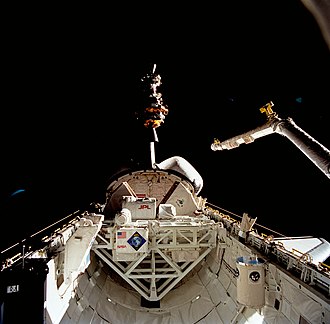
| image_caption | Columbias payload bay, with the LAGEOS 2 satellite being deployed. |
| mission_type | LAGEOS 2 satellite deployment |
| Microgravity research | |
| operator | NASA |
| mission_duration | |
| distance_travelled | 6645026 km |
| orbits_completed | 159 |
| spacecraft | |
| launch_mass | 113460 kg |
| landing_mass | 97574 kg |
| payload_mass | 8078 kg |
| crew_size | 6 |
| crew_members | |
| launch_date | UTC (1:09:39pmEDT) |
| launch_site | Kennedy, LC-39B |
| launch_contractor | Rockwell International |
| landing_date | UTC (9:05:53amEST) |
| landing_site | Kennedy, SLF Runway 33 |
| orbit_reference | Geocentric orbit |
| orbit_regime | Low Earth orbit |
| orbit_periapsis | 300 km |
| orbit_apoapsis | 302 km |
| orbit_inclination | 28.45° |
| orbit_period | 90.60 minutes |
| apsis | gee |
| instruments | |
| insignia | Sts-52-patch.png |
| insignia_caption | STS-52 mission patch |
| crew_photo | Sts-52 crew.jpg |
| crew_photo_caption | Back: Baker, Wetherbee and MacLean |
| Front: Veach, Jernigan and Shepherd | |
| programme | Space Shuttle program |
| previous_mission | STS-47 (50) |
| next_mission | STS-53 (52) |
| :: |
| name = STS-52 | names_list = Space Transportation System-52 | image = Sts052-80-030 lrg.jpg | image_caption = Columbias payload bay, with the LAGEOS 2 satellite being deployed. | mission_type = LAGEOS 2 satellite deployment Microgravity research | operator = NASA | mission_duration = | distance_travelled = 6645026 km | orbits_completed = 159 | spacecraft = | launch_mass = 113460 kg | landing_mass = 97574 kg | payload_mass = 8078 kg | crew_size = 6 | crew_members = | launch_date = UTC (1:09:39pmEDT) | launch_site = Kennedy, LC-39B | launch_contractor = Rockwell International | landing_date = UTC (9:05:53amEST) | landing_site = Kennedy, SLF Runway 33 | orbit_reference = Geocentric orbit | orbit_regime = Low Earth orbit | orbit_periapsis = 300 km | orbit_apoapsis = 302 km | orbit_inclination = 28.45° | orbit_period = 90.60 minutes | apsis = gee | instruments = | insignia = Sts-52-patch.png | insignia_caption = STS-52 mission patch | crew_photo = Sts-52 crew.jpg | crew_photo_caption = Back: Baker, Wetherbee and MacLean Front: Veach, Jernigan and Shepherd | programme = Space Shuttle program | previous_mission = STS-47 (50) | next_mission = STS-53 (52)
STS-52 was a NASA Space Shuttle mission using Space Shuttle Columbia, launched on October 22, 1992.
Crew
| terminology = Astronaut
| position1 = Commander | crew1_up = USA Jim Wetherbee | flights1_up = Second
| position2 = Pilot | crew2_up = USA Michael A. Baker | flights2_up = Second
| position3 = Mission Specialist 1 | crew3_up = USA Charles L. Veach | flights3_up = Second and last
| position4 = Mission Specialist 2 Flight Engineer | crew4_up = USA William Shepherd | flights4_up = Third
| position5 = Mission Specialist 3 | crew5_up = USA Tamara E. Jernigan | flights5_up = Second
| position6 = Payload Specialist 1 | crew6_up = CAN Steve MacLean | flights6_up = First | agency6_up = CSA | terminology = Astronaut | crew = backup | position6 = Payload Specialist 1 | crew6_up = CAN Bjarni Tryggvason | agency6_up = CSA
Crew seat assignments
::data[format=table]
| Seat | Launch | Landing | 1 | 2 | 3 | 4 | 5 | 6 | 7 |
|---|---|---|---|---|---|---|---|---|---|
| [[File:Space Shuttle seating plan.svg | 150px]] | ||||||||
| Seats 1–4 are on the flight deck. | |||||||||
| Seats 5–7 are on the mid-deck. | |||||||||
| Wetherbee | |||||||||
| Baker | |||||||||
| Veach | Jernigan | ||||||||
| Shepherd | |||||||||
| Jernigan | Veach | ||||||||
| MacLean | |||||||||
| Unused | |||||||||
| :: |
Mission highlights
::figure[src="https://upload.wikimedia.org/wikipedia/commons/2/20/Columbia_180_Turn_and_Burn_-_GPN-2000-001875.jpg" caption="Liftoff"] ::
Primary mission objectives were deployment of the Laser Geodynamics Satellite 2 (LAGEOS-2) and operation of the U.S. Microgravity Payload-1 (USMP-1). LAGEOS 2, a joint effort between NASA and the Italian Space Agency (ASI), was deployed on day 2 and boosted into an initial elliptical orbit by ASI's Italian Research Interim Stage (IRIS). The spacecraft's apogee kick motor later circularized LAGEOS 2 orbit at its operational altitude of 5900 km. The USMP-1, activated on day one, included three experiments mounted on two connected Mission Peculiar Equipment Support Structures (MPESS) mounted in the orbiter's cargo bay. USMP-1 experiments were: Lambda Point Experiment; Matériel pour l'Étude des Phénomènes Intéressant la Solidification sur eT en Orbite (MEPHISTO), sponsored by the French agency Centre National d'Études Spatiales (CNES); and Space Acceleration Measurement System (SAMS).
Secondary payloads: (1) Canadian experiment (CANEX-2), located in both the orbiter's cargo bay and middeck and which consisted of Space Vision System (SVS); Materials Exposure in Low-Earth Orbit (MELEO); Queen's University Experiment in Liquid-Metal Diffusion (QUELD); Phase Partitioning in Liquids (PARLIQ); Sun Photospectrometre Earth Atmosphere Measurement-2 (SPEAM-2); Orbiter Glow-2 (OGLOW-2); and Space Adaptation Tests and Observations (SATO). A small, specially marked satellite, the Canadian Target Assembly (CTA), was deployed on day nine, to support SVS experiments. (2) ASP, featuring three independent sensors mounted on a Hitchhiker plate in the cargo bay – Modular Star Sensor (MOSS), Yaw Earth Sensor (YES) and Low Altitude Conical Earth Sensor (LACES), all provided by the European Space Agency (ESA).
Other middeck payloads: Commercial Materials Dispersion Apparatus Instrument Technology Associates Experiments; Commercial Protein Crystal Growth experiment; Chemical Vapor Transport Experiment Heat Pipe Performance Experiment (CVTEHPPE); Physiological Systems Experiment (PSE) (involving 12 rodents); and Shuttle Plume Impingement Experiment (SPIE). The orbiter also was used as a reference point for calibrating an Ultraviolet Plume Instrument on an orbiting Strategic Defense Initiative Organization (SDIO) satellite.
The Tank Pressure Control Experiment/Thermal Phenomena (TPCE/TP) was contained in a Getaway Special (GAS) canister in the orbiter's cargo bay.
Some of the ashes of Star Trek creator Gene Roddenberry were also carried aboard the orbiter for the duration of the mission.
Wake-up calls
NASA began a tradition of playing music to astronauts during the Project Gemini, and first used music to wake up a flight crew during Apollo 15. A special musical track is chosen for each day in space, often by the astronauts' families, to have a special meaning to an individual member of the crew, or in reference to the day's planned activities.
::data[format=table]
| Day | Song | Artist/Composer | Played For |
|---|---|---|---|
| Day 2 | Wake Up Columbia | Crow Carroll | |
| Day 3 | Shake, Rattle and Roll | Big Joe Turner | Deployment of LAGEOS-II |
| Day 5 | The World is Waiting for the Sunrise | Les Paul and Mary Ford | |
| Day 6 | Birthday | The Beatles | Mike Baker's 39th Birthday |
| Day 7 | "Hawaiian music" | ||
| Day 8 | Mack the Knife | Bobby Darin | |
| Day 9 | Bang the Drum | Todd Rundgren | |
| Day 10 | Monster Mash | Bobby "Boris" Picket | To celebrate Halloween |
| Day 11 | Notre Dame Victory March | JSC employees & Notre Dame grads | James Wetherbee |
| :: |
References
References
- (2009). "NASA Historical Data Book". NASA History Division.
- (December 1992). "STS-52 Space Shuttle Mission Report". NASA.
- (March 31, 2010). "STS-52". NASA.
- (October 1992). "STS-52 Press Kit". NASA.
- "STS-52". Spacefacts.
- (2012). "Celebrating 30 years of the space shuttle". NASA.
- (October 6, 2020). "STS-52". NASA.
- (October 1, 1993). "Attitude Sensor Package". NASA.
- "1981-1999 Space Shuttle Mission Chronology". NASA.
- (June 29, 2001). "STS-52". NASA.
- (October 23, 2012). "This Week @ NASA, 23 October 2012". NASA.
- (March 13, 2015). "Chronology of Wakeup Calls". NASA.
::callout[type=info title="Wikipedia Source"] This article was imported from Wikipedia and is available under the Creative Commons Attribution-ShareAlike 4.0 License. Content has been adapted to SurfDoc format. Original contributors can be found on the article history page. ::