STS-27

1988 near-disastrous American crewed spaceflight to deploy Lacrosse 1
title: "STS-27" type: doc version: 1 created: 2026-02-28 author: "Wikipedia contributors" status: active scope: public tags: ["space-shuttle-missions", "department-of-defense-space-shuttle-missions", "1988-in-the-united-states", "1988-in-military-history", "edwards-air-force-base", "spacecraft-launched-in-1988", "spacecraft-which-reentered-in-1988"] description: "1988 near-disastrous American crewed spaceflight to deploy Lacrosse 1" topic_path: "history" source: "https://en.wikipedia.org/wiki/STS-27" license: "CC BY-SA 4.0" wikipedia_page_id: 0 wikipedia_revision_id: 0
::summary 1988 near-disastrous American crewed spaceflight to deploy Lacrosse 1 ::
::data[format=table title="Infobox spaceflight"]
| Field | Value |
|---|---|
| name | STS-27 |
| names_list | Space Transportation System-27 |
| STS-27R | |
| image | Atlantis taking off on STS-27.jpg |
| image_caption | Launch of Atlantis |
| mission_type | DoD satellite deployment |
| operator | NASA |
| mission_duration | |
| distance_travelled | 2916252 km |
| orbits_completed | 68 |
| spacecraft | |
| launch_mass | (Classified) |
| landing_mass | 86616 kg |
| payload_mass | 14500 kg |
| crew_size | 5 |
| crew_members | |
| launch_date | UTC (9:30:34amEST) |
| launch_site | Kennedy, LC-39B |
| launch_contractor | Rockwell International |
| landing_date | UTC (3:36:11pmPDT) |
| landing_site | Edwards, Runway17 |
| orbit_reference | Geocentric orbit |
| orbit_regime | Low Earth orbit |
| orbit_periapsis | 437 km |
| orbit_apoapsis | 447 km |
| orbit_inclination | 57.00° |
| orbit_period | 93.40 minutes |
| apsis | gee |
| insignia | Sts-27-patch.png |
| insignia_caption | STS-27 mission patch |
| crew_photo | Crew_STS-27.jpg |
| crew_photo_caption | Back row: Shepherd and Mullane |
| Front row: Gardner, Gibson and Ross | |
| programme | Space Shuttle program |
| previous_mission | STS-26 |
| next_mission | STS-29 (28) |
| :: |
| name = STS-27 | names_list = Space Transportation System-27 STS-27R | image = Atlantis taking off on STS-27.jpg | image_caption = Launch of Atlantis | mission_type = DoD satellite deployment | operator = NASA | mission_duration = | distance_travelled = 2916252 km | orbits_completed = 68 | spacecraft = | launch_mass = (Classified) | landing_mass = 86616 kg | payload_mass = 14500 kg | crew_size = 5 | crew_members = | launch_date = UTC (9:30:34amEST) | launch_site = Kennedy, LC-39B | launch_contractor = Rockwell International | landing_date = UTC (3:36:11pmPDT) | landing_site = Edwards, Runway17 | orbit_reference = Geocentric orbit | orbit_regime = Low Earth orbit | orbit_periapsis = 437 km | orbit_apoapsis = 447 km | orbit_inclination = 57.00° | orbit_period = 93.40 minutes | apsis = gee | insignia = Sts-27-patch.png | insignia_caption = STS-27 mission patch | crew_photo = Crew_STS-27.jpg | crew_photo_caption = Back row: Shepherd and Mullane Front row: Gardner, Gibson and Ross | programme = Space Shuttle program | previous_mission = STS-26 | next_mission = STS-29 (28)
STS-27 was the 27th NASA Space Shuttle mission, and the third flight of Space Shuttle Atlantis. Launching on December 2, 1988, on a four-day mission, it was the second shuttle flight after the Space Shuttle Challenger disaster of January 1986. STS-27 carried a classified payload for the U.S. Department of Defense (DoD), ultimately determined to be a Lacrosse surveillance satellite. The vessel's heat shielding was substantially damaged during lift-off, and crew members thought that they would die during reentry. This was a situation that was similar to the one that would prove fatal 15 years later on STS-107. Compared to the damage that Columbia sustained on STS-107, Atlantis experienced more extensive damage. However, this was over less critical areas and the missing tile was over an antenna which gave extra protection to the spacecraft structure. The mission landed successfully, although intense heat damage needed to be repaired.
The mission is technically designated STS-27R, as the original STS-27 designator belonged to STS-51-I, the twentieth Space Shuttle mission. Official documentation for that mission contained the designator STS-27 throughout. As STS-51-L was designated STS-33, future flights with the STS-26 through STS-33 designators would require the R in their documentation to avoid conflicts in tracking data from one mission to another.
Crew
| terminology = Astronaut
| position1 = Commander | crew1_up = Robert L. Gibson | flights1_up = Third
| position2 = Pilot | crew2_up = Guy S. Gardner | flights2_up = First
| position3 = Mission Specialist 1 | crew3_up = Richard M. Mullane | flights3_up = Second
| position4 = Mission Specialist 2 Flight Engineer | crew4_up = Jerry L. Ross | flights4_up = Second
| position5 = Mission Specialist 3 | crew5_up = William M. Shepherd | flights5_up = First
Crew seat assignments
::data[format=table] | url=http://spacefacts.de/mission/english/sts-27.htm|title=Spaceflight mission report: STS-27|last=Becker|first=Joachim|publisher=SPACEFACTS|url-status=live |archive-url=https://web.archive.org/web/20200928155326/http://www.spacefacts.de/mission/english/sts-27.htm|archive-date=September 28, 2020|access-date=February 26, 2014}} | Launch | Landing | 1 | 2 | 3 | 4 | 5 | 6 | 7 | |---|---|---|---|---|---|---|---|---|---| | [[File:Space Shuttle seating plan.svg|150px]] Seats 1–4 are on the flight deck. Seats 5–7 are on the mid-deck. | | | | | | | | | | | Gibson | | | | | | | | | | | Gardner | | | | | | | | | | | Mullane | Shepherd | | | | | | | | | | Ross | | | | | | | | | | | Shepherd | Mullane | | | | | | | | | | Unused | | | | | | | | | | | Unused | | | | | | | | | | ::
Mission summary
::figure[src="https://upload.wikimedia.org/wikipedia/commons/5/5f/STS-27_liftoff.jpg" caption="''Atlantis'' launches on STS-27."] ::
::figure[src="https://upload.wikimedia.org/wikipedia/commons/7/71/Sts-27_Landing.jpg" caption="thermal protection tiles]] are clearly visible at touchdown.]]{{LaunchAttempt"] ::
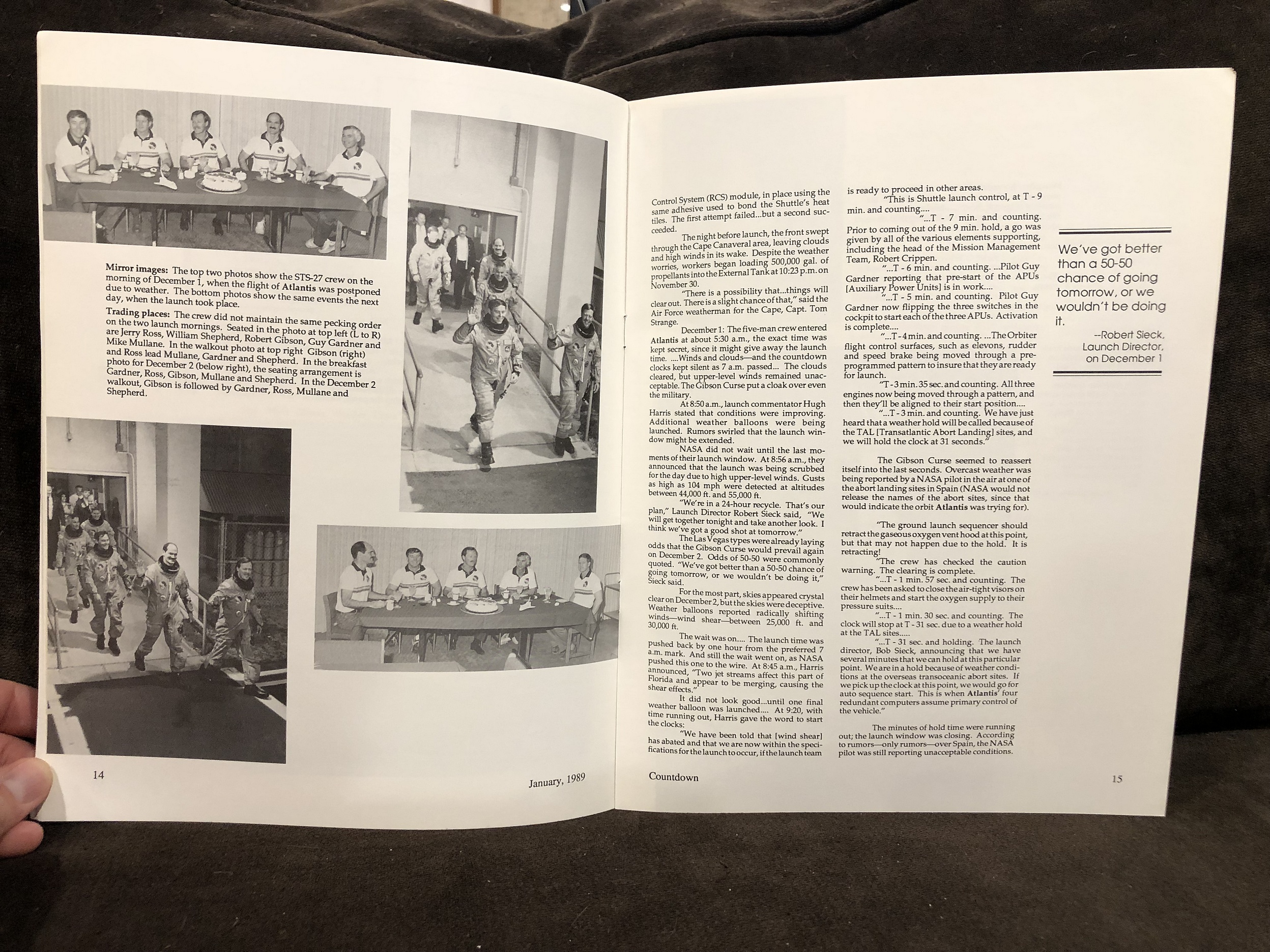
| date1 = 1988-12-01 6:32 | result1 = Scrubbed | reason1 = Weather | decision_date1 = 1988-12-01 9:15 | decision_clock1 = −00:09:00 hold | weathergo1 = 20 | notes1 = Cloud cover and strong high-altitude winds. Due to the secrecy of the mission, NASA did not provide live coverage of the launch until nine minutes before liftoff. NASA and the Air Force stated that 6:32 AM was the earliest time that launch would occur. | date2 = 1988-12-02 9:30:34 | result2 = Success | notes2 = T−9 minute hold extended due to high windshear. Countdown clock was held at T−31 seconds to assess TAL site weather. The Space Shuttle Atlantis (OV-104), at the time the youngest in NASA's shuttle fleet, made its third flight on a classified mission for the United States Department of Defense (DoD). It deployed a single satellite, USA-34. NASA archival information has identified USA-34 as Lacrosse 1, a side-looking radar, all-weather surveillance satellite for the U.S. National Reconnaissance Office (NRO) and the Central Intelligence Agency (CIA).
The mission was originally scheduled to launch on December 1, 1988, but the launch was postponed one day because of cloud cover and strong wind conditions at the launch site. Liftoff occurred from LC-39B at Kennedy Space Center, Florida, on December 2, 1988, at 09:30:34 a.m. EST. Atlantis touched down on December 6, 1988, on Runway 17 at Edwards Air Force Base, California, at 18:36:11 EST. The total mission elapsed time at wheels-stop was 4 days, 9 hours, 5 minutes, and 37 seconds. Atlantis was returned to the Kennedy Space Center on December 13, 1988, and moved into an OPF on December 14, 1988.
There has been speculation that an EVA was conducted during this mission.{{cite news|last=Cassutt|first=Michael |url=https://www.airspacemag.com/space/secret-space-shuttles-35318554/|title=Secret Space Shuttles|work=Air & Space magazine|location=Washington, D.C.|publisher=Smithsonian Institution|date=August 2009 |url-status=live|archive-url=https://web.archive.org/web/20210106082809/https://www.airspacemag.com/space/secret-space-shuttles-35318554/|archive-date=January 6, 2021}} Interviews with members of the crew several years after the flight confirmed there had been a problem with the satellite upon release, whereupon a rendezvous with the satellite was effected and repairs performed. These unspecified repairs could have necessitated a spacewalk, likely performed by Ross and Shepherd. As a classified DoD mission, details or confirmation of such an EVA remain unreleased.
The day after Atlantis landed, the 1988 Armenian earthquake killed tens of thousands in the Soviet Union. At an astronaut meeting Gibson said, "I know many of you may have been very curious about our classified payload. While I can't go into its design features, I can say Armenia was its first target! And we only had the weapon set on stun!"
Tile damage
::figure[src="https://upload.wikimedia.org/wikipedia/commons/4/4a/STS-27metalmelt.jpg" caption="A partly melted aluminum plate on ''Atlantis''{{'}} underside."] ::
Atlantis Thermal Protection System tiles sustained extensive damage during the flight. Ablative insulating material from the starboard solid rocket booster nose cap had hit the orbiter about 85 seconds into the flight, as seen in footage of the ascent. The STS-27 crew also commented that white material was observed on the windshield at various times during ascent. The crew made an inspection of the shuttle's impacted starboard side using the shuttle's Canadarm, but the limited resolution and range of the cameras made it impossible to determine the full extent of the tile damage.
The problem was compounded by the fact that the crew was prohibited from using their standard method of sending images to ground control due to the classified nature of the mission. The crew was forced to use a slow, encrypted transmission method, likely causing the images NASA engineers received to be of poor quality, causing them to think the damage was actually "just lights and shadows". They told the crew the damage did not look any more severe than on past missions.
One report describes the crew as "infuriated" that Mission Control Center seemed unconcerned. When Gibson saw the damage he thought to himself, "We are going to die"; he and others did not believe that the shuttle would survive reentry. Gibson advised the crew to relax because "No use dying all tensed-up", he said, but if instruments indicated that the shuttle was disintegrating, Gibson planned to "tell mission control what I thought of their analysis" in the remaining seconds before his death.
Mullane recalled that while filming the reentry through the upper deck's overhead windows, "I had visions of molten aluminum being smeared backwards, like rain on a windshield". Although the shuttle landed safely, "The damage was much worse than any of us had expected", he wrote. Upon landing, the magnitude of the damage to the shuttle astonished NASA; over 700 damaged tiles were noted, and one tile was missing altogether. This missing tile had fortunately been located over the aluminum mounting plate for an L-band antenna (one of six, part of the Tactical air navigation system (TACAN) landing system), perhaps preventing a burn-through of the sort that would ultimately doom Columbia in 2003. There was almost no damage present on the orbiter's left side. STS-27 Atlantis was the most damaged launch-entry vehicle to return to Earth successfully. Gibson believed that had the shuttle been destroyed, Congress would have ended the shuttle program given that only one successful mission had occurred between his flight and the loss of Challenger.
A review team investigated the cause, beginning with a detailed inspection of the Atlantis TPS damage, and a review of related inspection reports to establish an in-depth anomaly definition. An exhaustive data review followed to develop a fault tree and several failure scenarios. This and other information gained during the review formed the basis for the team's findings and recommendations.
Wake-up calls
NASA began a tradition of playing music to astronauts during Project Gemini, and first used music to awaken a flight crew during Apollo 15. Each track is specially chosen, often by the astronauts' families, and usually has a special meaning to an individual member of the crew, or is applicable to their daily activities.
::data[format=table]
| Flight Day | Song | Artist/Composer |
|---|---|---|
| Day 2 | Army fight song | |
| Day 3 | "Rawhide" parody | Dimitri Tiomkin |
| Day 4 | "Do You Want to Know a Secret" parody | Mike Cahill |
| :: |
Gallery
Image:STS-27 Rollout - GPN-2000-000659.jpg|Atlantis on its launchpad Image:Scanned highres STS027 STS027-33-79 2.jpg|The Brahmaputra River imaged from orbit. Image:ReefBase highres STS027 STS027-32-34.jpg|Fiji imaged from orbit.
References
References
- Harwood, William. (March 27, 2009). "Legendary commander tells story of shuttle's close call". Spaceflight Now.
- (April 25, 2015). "Tell Me A Story: Astronaut Hoot Gibson's and Atlantis' Close Call". Kennedy Space Center Visitor Complex.
- (2016). "Space Shuttle: Developing an Icon - 1972-2013". Specialty Press.
- Becker, Joachim. "Spaceflight mission report: STS-27". SPACEFACTS.
- (1988-12-01). "Advancing storms drops odds to 1 in 5 that Atlantis will be launched on time". Deseret News.
- (January 1989). "Atlantis beats the weather... Although its tiles take a beating". NASA.
- "NASA - NSSDCA - Spacecraft - Details". NASA.
- "Lacrosse 1". NASA.
- Benedict, Howard. (1988-12-01). "Launch is delayed". The Free Lance–Star.
- Benedict, Howard. (1988-12-02). "Shuttle takes off on spy mission". The Free Lance–Star.
- (September 1, 2011). "Space Shuttle Missions Summary". NASA.
- Evans, Ben. (January 30, 2012). "Into the Black: NASA's Secret Shuttle Missions – Part Two". AmericaSpace.
- Evans, Ben. (December 9, 2018). "'Dying All Tensed-Up': 30 Years Since the Troubled Secret Mission of STS-27". AmericaSpace.
- (February 1, 1989). "STS-27R OV-104 Orbiter TPS Damage Review Team, Summary Report - Volume I". NASA.
- Wade, Mark. "STS-27". Astronautix.
- (2006). "Riding Rockets: The Outrageous Tales of a Space Shuttle Astronaut". Charles Scribner's Sons.
- Katnik, Gregory N.. (1989-02-01). "Ice/frost/debris assessment for space shuttle mission STS-27R, December 2, 1988". NASA.
- Gebhardt, Chris. (July 2, 2011). "OV-104/ATLANTIS: An International Vehicle for a Changing World".
- Fries, Colin. (March 13, 2015). "Chronology of Wakeup Calls". NASA.
::callout[type=info title="Wikipedia Source"] This article was imported from Wikipedia and is available under the Creative Commons Attribution-ShareAlike 4.0 License. Content has been adapted to SurfDoc format. Original contributors can be found on the article history page. ::