Structure fire
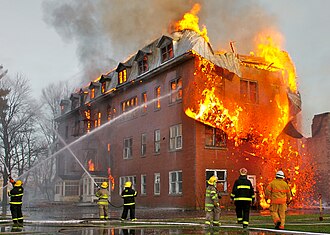
Type of fire
title: "Structure fire" type: doc version: 1 created: 2026-02-28 author: "Wikipedia contributors" status: active scope: public tags: ["firefighting", "types-of-fire", "building-and-structure-fires"] description: "Type of fire" topic_path: "general/firefighting" source: "https://en.wikipedia.org/wiki/Structure_fire" license: "CC BY-SA 4.0" wikipedia_page_id: 0 wikipedia_revision_id: 0
::summary Type of fire ::
::figure[src="https://upload.wikimedia.org/wikipedia/commons/8/8f/Fire_inside_an_abandoned_convent_in_Massueville,_Quebec,_Canada.jpg" caption="A structure fire in [[Massueville, Quebec]], Canada"] ::
A structure fire is a fire involving the structural components of various types of residential, commercial or industrial buildings, such as barn fires. Residential buildings range from single-family detached homes and townhouses to apartments and tower blocks, or various commercial buildings ranging from offices to shopping malls. This is in contrast to "room and contents" fires, chimney fires, vehicle fires, wildfires or other outdoor fires.
Structure fires typically have a similar response from the fire department that include engines, ladder trucks, rescue squads, chief officers, and an EMS unit, each of which will have specific initial assignments. The actual response and assignments will vary between fire departments.
It is not unusual for some fire departments to have a predetermined mobilization plan for when a fire incident is reported in certain structures in their area. This plan may include mobilizing the nearest aerial firefighting vehicle to a tower block, or a foam-carrying vehicle to structures known to contain certain hazardous chemicals.
Types (United States)
In the United States, according to NFPA, structures are divided into five construction types based on the severity of the fire hazard:
::data[format=table]
| Type V: Wood frame | Typically used in recent construction of single-family dwellings, townhouses, garden apartments with four floors or less. |
|---|---|
| :: |
File:Fire- Cotton Avenue, burned section, circa 1876 - DPLA - c5e660569712d1f1d37835782cdaf77f.jpeg|Remains of a structure fire on Cotton Avenue, Macon, Georgia, US. File:Burned-out house in Spokane 2018.jpg|A burned-out house
Causes of house fires
Canada
Information from Canada's National Fire Information Database shows these ignition sources for residential fires in 2014. ::data[format=table title="Residential fire sources of ignition, 6 jurisdictions, 2014{{cite report | url = http://nfidcanada.ca/wp-content/uploads/2017/09/Fire-statistics-in-Canada-2005-to-2014.pdf | title = Fire statistics in Canada, Selected Observations from the National Fire Information Database 2005 to 2014 | author = Statistics Canada | date = Sep 2017 | at = Table D-8, p. 48 | access-date = 1 Jan 2025 | archive-url = https://web.archive.org/web/20240317050338/http://nfidcanada.ca/wp-content/uploads/2017/09/Fire-statistics-in-Canada-2005-to-2014.pdf | archive-date = 17 Mar 2024 | url-status = live | language = en }} ''(Note: only ON, MB, SK, AB, BC, and the CAF reported this data in 2014).''"]
| Ignition source | Examples | Percentage |
|---|---|---|
| Cooking equipment | stoves, hot plates, BBQs, deep fryers | 33% |
| Smoker's material and open flame | cigarettes, lighters, matches, candles, lanterns, blow torches | 24% |
| Heating equipment | central heating, space heaters, wood stoves, fireplaces | 14% |
| Electrical distribution equipment | permanent electric wiring, extension cords, batteries | 11% |
| Appliances and household equipment | televisions, household appliances | 7% |
| Exposure | fire spread from other buildings or outdoors | 7% |
| Other electrical equipment | power tools, lamps, computers | 4% |
| No igniting object | lightning | 1% |
| :: |
A 2023 update from Statistics Canada confirmed that cooking equipment and smoker's material continued to be the top causes of residential fires, at 32% and 25% of total incidents respectively.
United States
Data from the U.S. Fire Administration's National Fire Incident Reporting System shows that cooking has consistently been the leading cause of residential building fires.
::data[format=table title="Residential building fire causes, 2017-2019{{cite web | url = https://www.usfa.fema.gov/downloads/pdf/statistics/v21i2.pdf | title = Residential Building Fires (2017-2019) | author = National Fire Data Center | date = May 2021 | publisher = U.S. Fire Administration | access-date = 31 Dec 2024 | pages = 6 | language = en }} ''(Note: Fires with a cause determined only.)''{{cite web | url = https://www.usfa.fema.gov/downloads/xls/overview_cause_matrix.xls | title = Structure Fire Cause Matrix | publisher = U.S. Fire Administration | access-date = 31 Dec 2024 | language = en}}"]
| Cause | Examples | Percentage |
|---|---|---|
| Cooking | stoves, ovens, cooking fires | 50.9% |
| Heating | furnaces, boilers, water heaters, portable heaters, chimneys | 9.3% |
| Other Unintentional, Careless | product misuse, discarded materials, heat source too close to combustibles | 7.4% |
| Electrical Malfunction | electrical wiring, lighting fixtures | 6.7% |
| Intentional | deliberately set fires | 4.3% |
| Open Flame | candles, matches, lighters, embers | 4.3% |
| Other Heat | fireworks, heat/sparks from friction | 3.4% |
| Appliances | most electronic and electrical appliances | 3.0% |
| Equipment Misoperation, Failure | equipment malfunction or operation deficiency | 2.3% |
| Smoking | cigarettes and other smoking materials | 2.0% |
| Exposure | heat spread from another hostile fire | 1.8% |
| Natural | spontaneous ignition, chemicals, storms | 1.7% |
| Other Equipment | computer, telephone, special or unspecified equipment | 1.3% |
| Cause under investigation | cause still undetermined | 1.3% |
| Playing with Heat Source | children or others playing with fire | 0.4% |
| :: |
References
References
- Statistics Canada. (Sep 2017). "Fire statistics in Canada, Selected Observations from the National Fire Information Database 2005 to 2014".
- Statistics Canada. (8 June 2023). "The Daily: Fire incidents increase during the pandemic".
- "Residential Building Fire Causes (2013-2022)". U.S. Fire Administration.
- National Fire Data Center. (May 2021). "Residential Building Fires (2017-2019)". U.S. Fire Administration.
- "Structure Fire Cause Matrix". U.S. Fire Administration.
::callout[type=info title="Wikipedia Source"] This article was imported from Wikipedia and is available under the Creative Commons Attribution-ShareAlike 4.0 License. Content has been adapted to SurfDoc format. Original contributors can be found on the article history page. ::