Special mark
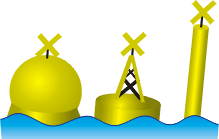
Type of sea mark
title: "Special mark" type: doc version: 1 created: 2026-02-28 author: "Wikipedia contributors" status: active scope: public tags: ["navigational-buoys"] description: "Type of sea mark" topic_path: "general/navigational-buoys" source: "https://en.wikipedia.org/wiki/Special_mark" license: "CC BY-SA 4.0" wikipedia_page_id: 0 wikipedia_revision_id: 0
::summary Type of sea mark ::
::figure[src="https://upload.wikimedia.org/wikipedia/commons/6/60/IALA_specjal_mark.png" caption="Examples of Special Marks"] ::
::figure[src="https://upload.wikimedia.org/wikipedia/commons/b/b2/Buoy_off_Seahill_-geograph.org.uk-_720806.jpg" caption="A '''Special mark''' indicating an outfall pipe in the [[Irish Sea"] ::
off Helen's Bay, Northern Ireland. It has the group flashing sequence "Fl(2) Y" meaning it flashes yellow twice followed by a longer period of darkness.]] A Special Mark, as defined by the International Association of Lighthouse Authorities, is a sea mark used in maritime pilotage. It is recognisable by its yellow colour and "X" (also referred to as a St. Andrews Cross or saltire) top-mark. If a light is fitted the light is always yellow in colour and can have any light characteristic which differs from those used for cardinal marks, isolated danger marks, mobile aid to navigation marks and safe water marks.
Purpose
Special marks can indicate:
- Administrative areas
- Water skiing areas
- Anchorage areas
- Mooring areas
- Waiting areas
- Marine farms
- Oil wells
- Dead ends
- Pipelines
- Spoil ground (an area where dredged material is deposited)
- Historic wrecks
- Protected areas
- Outfall pipes (such as Stormwater, and Cooling water)
- Sewerage pipes
- Intake pipes
- Submarine cables
Other uses
- Buoys, such as a Weather buoy or Mooring buoy are coloured yellow or have a yellow light to indicate it is not an aid to navigation.
References
References
- "R1001 The IALA Maritime Buoyage System".
- "R0110 – Rhythmic Characters of Lights on Aids to Navigation".
::callout[type=info title="Wikipedia Source"] This article was imported from Wikipedia and is available under the Creative Commons Attribution-ShareAlike 4.0 License. Content has been adapted to SurfDoc format. Original contributors can be found on the article history page. ::