Sonnet 75
title: "Sonnet 75" type: doc version: 1 created: 2026-02-28 author: "Wikipedia contributors" status: active scope: public tags: ["sonnets-by-william-shakespeare"] topic_path: "general/sonnets-by-william-shakespeare" source: "https://en.wikipedia.org/wiki/Sonnet_75" license: "CC BY-SA 4.0" wikipedia_page_id: 0 wikipedia_revision_id: 0
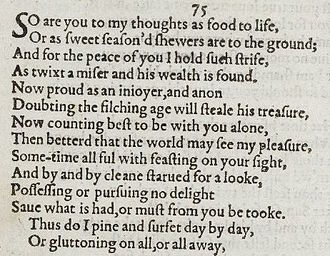
So are you to my thoughts as food to life, Or as sweet-season’d showers are to the ground; And for the peace of you I hold such strife As ’twixt a miser and his wealth is found; Now proud as an enjoyer, and anon Doubting the filching age will steal his treasure; Now counting best to be with you alone, Then better’d that the world may see my pleasure: Sometime all full with feasting on your sight, And by and by clean starved for a look; Possessing or pursuing no delight, Save what is had or must from you be took. :Thus do I pine and surfeit day by day, :Or gluttoning on all, or all away. |source=
Sonnet 75 is one of 154 sonnets written by the English playwright and poet William Shakespeare. It is a member of the Fair Youth sequence, in which the poet expresses his love towards a young man.
Synopsis
The poet expresses his complete pleasure in the presence of his beloved, but says that his devotion resembles that of a miser to his money, filled with anxiety combined with pleasure in his wealth.
Structure
Sonnet 75 is an English or Shakespearean sonnet. The English sonnet has three quatrains, followed by a final rhyming couplet. It follows the typical rhyme scheme of the form, ABAB CDCD EFEF GG, and is composed in iambic pentameter, a type of poetic metre based on five pairs of metrically weak/strong syllabic positions. The 4th line exemplifies a regular iambic pentameter:
× / × / × / × / × / As 'twixt a miser and his wealth is found. (75.4)
The 6th line exhibits two common variations: an initial reversal and a final extrametrical syllable or feminine ending:
/ × × / × / × / × / (×) Doubting the filching age will steal his treasure; (75.6) :/ = ictus, a metrically strong syllabic position. × = nonictus. (×) = extrametrical syllable.
Line 8 necessarily repeats the 6th line's feminine ending. Possible initial reversals also occur in lines 1, 2, 3, 9, 12, and 13; though these can be interpreted in other ways.
The meter demands a few variant pronunciations: in the 2nd line, "showers" functions as 1 syllable, and in the 10th line "starvèd" functions as 2.
Notes
References
References
- (1918). "The Works of Shakespeare: Sonnets". Methuen & Company.
::callout[type=info title="Wikipedia Source"] This article was imported from Wikipedia and is available under the Creative Commons Attribution-ShareAlike 4.0 License. Content has been adapted to SurfDoc format. Original contributors can be found on the article history page. ::