Simoeis
River of the Trojan plain and god in Greek mythology
title: "Simoeis" type: doc version: 1 created: 2026-02-28 author: "Wikipedia contributors" status: active scope: public tags: ["geography-of-ancient-greece", "river-gods-in-greek-mythology", "places-in-the-iliad"] description: "River of the Trojan plain and god in Greek mythology" topic_path: "geography" source: "https://en.wikipedia.org/wiki/Simoeis" license: "CC BY-SA 4.0" wikipedia_page_id: 0 wikipedia_revision_id: 0
::summary River of the Trojan plain and god in Greek mythology ::
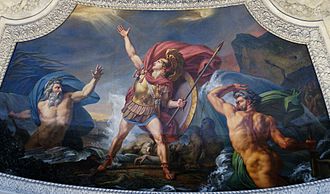
::figure[src="https://upload.wikimedia.org/wikipedia/commons/b/b8/Achilles_Xanthos_Simoeis_Couder_decoration_Louvre_INV3379.jpg" caption="''Water, or the fight of Achilles against Scamander and Simoeis'' by [[Auguste Couder]] (1819), decoration of the Rotonde d'Apollon in the [[Palais du Louvre]]."] ::
Simoeis or Simois ( Simóeis) was a river of the Trojan plain, now called the Dümruk Su (Dümrek Çayı), and the name of its god in Greek mythology.
River
The Simoeis was a small river of the ancient Troad, having its source in Mount Ida, or more accurately in Mount Cotylus, which passed by Troy, joined the Scamander River below that city. This river is frequently spoken of in the Iliad, and described as a rapid mountain torrent. The river is also noted by the ancient geographers Strabo, Ptolemy, Stephanus of Byzantium, Pomponius Mela, and Pliny the Elder. Its present course is so altered that it is no longer a tributary of the Scamander, but flows directly into the Hellespont.
Family
Like other river-gods, Simoeis was the son of Oceanus and Tethys. Simoeis had two daughters who were married into the Trojan royal family. One daughter, Astyoche, was married to Erichthonius, and the other daughter, Hieromneme was the wife of Assaracus.
Mythology
When the gods took sides in the Trojan War, Simoeis supported the Trojans. Scamander, another river who also supported the Trojans, called upon Simoeis for help in his battle against Achilles:"Come to my aid with all speed, fill your streams with water from your springs, stir up all your torrents, stand high in a great wave, and rouse a mighty roar of timbers and rocks, so we can stop this savage man who in his strength is raging like the gods." (Iliad, 21.311-15).Before Simoeis could respond, Hephaestus was able to save Achilles by subduing Scamander with flame.
Trojan descendants
References
- March, J. Cassell's Dictionary Of Classical Mythology. London, 1999.
References
- Or ''Simoïs''
- {{Cite Barrington. 56
- {{Cite Iliad. 4.475, 5.774, 12.22, 21.308
- {{Cite Strabo. xiii. p.597
- {{Cite Ptolemy. 5.2.3
- {{Cite Stephanus. ''s.v.'' Σιμόεις
- {{Cite Mela. 1.18
- {{Cite Pliny. 5.33
- [[Hesiod]], ''[[Theogony]]'' [https://www.perseus.tufts.edu/hopper/text?doc=Hes.+Th.+337&fromdoc=Perseus%3Atext%3A1999.01.0130:boo=0:chapter=0&highlight=Simois 342] & [https://www.perseus.tufts.edu/hopper/text?doc=Hes.+Th.+337 366–370]
::callout[type=info title="Wikipedia Source"] This article was imported from Wikipedia and is available under the Creative Commons Attribution-ShareAlike 4.0 License. Content has been adapted to SurfDoc format. Original contributors can be found on the article history page. ::