Shelled slug
Species of mollusc
title: "Shelled slug" type: doc version: 1 created: 2026-02-28 author: "Wikipedia contributors" status: active scope: public tags: ["testacellidae", "gastropods-described-in-1801"] description: "Species of mollusc" topic_path: "general/testacellidae" source: "https://en.wikipedia.org/wiki/Shelled_slug" license: "CC BY-SA 4.0" wikipedia_page_id: 0 wikipedia_revision_id: 0
::summary Species of mollusc ::
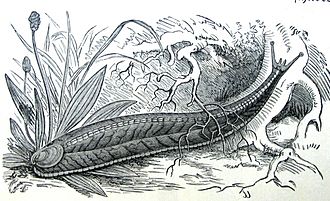
| image = Testacella haliotidea.jpg | image_caption = Drawing of the shelled slug, Testacella haliotidea |status = LC |status_system = IUCN3.1 |status_ref = | taxon = Testacella haliotidea | authority = Lamarck, 1801
The shelled slug, scientific name Testacella haliotidea, is a rarely seen, air-breathing, carnivorous land slug, a terrestrial gastropod mollusk in the family Testacellidae, the shelled slugs.
::figure[src="https://upload.wikimedia.org/wikipedia/commons/4/4a/TaylorMonographSlugsPlate1.jpg" caption="''Testacella haliotidea'', ''Testacella scutulum'' and ''Testacella maugei'' Plate from John W. Taylor ''Monograph of the land & freshwater Mollusca of the British Isles''"] ::
Description
This slug, like others in the family, has a small shell, which is situated towards the rear of the animal. The species epithet is haliotidea because the shell of this species resembles in shape a miniature version of the shell of the marine species in the family Haliotidae, the abalones.
This is a large, very agile, pale brown slug, with a length of 12 cm. It has a small ear-shaped, external shell, less than 1 cm long, at the tail end of the mantle.
ORIGINAL: ''Shell oval-auriform, depressed, rugosely striate, with a thin, readily deciduous epidermis; apex minute, very short, not separated from the columellar margin; aperture rounded, usually dilated anteriorly; columella and outer margin forming a distinct angle at their junction; interior whitish pearly. Length, 6-10 mill.''
-- The following shell description is modified from Tryon 1885. The shell is oval-auriform, depressed, and rugosely striate. It has a thin, readily deciduous epidermis. The apex is minute, very short and not separated from the columellar margin. The aperture is rounded and usually dilated anteriorly; the columella and the outer margin of the aperture form a distinct angle at their junction. The interior of the shell is whitish and pearly. The length of the shell is 6–10 mm.
Distribution
This species is common along the western Mediterranean, along the European Atlantic coast and throughout Great Britain apart from northern Scotland. This slug occurs in Europe but its distribution is under-recorded there.
It was recorded in Czechia as an introduced species. It also occurs as an introduced species in southern Australia, New Zealand and North America (where it is called the earshell slug). The distribution data for the United States, (Oregon, Wisconsin) and Canada (British Columbia, Nova Scotia) are incomplete.
Habitat
This species is seen mostly in the spring, living in cultivated habitats or on disturbed ground. The slug lives mostly underground, but may sometimes be found under stones or in leaf litter.
Life habits
This slug hunts and eats earthworms underground. The radula teeth are a functional adaption in the capturing of prey. The diet of these slugs consists mainly of earthworms, which are usually attacked and eaten underground. However, in very wet conditions, when earthworms are found on the surface, the slugs may attack them there. The grip of the needlelike teeth of the radula of the slug is so strong that when the earthworm prey retreats to its burrow, the slug is also drawn below the surface, where it continues to eat the worm.
Conservation status
- Least concern (LC)
References
References
- Allen, D.J.. (2017). "''Testacella haliotidea''".
- Marshall, B. (2014). Testacella haliotidea Lamarck, 1801. Accessed through: World Register of Marine Species at http://www.marinespecies.org/aphia.php?p=taxdetails&id=819973 on 2014-11-06
- [[George Washington Tryon]]: ''[https://archive.org/details/manualconch01tryorich Manual of conchology; structural and systematic. With illustrations of the species. Second series: Pulmonata, volume 1]''. - 1885, Philadelphia, page 10.
- Podroužková, Štěpánka. (2022-09-12). "The first record of carnivorous semislug Testacella haliotidea Draparnaud, 1801 in Czechia". Malacologica Bohemoslovaca.
- Spencer, H.G., Marshall, B.A. & Willan, R.C. (2009). Checklist of New Zealand living Mollusca. pp 196–219 in Gordon, D.P. (ed.) New Zealand inventory of biodiversity. Volume one. Kingdom Animalia: Radiata, Lophotrochozoa, Deuterostomia. Canterbury University Press, Christchurch
- Stuart M. Bennett. 2000. [http://www.the-piedpiper.co.uk/th11a(1).htm ''Testacella baliotidea'']. Casual Intruders page.
::callout[type=info title="Wikipedia Source"] This article was imported from Wikipedia and is available under the Creative Commons Attribution-ShareAlike 4.0 License. Content has been adapted to SurfDoc format. Original contributors can be found on the article history page. ::