Riddle Gawne

1918 film
title: "Riddle Gawne" type: doc version: 1 created: 2026-02-28 author: "Wikipedia contributors" status: active scope: public tags: ["1918-films", "1918-western-(genre)-films", "1918-lost-films", "american-black-and-white-films", "films-directed-by-william-s.-hart", "films-directed-by-lambert-hillyer", "english-language-western-(genre)-films", "1918-american-films", "1910s-english-language-films", "lost-american-silent-western-(genre)-films"] description: "1918 film" topic_path: "arts" source: "https://en.wikipedia.org/wiki/Riddle_Gawne" license: "CC BY-SA 4.0" wikipedia_page_id: 0 wikipedia_revision_id: 0
::summary 1918 film ::
::data[format=table title="Infobox film"]
| Field | Value |
|---|---|
| name | Riddle Gawne |
| image | Riddle-Gawne-1918-Poster.jpg |
| caption | Theatrical release poster |
| director | {{Plainlist |
| producer | {{Plainlist |
| writer | Charles Alden Seltzer |
| starring | {{Plainlist |
| cinematography | Joseph H. August |
| studio | William S. Hart Productions |
| distributor | Paramount Pictures |
| released | |
| runtime | 5 reels (50 minutes) |
| country | United States |
| language | Silent (English intertitles) |
| :: |
| name = Riddle Gawne | image = Riddle-Gawne-1918-Poster.jpg | caption = Theatrical release poster | director = {{Plainlist|
- William S. Hart
- Lambert Hillyer | producer = {{Plainlist|
- William S. Hart
- Thomas H. Ince | writer = Charles Alden Seltzer | starring = {{Plainlist|
- William S. Hart
- Lon Chaney
- Katherine MacDonald | cinematography = Joseph H. August | studio = William S. Hart Productions | distributor = Paramount Pictures | released = | runtime = 5 reels (50 minutes) | country = United States | language = Silent (English intertitles) Riddle Gawne is a 1918 American silent Western film directed by William S. Hart and Lambert Hillyer, and featuring William S. Hart, Katherine MacDonald and Lon Chaney. The film was co-produced by William S. Hart and Thomas H. Ince. The screenplay was written by Charles Alden Seltzer from his earlier novel The Vengeance of Jefferson Gawne. Chaney historian Jon C. Mirsalis claims that William S. Hart contributed greatly to the screenplay but all other sources credit the writing of the screenplay solely to Charles Alden Seltzer.
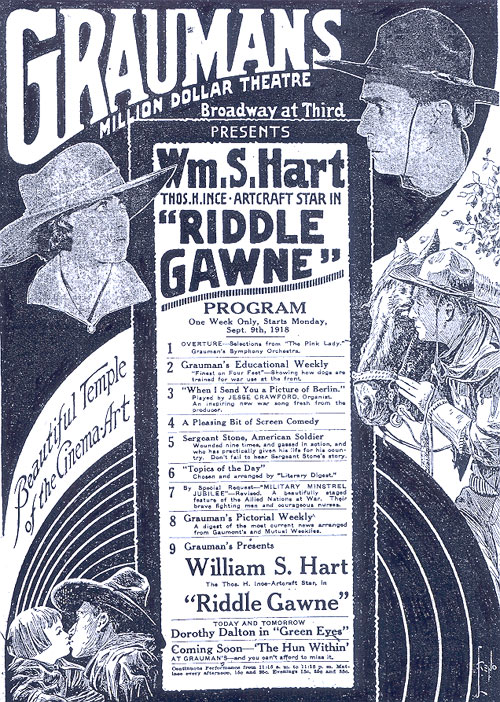
Considered lost for decades, two of the five reels were found to have survived in a Russian archive and are now kept in the film archive of the Library of Congress. It is unknown if Lon Chaney appears in those two reels.' A still exists showing Lon Chaney (as Hame Bossam) preparing to shoot the unconscious Riddle Gawne (William S. Hart) in the head. A 1918 advertisement for the showing of the film at Sid Grauman's "Million Dollar Theater" in downtown Los Angeles exists, as well as a publicity photo showing the film's major players in a group shot.
Plot
Riddle Gawne is a man who seeks vengeance on the man who killed his brother Wesley. Before dying, his brother had revealed his killer's name as "Watt Hyat". Riddle buys a cattle ranch and settles down in an area ruled over by criminal cattle rustlers led by Hame Bozzam (Lon Chaney), who is in reality "Watt Hyat" under an alias.
Kathleen Harkness (MacDonald), the daughter of Colonel Harkness (Tilton), arrives in the West. Defending her honor, Riddle shoots two of Hame Bozzam's henchmen. Unbeknownst to the young woman, her father is a member of Bozzam's cattle rustlers, and Bozzam holds this fact over the old colonel's head so that he will let Hame marry Kathleen. Hame has Riddle shot, but Riddle survives and is nursed back to health.
Riddle then determines to clean up the town, and in the fight that follows, Bozzam kidnaps Kathleen after fatally wounding her father. Riddle, lone handed, pursues the fleeing man and his gang. After the chase, Riddle fights and kills Bozzam's henchman "Nigger" Paisley. But during the fight, Riddle's leg is broken. Threatening the now injured Riddle, Bozzam reveals his real identity as Watt Hyat, the man who killed Riddle's brother. In an ensuing struggle Hame Bozzam is killed, and Riddle wins Kathleen's hand.
Cast
- William S. Hart as Jefferson "Riddle" Gawne
- Katherine MacDonald as Kathleen Harkness
- Lon Chaney as Hame Bozzam / Watt Hyat
- Gretchen Lederer as Blanche Dillon
- Gertrude Short as Jane Gawne (Riddle's niece)
- Edwin B. Tilton as Colonel Harkness
- Milton Ross as Reb Butler
- George Field as "Nigger" Paisley
- Leon De La Mothe as Jess Cass (credited as Leon Kent) ::figure[src="https://upload.wikimedia.org/wikipedia/commons/7/7d/Riddle_Gawne_publicity_photo_1918.jpg" caption="Publicity photo with the cast" alt="Group portrait of the cast in Western costumes, including Hart and Chaney"] ::
Production
Lon Chaney had just left Universal Pictures over a salary dispute before getting hired to appear in Riddle Gawne (at the much higher salary of $125 per week). William S. Hart did not initially want Chaney to play the villain because he felt Chaney was too short to be imposing. It was Lambert Hillyer who talked Hart into using Chaney for the role. (Hillyer claimed his mother had seen Chaney in Hell Morgan's Girl (1917) and called him to Lambert's attention.) Riddle Gawne gave Chaney great exposure to the movie-going public and was instrumental in propelling him to later stardom. (Lambert Hillyer later directed Chaney again in The Shock (1923).)'
Parts of the film were shot on location in the Santa Monica Mountains and in Chatsworth, California, from June 14 to early July. A western ranch house was built on a dairy farm for the production and later burned to the ground for a scene in the film.'
Reception
Censorship
Like many American films of the time, Riddle Gawne was subject to restrictions and cuts by city and state film censorship boards. For example, the Chicago Board of Censors required cuts in Reel 1 (scene of woman at bar), Reel 2 (two scenes of woman at bar, scene of Riddle shooting man in back, the intertitle "Blanche Dillon, former dance hall girl, now Bozzam's 'housekeeper'", and all scenes of young woman in Bozzam's house, scene of Bozzam slugging Jess Cass with gun), Reel 3 (man shooting Riddle from horse, the intertitle "She may be a good nurse, but she ain't the sort of woman I want", etc.), and Reel 5 (Bozzam shooting woman's father, shooting Riddle, and flashback scene showing the shooting of Riddle's brother).
References
References
- Mirsalis, Jon C.. "Riddle Gawne".
- Blake, Michael F.. (1998). "The Films of Lon Chaney". Vestal Press Inc..
- "Progressive Silent Film List: ''Riddle Gawne''".
- "Riddle Gawne (1918)".
- "Riddle Gawn".
- "Riddle Gawne (1918)".
- (August 31, 1918). "Reviews: ''Riddle Gawne''". Exhibitors Herald Company.
- (September 7, 1918). "Official Cut-Outs by the Chicago Board of Censors". Exhibitors Herald.
::callout[type=info title="Wikipedia Source"] This article was imported from Wikipedia and is available under the Creative Commons Attribution-ShareAlike 4.0 License. Content has been adapted to SurfDoc format. Original contributors can be found on the article history page. ::