Restless flycatcher
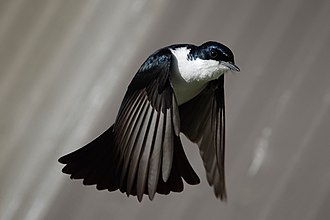
Species of bird
title: "Restless flycatcher" type: doc version: 1 created: 2026-02-28 author: "Wikipedia contributors" status: active scope: public tags: ["myiagra", "birds-of-south-australia", "birds-of-western-australia", "birds-of-new-south-wales", "birds-of-victoria-(state)", "birds-of-queensland", "endemic-birds-of-australia", "birds-described-in-1801"] description: "Species of bird" topic_path: "geography/australia" source: "https://en.wikipedia.org/wiki/Restless_flycatcher" license: "CC BY-SA 4.0" wikipedia_page_id: 0 wikipedia_revision_id: 0
::summary Species of bird ::
| name = Restless flycatcher | status = LC | status_system = IUCN3.1 | status_ref = | image = Restless flycatcher04.jpg | image_caption = Restless flycatcher in flight | genus = Myiagra | species = inquieta | authority = (Latham, 1801) | synonyms = {{Specieslist |Myiagra westralensis| |Seisura inquieta| |Turdus inquietus|
The restless flycatcher (Myiagra inquieta) or restless myiagra is a passerine bird in the family Monarchidae; it is also known as the razor grinder or scissors grinder because of its distinctive call. It is a native of eastern and southern Australia. Populations in New Guinea and northern Australia, which were at one time considered to be a subspecies, are now accepted as a separate species, the paperbark flycatcher (Myiagra nana). It is a small to medium-sized bird and has similar colouring to the willie wagtail.
Taxonomy and systematics
::figure[src="https://upload.wikimedia.org/wikipedia/commons/f/ff/Restless_Flycatcher_Dayboro.JPG" caption="Photographed at Dayboro, SE Queensland, Australia"] ::
Also known colloquially as razor grinder, scissors grinder, dishlicker or dishwasher on account of its unusual call, the restless flycatcher was first described by ornithologist John Latham in 1801 under the binomial name Turdus inquietus. Its specific epithet is derived from the Latin inquietus 'restless'. Populations from northern Australia and New Guinea, formerly considered a distinctive subspecies, are now separated as the paperbark flycatcher (Myiagra nana), with which it forms a superspecies.
Description
It is about 20 cm long, with a glossy dark blue crest, a grey-blue back and white underparts. It is similar to the willie wagtail, though the lack of a black throat, crest on head, white eyebrow and slenderer body shape are distinguishing features.
Distribution and habitat
The Restless Flycatcher is found throughout east, south-east and south-west Australia and Papua New Guinea. From Cairns in Far North Queensland into west of Central Queensland and most of New South Wales, Victoria, southern South Australia and south-west of Western Australia. During winter many south and south-eastern populations move further north. Its habitat is usually open and wooded forests, in river red gums near water, inland and coastal scrubs and some semi-urban environments.
Conservation
Despite being described as of least concern by the IUCN, their population is decreasing. The exact number of individuals is unknown.
Behaviour and ecology
Breeding
The restless flycatcher builds a cup-shaped nest from shredded bark and grasses, matted and bound with spider-webbing. Linings used are soft bark, grasses, hair or feathers. It is often decorated with lichen, strips of bark or spiders' egg sacs. The nest site is in the fork of a well-foliaged tree mostly near or overhanging water, though it can be up to twenty or more metres above the ground. They will lay three, light-grey to white glossy eggs with brown or dark spots at the larger end.
Food and feeding
The restless flycatcher feeds on insects, as well as other invertebrates such as spiders and centipedes and will feed alone or in pairs. It often hovers with its head and tail pointed downwards as it picks insects off from leaves, and it rarely goes to the ground, preferring to hunt insects from mid-canopy.
Footnotes
; References
; Cited texts
- {{cite book | last = Beruldsen | first = Gordon | author-link = Gordon Beruldsen | year = 2003 | title = Australian Birds: Their Nests and Eggs | edition = revised | publisher = self | location = Kenmore Hills, Qld | isbn = 978-0-646-42798-0 | oclc = 615122047
- {{cite book | last = Boles | first = Walter E. | year = 1988 | title = The Robins and Flycatchers of Australia | publisher = Angus & Robertson | location = Sydney | isbn = 978-0-207-15400-3 | oclc = 59196420
- {{cite book | last1 = Christidis | first1 = Les | last2 = Boles | first2 = Walter | year = 2008 | title = Systematics and taxonomy of Australian birds | publisher = CSIRO Publishing | location = Melbourne | isbn = 978-0-643-06511-6 | oclc = 488685950 | url = https://books.google.com/books?id=SFP9P1i-PoEC&q=%22Myiagra+nana%22&pg=PA200 | access-date = 2011-05-25
- {{cite book | last1 = Schodde | first1 = Richard | last2 = Mason | first2 = Ian J. | year = 1999 | title = The Directory of Australian Birds: Passerines | publisher = CSIRO Publishing | location = Melbourne | isbn = 978-0-643-06456-0 | oclc = 499953986
- {{cite book | last = Simpson | first = D. P. | year = 1979 | title = Cassell's Latin Dictionary | publisher = Cassell Ltd. | edition = 5th | location = London | isbn = 978-0-304-52257-6 | oclc = 7260402
::data[format=table] | [[File:Restless flycatcher.jpg|thumb|250px|left|Restless flycatcher]] | [[File:Restless flycatcher with huntsman.jpg|thumb|250px|left|Contrary to their name, restless flycatchers do not only eat flies. Here, one is pictured with a huntsman spider.]] | |---|---| ::
References
- BirdLife International. (2017). "''Myiagra inquieta''".
- "Myiagra nana - Avibase".
- (10 September 1879). "Some Familiar Birds". National Library of Australia.
- Latham, John. (1801). "Supplementum indicis ornithologici sive systematis ornithologiae". Leigh & Sotheby.
- "Restless Flycatchers {{!}} Beauty of Birds".
- "Restless Flycatcher {{!}} BirdLife Australia".
- "Restless Flycatcher {{!}} BIRDS in BACKYARDS".
- Pizzey and Knight, Graham and Frank. (2012). "The Field Guide to the Birds of Australia". Harper Collins.
::callout[type=info title="Wikipedia Source"] This article was imported from Wikipedia and is available under the Creative Commons Attribution-ShareAlike 4.0 License. Content has been adapted to SurfDoc format. Original contributors can be found on the article history page. ::