Phylliidae
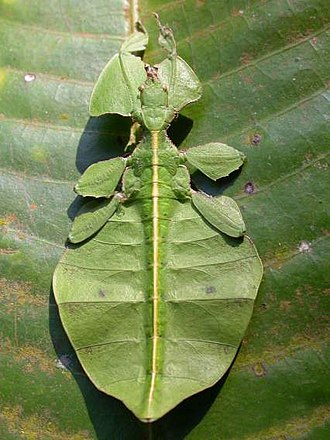
Family of leaf insects
title: "Phylliidae" type: doc version: 1 created: 2026-02-28 author: "Wikipedia contributors" status: active scope: public tags: ["phasmatodea-families", "phylliidae", "taxa-named-by-ludwig-redtenbacher"] description: "Family of leaf insects" topic_path: "general/phasmatodea-families" source: "https://en.wikipedia.org/wiki/Phylliidae" license: "CC BY-SA 4.0" wikipedia_page_id: 0 wikipedia_revision_id: 0
::summary Family of leaf insects ::
| name = Leaf insects | fossil_range = Eocene - Recent | image = LeafInsect.jpg | image_caption = Pulchriphyllium from the Western Ghats | display_parents = 2 | parent_authority = Brunner von Wattenwyl, 1893 | taxon = Phylliidae | authority = Brunner von Wattenwyl, 1893 | subdivision_ranks = Tribes |subdivision_ref = | subdivision =
The family Phylliidae (often misspelled Phyllidae) contains the extant true leaf insects or walking leaves, which include some of the most remarkably camouflaged leaf mimics (mimesis) in the entire animal kingdom. They occur from South Asia through Southeast Asia to Australia. Earlier sources treat Phylliidae as a much larger taxon, containing genera in what are presently considered to be several different families.
Characteristics
Leaf insects are well camouflaged, taking on the appearance of leaves. They do this so accurately that predators often are not able to distinguish them from real leaves. In some species, the edge of the leaf insect's body has the appearance of bite marks. To further confuse predators, when the leaf insect walks, it rocks back and forth, mimicking a real leaf being blown by the wind. In the female this deceptive resemblance is enhanced by the large size and foliaceous form of the front wings which, when at rest edge to edge on the abdomen, forcibly suggest in their neuration the midrib and costae of an ordinary leaf.
The freshly hatched young are reddish in colour; but turn green after feeding for a short time upon leaves. Before death a specimen has been observed to pass through the various hues of a decaying leaf, and the spectrum of the green colouring matter does not differ from that of the chlorophyll of living leaves. Their egg capsules are similarly protected by their likeness to various seeds.
::figure[src="https://upload.wikimedia.org/wikipedia/commons/1/10/Leaf_insect_in_Pakke_Tiger_Reserve.JPG" caption="Leaf insect (''[[Pulchriphyllium]]'' species) in Pakke Tiger Reserve"] ::
The scholar Antonio Pigafetta was probably the first Western person to document the species, though it was known to people in the tropics for a long time. Sailing with Ferdinand Magellan's circumnavigational expedition, he studied and chronicled the fauna on the island of Cimbonbon as the fleet hauled ashore for repairs. During this time he documented the Phyllium species with the following passage:
Tribes, genera and species
The subfamily Phylliinae has been divided into two tribes since 2003. This classification is not confirmed by more recent molecular genetics investigations. In addition to the fossil genus Eophyllium, the subfamily distinguishes thirteen recent genera, eight of which have been described since 2017. Within the Phyllium, previously there were several subgenera recognized, Pulchriphyllium Griffini, 1898 Comptaphyllium and Walaphyllium. As of a 2021 phylogeny, all three subgenera are now considered separate genera .
Since 2021, in addition to morphological, molecular genetic studies have also increasingly been included in clarification of the phylogeny of Phylliidae. Their results show the general relationship between the genera, but when comparing female and male representatives, they do not yet provide a clear phylogenetic picture of the recent genera.
Cladograms of the Phylliidae species determined on the basis of molecular genetics analysis and morphological investigations according to Cumming and Le Tirant (2022):
::data[format=table]
| label1=Phylliidae | 1={{clade | 1={{clade | 40 px]] | 2={{clade | 1={{clade | 50 px]] | 2=Chitoniscus | 50 px]] | 2={{clade | 1={{clade | 1={{clade | 50 px]] | 2={{clade | 1={{clade | 50 px]] | 50 px]] | 50 px]] | 50 px]] | 2={{clade | 1={{clade | 50 px]] | 50 px]] | 2={{clade | 1=Microphyllium | 2=Pseudomicrophyllium | label1=Phylliidae | 1={{clade | 1={{clade | 1={{clade | 1={{clade | 50 px]] | 40 px]] | 2=Chitoniscus | 50 px]] | 2={{clade | 1={{clade | 1={{clade | 1={{clade | 50 px]] | 2={{clade | 50 px]] | 50 px]] | 50 px]] | 50 px]] | 2={{clade | 50 px]] | 2={{clade | 50 px]] | 2={{clade | 1=Microphyllium | 2=Pseudomicrophyllium | ||||
|---|---|---|---|---|---|---|---|---|---|---|---|---|---|---|---|---|---|---|---|---|---|---|---|---|---|---|---|---|---|---|---|---|---|---|---|---|---|---|---|---|---|---|---|---|---|---|---|---|---|---|---|---|---|---|---|
| :: |
The Phasmida Species File lists the following genera in two tribes:
[[Phylliini]]
Auth. Brunner von Wattenwyl, 1893
-
Chitoniscus Stål, 1875 (Pacific)
- Chitoniscus feejeeanus (Westwood, 1864)
- Chitoniscus lobipes Redtenbacher, 1906
- Chitoniscus lobiventris (Blanchard, 1853) - type species (as Phyllium lobiventre Blanchard)
-
Comptaphyllium Cumming, Le Tirant & Hennemann, 2019 (Australasia) [[File:Comptaphyllium caudatum - male with open wings.jpg|thumb|upright|[[Comptaphyllium caudatum]], male from the collection of D. Größer]]
- Comptaphyllium caudatum (Redtenbacher, 1906) - type species (as Phyllium caudatum Redtenbacher)
- Comptaphyllium regina (Cumming, Le Tirant & Hennemann, 2019)
- Comptaphyllium riedeli (van de Kamp & Hennemann, 2014)
-
Cryptophyllium Cumming, Bank, Bresseel, Constant, Le Tirant, Dong, Soner & Bradler, 2021 (SE Asia). Selected species:
- Cryptophyllium athanysus Westwood, 1859
- Cryptophyllium celebicum (De Haan, 1842) - type species (as Phyllium celebicum Haan, W. de)
- Cryptophyllium westwoodii (Wood-Mason, 1875)
-
Microphyllium Zompro, 2001 (Northern Philippine Islands)
- Microphyllium haskelli Cumming, 2017
- Microphyllium spinithorax Zompro, 2001 - type species ::figure[src="https://upload.wikimedia.org/wikipedia/commons/f/fc/The_Childrens_Museum_of_Indianapolis_-_Leaf_insect.jpg" caption="''[[Pulchriphyllium giganteum]]'' in the permanent collection of [[The Children's Museum of Indianapolis"] ::
-
Phyllium Illiger, 1798 (Sundaland, Philippine Islands, Wallacea, Australasia). Selected species:
- Phyllium bilobatum Gray, G.R., 1843
- Phyllium hausleithneri Brock, 1999
- Phyllium jacobsoni Rehn, J.A.G. & Rehn, J.W.H., 1934
- Phyllium letiranti Cumming & Teemsma, 2018
- Phyllium siccifolium (Linnaeus, 1758) - type species (as Gryllus siccifolius Linnaeus)
-
Pseudomicrophyllium Cumming, 2017 (Northern Philippine Islands)
- Pseudomicrophyllium geryon (Gray, G.R., 1843)
- Pseudomicrophyllium pusillulum (Rehn, J.A.G. & Rehn, J.W.H., 1934) - type species (as Pseudomicrophyllium faulkneri Cumming)
-
Pulchriphyllium Griffini, 1898 (Seychelles, India, Western Indonesia, continental Asia) Selected species:
- Pulchriphyllium bioculatum (Gray, G.R., 1832)
- Pulchriphyllium giganteum (Hausleithner, 1984)
- Pulchriphyllium pulchrifolium (Serville, 1838) - type species (as Phyllium pulchrifolium Serville)
-
Rakaphyllium Cumming & Le Tirant, 2022 (New Guinea and Ayu Islands)
- Rakaphyllium exsectum (Zompro, 2001)
- Rakaphyllium schultzei (Giglio-Tos, 1912) – type species (as Pulchriphyllium schultzei Giglio-Tos)
-
Trolicaphyllium Cumming, Le Tirant & Büscher, 2021 (Pacific)[[File:Trolicaphyllium sarrameaense-female.jpg|thumb|upright=0.6|[[Trolicaphyllium sarrameaense]], female from the collection of D. Größer]]
- Trolicaphyllium brachysoma (Sharp, 1898) - type species (as Phyllium brachysoma Sharp)
- Trolicaphyllium erosus (Redtenbacher, 1906)
- Trolicaphyllium sarrameaense Grösser, 2008
-
Vaabonbonphyllium Cumming & Le Tirant, 2022 (New Guinea and Solomon Islands)
- Vaabonbonphyllium groesseri (Zompro, 1998) – type species (as Phyllium groesseri Zompro)
- Vaabonbonphyllium rafidahae Cumming & Le Tirant, 2022
-
Walaphyllium Cumming, Thurman, Youngdale & Le Tirant, 2020 (Australasia)
- Walaphyllium lelantos (Cumming, Thurman, Youngdale & Le Tirant, 2020)
- Walaphyllium monteithi (Brock & Hasenpusch, 2002)
- Walaphyllium zomproi (Grösser, 2001) - type species (as Phyllium zomproi Grösser)
[[Nanophylliini]]
::figure[src="https://upload.wikimedia.org/wikipedia/commons/5/53/Nanophyllium_asekiense_-_female_prepared.jpg" caption="''[[Nanophyllium asekiense]]'', female from the collection of D. Größer"] ::
Auth. Zompro & Grösser, 2003
- Acentetaphyllium Cumming & Le Tirant, 2022 (New Guinea)
- Acentetaphyllium brevipenne (Grösser, 1992) – type species (as Phyllium brevipennis Grösser)
- Acentetaphyllium larssoni (Cumming, 2017)
- Acentetaphyllium miyashitai (Cumming, Le Tirant, Teemsma, Hennemann, Willemse & Büscher, 2020)
- Acentetaphyllium stellae (Cumming, 2016)
- Nanophyllium Redtenbacher, 1906 (Southern Indonesia, New Guinea, NE Australia)
- Nanophyllium adisi Zompro & Grösser, 2003
- Nanophyllium asekiense Grösser, 2002
- Nanophyllium australianum Cumming, Le Tirant & Teemsma, 2018
- *Nanophyllium chitoniscoides * (Grösser, 1992)
- Nanophyllium daphne Cumming, Le Tirant, Teemsma, Hennemann, Willemse & Büscher, 2020
- Nanophyllium frondosum (Redtenbacher, 1906)
- Nanophyllium hasenpuschi Brock & Grösser, 2008
- Nanophyllium keyicum (Karny, 1914)
- Nanophyllium pygmaeum Redtenbacher, 1906 – type species
- Nanophyllium rentzi Brock & Grösser, 2008
- Nanophyllium suzukii (Grösser, 2008)
Captivity
Several species have gained in popularity as pets including Cryptophyllium celebicum, Cryptophyllium westwoodii, Phyllium jacobsoni, Phyllium ericoriai, Phyllium siccifolium, Phyllium letiranti, Phyllium monteithi, Phyllium philippinicum , Phyllium rubrum, Phyllium tobeloense, Pulchriphyllium bioculatum and Pulchriphyllium giganteum .
Extinct species
A 47-million-year-old fossil of Eophyllium messelensis, a prehistoric ancestor of Phylliidae, displays many of the same characteristics of modern leaf insects, indicating that this family has changed little over time.
References
References
- (1977). "The taxonomic arrangement of the Phasmatodea with keys to the subfamilies and tribes". Proceedings of the Entomological Society of Washington.
- [https://web.archive.org/web/20070503162146/http://library.thinkquest.org/C003908/englisch/biology/camouflage_warning/camouflage.html#Anchor-The-5677 Hidden Beauty (Archived)]
- (2003). "Over the Edge of the World: Magellan's Terrifying Circumnavigation of the Globe". William Morrow.
- Pigafetta, Antonio. "Anthony Pigapheta, Patrician of Vincenza, and King of Rhodes, to the very illustrious and very excellent Lord Philip de Villers Lisleaden, the famous Grand Master of Rhodes, his most respected Lord." Alderley, Lord Stanley of. ''The First Voyage Round the World, by Magellan''. New York: Burt Franklin, n.d. 35-163.
- Wedmann, Sonja. (9 January 2007). "The first fossil leaf insect: 47 million years of specialized cryptic morphology and behavior". Proceedings of the National Academy of Sciences.
- [[Paul D. Brock. Brock, P. D.]]; Büscher, T. H. & [[Edward W. Baker. Baker, E. W.]] [https://phasmida.speciesfile.org/otus/852748/overview Phasmida Species File Online]. (access-date 11 August 2025)
- [[Royce T. Cumming. Cumming, R. T.]]; [[Sarah Bank. Bank, S.]]; [[Joachim Bresseel. Bresseel, J.]]; [[Jérôme Constant. Constant, J]]; [[Stéphane Le Tirant. Le Tirant, S.]]; Dong, Z.; Sonet, G. & [[Sven Bradler. Bradler, S.]]: ''[https://zookeys.pensoft.net/article/61033/ Cryptophyllium, the hidden leaf insects – descriptions of a new leaf insect genus and thirteen species from the former celebicum species group (Phasmatodea, Phylliidae)]''ZooKeys 1018: 1–179 (2021)
- Cumming, R. T.; Le Tirant, S. & Büscher, T. H. (2021) ''Resolving a century-old case of generic mistaken identity: polyphyly of Chitoniscus sensu lato resolved with the description of the endemic New Caledonia ''Trolicaphyllium'' gen. nov. (Phasmatodea, Phylliidae)'', ZooKeys 1055: 1–41 (2021), {{doi. 10.3897/zookeys.1055.66796
- Cumming, R. T.; [[Sierra N. Teemsma
- Cumming, R. T.; Le Tirant, S. & [[Frank H. Hennemann. Hennemann F. H.]] (2019) ''[https://www.researchgate.net/publication/335973870_A_new_leaf_insect_from_Obi_Island_Wallacea_Indonesia_and_description_of_a_new_subgenus_within_Phyllium_Illiger_1798_Phasmatodea_Phylliidae_Phylliinae Review of the Phyllium Illiger, 1798 of Wallacea, with description of a new subspecies from Morotai Island (Phasmatodea: Phylliidae: Phylliinae)]'', Faunitaxys, 7(4), Saint-Etienne, 2019: 1 – 25.
- Cumming, R. T.; Thurman, J. H.; Youngdale, S. & Le Tirant, S. (2020) ''[https://zookeys.pensoft.net/article/61033/ Walaphyllium subgen. nov., the dancing leaf insects from Australia and Papua New Guinea with description of a new species (Phasmatodea, Phylliidae)]'' ZooKeys 939:5 (2020)
- Bank, S.; Cumming, R. T.; Li, Y.; Henze, K.; Le Tirant, S. & Bradler, S. (2021) [https://doi.org/10.1038/s42003-021-02436-z A tree of leaves: Phylogeny and historical biogeography of the leaf insects (Phasmatodea: Phylliidae)]
- Cumming, R. T. & Le Tirant, S. (2022) ''Three new genera and one new species of leaf insect from Melanesia (Phasmatodea, Phylliidae)'', ZooKeys 1110: 151–200 (2022), [[doi:10.3897/zookeys.1110.80808]]
- {{EB1911. Reginald Innes. Pocock
::callout[type=info title="Wikipedia Source"] This article was imported from Wikipedia and is available under the Creative Commons Attribution-ShareAlike 4.0 License. Content has been adapted to SurfDoc format. Original contributors can be found on the article history page. ::