Phi Sagittarii
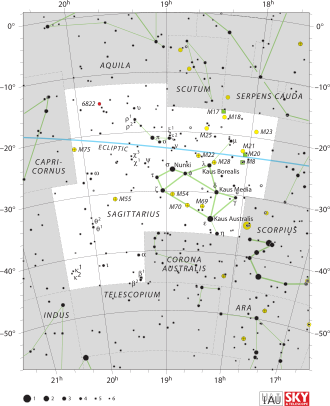
Binary star in the constellation Sagittarius
title: "Phi Sagittarii" type: doc version: 1 created: 2026-02-28 author: "Wikipedia contributors" status: active scope: public tags: ["b-type-giants", "b-type-subgiants", "sagittarius-(constellation)", "bayer-objects", "durchmusterung-objects", "flamsteed-objects", "henry-draper-catalogue-objects", "hipparcos-objects", "bright-star-catalogue-objects"] description: "Binary star in the constellation Sagittarius" topic_path: "general/b-type-giants" source: "https://en.wikipedia.org/wiki/Phi_Sagittarii" license: "CC BY-SA 4.0" wikipedia_page_id: 0 wikipedia_revision_id: 0
::summary Binary star in the constellation Sagittarius ::
| image = | image=Sagittarius IAU.svg | float=center | width=250 | position=right | mark=Red circle.svg | mark_width=10 | mark_link=φ Sgr | x%=56.1 | y%=43.0 | caption=Location of φ Sagittarii (circled) | epoch = J2000 | ra = | dec = | appmag_v = 3.17 | constell = Sagittarius | class = B8.5 III | b-v = −0.11 | u-b = −0.36 | variable = | radial_v = +21.5 | prop_mo_ra = +50.61 | prop_mo_dec = +1.22 | parallax = 13.63 | p_error = 0.19 | parallax_footnote = | absmag_v = −1.16 | component1 = A | mass = 3.48 | radius = 5.31 | luminosity = 475 | temperature = 10,620 | gravity = 3.73 | metal_fe = | rotational_velocity = 46 | age_myr = 152 | component2 = B | mass2 = 1.59 | radius2 = 1.50 | temperature2 = 7,630 | names =
Phi Sagittarii, Latinized from φ Sagittarii, is a binary star in the southern constellation of Sagittarius. With an apparent visual magnitude of 3.17, it is the ninth-brightest star in the constellation and is readily visible to the naked eye. Parallax measurements place it at a distance of roughly 239 ly from the Earth. It is receding with a radial velocity of +21.5 km/s.
The stellar classification of this star has been rated at B8.5 III, with the luminosity class of III indicating it is a giant star evolved away from the main sequence after it has exhausted the hydrogen at its core. This energy is being radiated from the star's outer envelope at an effective temperature of , which produces the blue-white hue typical of B-type stars.
This star has been catalogued as a spectroscopic binary and a companion was apparently detected through lunar occultation. However, the latter was pointed out as spurious. Interferometric observations taken in 2017 finally revealed that Phi Sgr is indeed a binary. The companion is a main sequence star around 60% more massive than the Sun, with an orbital period of roughly a year and an orbital separation of .
Name and etymology
In the catalogue of stars in the Calendarium of Al Achsasi al Mouakket, this star was designated Aoul al Sadirah, which was translated into Latin as Prima τού al Sadirah, meaning first returning ostrich.
In Chinese, 斗 (Dǒu), meaning Dipper, refers to an asterism consisting of φ Sagittarii, λ Sagittarii, μ Sagittarii, σ Sagittarii, τ Sagittarii and ζ Sagittarii. Consequently, the Chinese name for φ Sagittarii itself is 斗宿一 (Dǒu Xiù yī, .)
This star, together with γ Sgr, δ Sgr, ε Sgr, ζ Sgr, λ Sgr, σ Sgr and τ Sgr comprising the Teapot asterism. φ Sgr, σ Sgr, ζ Sgr, χ Sgr and τ Sgr were Al Naʽām al Ṣādirah (النعم السادرة), the Returning Ostriches. According to the catalogue of stars in the Technical Memorandum 33-507 - A Reduced Star Catalog Containing 537 Named Stars, Al Naʽām al Ṣādirah or Namalsadirah was originally the title for four stars: φ Sgr as Namalsadirah I, τ Sgr as Namalsadirah II, χ1 Sgr as Namalsadirah III and χ2 Sgr as Namalsadirah IV (except σ Sgr and ζ Sgr) .
References
References
- Lee, O. J.. (1910-11-01). "Measures on nineteen new spectroscopic binaries.". The Astrophysical Journal.
- {{in lang. zh [http://aeea.nmns.edu.tw/2006/0605/ap060511.html AEEA (Activities of Exhibition and Education in Astronomy) 天文教育資訊網 2006 年 5 月 11 日] {{Webarchive. link. (2011-05-22)
- van Leeuwen, F.. (November 2007). "Validation of the new Hipparcos reduction". Astronomy and Astrophysics.
- (2023-05-16). "Hidden Companions to Intermediate-mass Stars. III. Discovery of a 1.6{{solar mass}}, 1.3 au Companion to HIP 92041 = φ Sagittarii*". Research Notes of the AAS.
- Allen, R. H.. (1963). "Star Names: Their Lore and Meaning". Dover Publications Inc.
- (1979). "Michigan catalogue of two-dimensional spectral types for the HD stars". Dept. of Astronomy, University of Michigan.
- (1999). "Sixth Catalogue of Fundamental Stars (FK6). Part I. Basic fundamental stars with direct solutions". Astronomisches Rechen-Institut Heidelberg.
- (1966). "UBVRIJKL photometry of the bright stars". Communications of the Lunar and Planetary Laboratory.
- "phi Sgr -- Star". Centre de Données astronomiques de Strasbourg.
- (September 2008). "A catalogue of multiplicity among bright stellar systems". [[Monthly Notices of the Royal Astronomical Society]].
- (April 1951). "The duplicity of phi Sgr". Astronomical Journal.
- "PHI SGR (Phi Sagittarii)". University of Illinois.
- (December 21, 2004). "The Colour of Stars". Commonwealth Scientific and Industrial Research Organisation.
::callout[type=info title="Wikipedia Source"] This article was imported from Wikipedia and is available under the Creative Commons Attribution-ShareAlike 4.0 License. Content has been adapted to SurfDoc format. Original contributors can be found on the article history page. ::