Phalguna
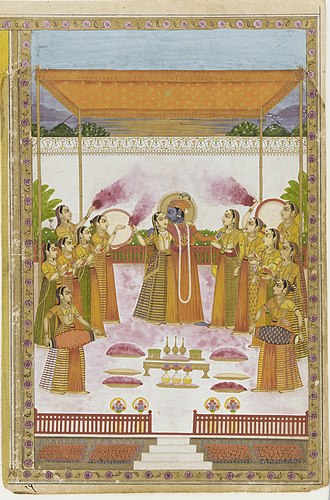
Eleventh month of the Hindu calendar
title: "Phalguna" type: doc version: 1 created: 2026-02-28 author: "Wikipedia contributors" status: active scope: public tags: ["months-of-the-hindu-calendar"] description: "Eleventh month of the Hindu calendar" topic_path: "society/religion" source: "https://en.wikipedia.org/wiki/Phalguna" license: "CC BY-SA 4.0" wikipedia_page_id: 0 wikipedia_revision_id: 0
::summary Eleventh month of the Hindu calendar ::
::data[format=table title="Infobox month"]
| Field | Value |
|---|---|
| image | A_Holi_Festival_-_Krishna_Radha_and_Gopis.jpg |
| caption | Krishna and Radha celebrating Holi, the Hindu festival of colours |
| native_name | sa |
| calendar | Hindu calendar |
| num | 12 |
| days | 29 or 30 |
| season | Shishira (Winter) |
| gregorian | February–March |
| holidays | |
| prev_month | Magha |
| next_month | Chaitra |
| :: |
| image = A_Holi_Festival_-_Krishna_Radha_and_Gopis.jpg | alt = | caption = Krishna and Radha celebrating Holi, the Hindu festival of colours | native_name = sa | calendar = Hindu calendar | num = 12 | days = 29 or 30 | season = Shishira (Winter) | gregorian = February–March | holidays = | prev_month = Magha | next_month = Chaitra Phalguna or Phagun is the twelfth and last month of the Hindu lunar calendar and the Indian national calendar. The name of the month is derived from the position of the Moon near the Pushya nakshatra (star) on the full moon day. The month corresponds to the end of the winter (Shishira) season and falls in January–February of the Gregorian calendar.
In the Hindu solar calendar, it corresponds to the month of Kumbha and begins with the Sun's entry into Aquarius. It corresponds to Falgun, the eleventh month in the Bengali calendar and Vikram Samvat. In the Tamil calendar, it corresponds to the twelfth and last month of Panguni, falling in the Gregorian months of March–April. In the Vaishnav calendar, it corresponds to the twelfth month of Govinda.
In the Hindu lunar calendar, each month has 29 or 30 days. The month begins on the next day after Amavasya (new moon) or Purnima (full moon) as per amanta and purnimanta systems respectively. A month consists of two cycles of 15 days each, Shukla Paksha (waning moon) and Krishna Paksha (waxing moon). Days in each cycle is labeled as a thithi, with each thithi repeating twice in a month.
Festivals
Holi
Holi is a Hindu festival celebrated to mark the end of winter and the arrival of spring (Vasanta). It celebrates various events from Hindu mythology including the love between god Krishna and his consort Radha. It symbolises the victory of good over evil and includes the ritual of lighting bonfires (Holika Dahan) the night before. The bonfire is lit to symbolise the burning away of evil, and is attributed to the event in which Prahalada is saved by god Vishnu from a fire lit by demoness Holika, who is made to instead burn in it. The festival involves throwing coloured powders (gulal) and coloured water, with each colour carrying symbolic meanings.
Maha Shivaratri
Maha Shivaratri is a major Hindu Shaiva festival celebrated on Chaturdashi (14th lunar night) thithi of Krishna Paksha (waxing moon) of the month. It is dedicated to worshipping lord Shiva. The festival commemorates several events from Hindu mythology associated with Shiva including his union with Parvati. People remain awake the entire night, while offering prayers, chanting mantras and performing various rituals.
Panguni Uthiram
Panguni Uthiram is a Tamil festival that falls on the day when the Nakshatra (star) of Uttiram aligns with purnima (full moon day) in the Tamil month of Panguni. The day commemorates the divine marriages of Hindu deities such as Shiva and Parvati, Murugan and Deivanai, and Vishnu and Lakshmi. It also marks the day of manifestation of lord Ayyappan. On the day, special rituals, processions and marriage ceremonies of gods are conducted across Hindu temples.
Shigmo
Shigmo is a spring-festival celebrated by agricultural communities in the state of Goa. The festival marks the onset of spring and the upcoming harvest season. The festival features various folk dances accompanies by music and parades.
Notes
References
References
- Garg, Gaṅgā Rām. (1992). "Encyclopaedia of the Hindu World". Concept Publishing Company.
- Roberts, C.. (2004). "What India Thinks: Being a Symposium of Thought Contributed by 50 Eminent Men and Women Having India's Interest at Heart". Asian Educational Services.
- Selin, Helaine. (2008-03-12). "Encyclopaedia of the History of Science, Technology, and Medicine in Non-Western Cultures". Springer Science & Business Media.
- (1987). "The Religion Of The Hindus". [[Motilal Banarsidass]].
- Garima Garg. (2022). "Heavens and Earth: The Story of Astrology Through Ages and Cultures". [[Penguin Random House]].
- (2005). "Holidays, festivals, and celebrations of the world dictionary". Omnigraphics.
- James G. Lochtefeld. (2002). "The Illustrated Encyclopedia of Hinduism: A-M, N-Z (Vol 1 & 2)". The Rosen Publishing Group.
- (1896). "The Indian Calendar". S. Sonnenschein & Company.
- Christopher John Fuller. (2004). "The Camphor Flame: Popular Hinduism and Society in India". [[Princeton University Press]].
- (1896). "The Indian Calendar". S. Sonnenschein & Company.
- (1989). "The Siddhantas and the Indian Calendar". [[Asian Educational Services]].
- "Tamil Calendar – Months". Time and Date.
- "Vaisnava Calendar Reminder Services – About Calendar". Vaisnava Calendar.
- "Something about the Vaisnava Calendar". ISVARA.
- "Hindu calendar". [[ISKCON]].
- "Hindu calendar". [[Arya Samaj]].
- "Holi: Celebrate the festival of colours". Incredible India.
- "Holi : History and Significance of Holi Festival". [[The Times of India]].
- "Holi 2025: What Do yellow, pink, green, blue and purple colours symbolise?". India Times.
- "Why Maha Shivaratri is celebrated? Know its significance". [[The Times of India]].
- "Astrological significance of Maha Shivaratri". [[The Times of India]].
- "Maha Shivaratri". [[Britannica]].
- University, Vijaya Ramaswamy, Jawaharlal Nehru. (2017-08-25). "Historical Dictionary of the Tamils". Rowman & Littlefield.
- Chambers, James. (2015-07-01). "Holiday Symbols & Customs, 5th Ed.". Infobase Holdings, Inc.
- "Panguni Uthiram 2025: Why it is the perfect time to strengthen marriage or heal relationship, as per Hindu beliefs". [[The Times of India]].
- "Panguni Uthiram: Celebrating Divine Marriages in Tamil Nadu’s Sacred Temples". Culture & Heritage of India.
- "Shigmo : Goa’s harvest festival, hit by Covid-19 this year". [[The Indian Express]].
- "Shigmo celebrations in Goa find expression in unusual traditions". [[The Times of India]].
- "Shigmotsav". Utsav – Events & Festivals in India.
::callout[type=info title="Wikipedia Source"] This article was imported from Wikipedia and is available under the Creative Commons Attribution-ShareAlike 4.0 License. Content has been adapted to SurfDoc format. Original contributors can be found on the article history page. ::