Panopeidae
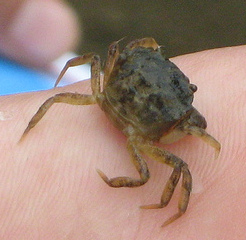
Family of crabs
title: "Panopeidae" type: doc version: 1 created: 2026-02-28 author: "Wikipedia contributors" status: active scope: public tags: ["xanthoidea", "decapod-families"] description: "Family of crabs" topic_path: "general/xanthoidea" source: "https://en.wikipedia.org/wiki/Panopeidae" license: "CC BY-SA 4.0" wikipedia_page_id: 0 wikipedia_revision_id: 0
::summary Family of crabs ::
| image = Dyspanopeus sayi.jpg
| image_caption = Dyspanopeus sayi
| taxon = Panopeidae
| authority = Ortmann, 1893
| synonyms = Eucratopsidae Stimpson, 1871 (nom. rej.)
| synonyms_ref =
::figure[src="https://upload.wikimedia.org/wikipedia/commons/0/05/Lophopanopeus_bellus,_Black-clawed_crab.jpg" caption="''Lophopanopeus bellus'', Black-clawed crab, [[San Luis Obispo County, California]]"]
::
The Panopeidae are a family containing 26 genera of morphologically similar crabs, often known as "mud crabs". Their centers of diversity are the Atlantic Ocean and eastern Pacific Ocean.
Distribution
Most members of the family Panopeidae live in the Atlantic Ocean or eastern Pacific Ocean. Only one species occurs in Australian waters – Homoioplax haswelli.
Ecology
The various genera of the Panopeidae are morphologically similar, partly as a result of many instances of convergent evolution to similar habitats and food preferences.
Crabs of the family Panopeidae are all free-living (not commensal or parasitic), and typically live in soft-bottomed parts of the ocean, lending them the common name "mud crabs" (a name also shared by other organisms). They burrow into the sediment and feed on a variety of marine invertebrates.
Genera
The World Register of Marine Species lists these subfamilies and genera:
| Acantholobulus | Felder & Martin, 2003 | † Balcacarcinus | Karasawa & Schweitzer, 2006 | † Bittnereus | Beschin, Busulini, De Angeli & Tessier, 2007 | † Carinocarcinus | Lőrenthey, 1898 | Dyspanopeus | Martin & Abele, 1986 | Eucratopsis | Smith, 1869 | Eurypanopeus | A. Milne-Edwards, 1880 | Eurytium | Stimpson, 1859 | † Glyphithyreus | Reuss, 1859 | Glyptoplax | Smith, 1870 | Hexapanopeus | Rathbun, 1898 | † Laevicarcinus | Lőrenthey in Lőrenthey & Beurlen, 1929 | Lithopanopeus | Felder & Thoma, 2020 | Lophopanopeus | Rathbun, 1898 | Metopocarcinus | Stimpson, 1860 | Milnepanopeus | Thoma & Felder, 2012 | Neopanope | A. Milne-Edwards, 1880 | Odontoplax | Garth, 1986 | † Pakicarcinus | Schweitzer, Feldmann & Gingerich, 2004 | † Palaeograpsus | Bittner, 1875 | Panopeus | H. Milne Edwards, 1834 | Rhithropanopeus | Rathbun, 1898 | † Sereneopeus | Collins, 2002 | † Serenopeus | Collins, 2002 | † Zovocarcinus | De Angeli & Garassino, 2014
References
References
- P. J. F. Davie. (2002). "Crustacea: Malocostraca: Eucarida (Part 2), Decapoda: Anomura, Brachyura". [[CSIRO Publishing]].
- C. D. Schubart, J. E. Neigel & D. L. Felder. (2000). "Molecular phylogeny of mud crabs (Brachyura: Panopeidae) from the northwestern Atlantic and the role of morphological statis and convergence". [[Marine Biology (journal).
- Boyko, Christopher B.. (15 December 2022). "Panopeidae Ortmann, 1893".
- Felder, Darryl L.. (3 September 2020). "A new genus and species of mud crab (Crustacea, Brachyura, Panopeidae) from shoreline waters of the western Gulf of Mexico". [[Zootaxa]].
::callout[type=info title="Wikipedia Source"] This article was imported from Wikipedia and is available under the Creative Commons Attribution-ShareAlike 4.0 License. Content has been adapted to SurfDoc format. Original contributors can be found on the article history page. ::