Orbital node
Point where an orbit crosses a plane of reference to which it is inclined
title: "Orbital node" type: doc version: 1 created: 2026-02-28 author: "Wikipedia contributors" status: active scope: public tags: ["technical-factors-of-astrology", "orbits", "point-(geometry)"] description: "Point where an orbit crosses a plane of reference to which it is inclined" topic_path: "science/mathematics" source: "https://en.wikipedia.org/wiki/Orbital_node" license: "CC BY-SA 4.0" wikipedia_page_id: 0 wikipedia_revision_id: 0
::summary Point where an orbit crosses a plane of reference to which it is inclined ::
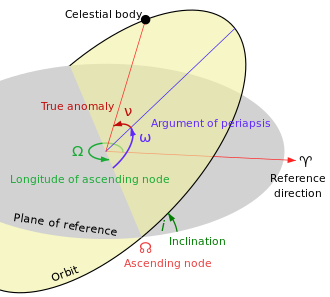
::figure[src="https://upload.wikimedia.org/wikipedia/commons/e/eb/Orbit1.svg" caption="The [[longitude of the ascending node]] is one of several [[orbital elements]]."] ::
An orbital node is either of the two points where an orbit intersects a plane of reference to which it is inclined. A non-inclined orbit, which is contained in the reference plane, has no nodes.
Planes of reference
Common planes of reference include the following:
- For a geocentric orbit, Earth's equatorial plane. In this case, non-inclined orbits are called equatorial.
- For a heliocentric orbit, the ecliptic or invariable plane. In this case, non-inclined orbits are called ecliptic.
- For an orbit outside the Solar System, the plane through the primary perpendicular to a line through the observer and the primary (called the plane of the sky).
Node distinction
::figure[src="https://upload.wikimedia.org/wikipedia/commons/b/b9/Planet_orbit_nodes_2_animation.gif" caption="Animation about nodes of two elliptic trajectories. (Click on image.)"] ::
If a reference direction from one side of the plane of reference to the other is defined, the two nodes can be distinguished. For geocentric and heliocentric orbits, the ascending node (or north node) is where the orbiting object moves north through the plane of reference, and the descending node (or south node) is where it moves south through the plane. In the case of objects outside the Solar System, the ascending node is the node where the orbiting secondary passes away from the observer, and the descending node is the node where it moves towards the observer., p. 137.
The position of the node may be used as one of a set of parameters, called orbital elements, which describe the orbit. This is done by specifying the longitude of the ascending node (or, sometimes, the longitude of the node).
The line of nodes is the straight line resulting from the intersection of the object's orbital plane with the plane of reference; it passes through the two nodes.
Symbols and nomenclature
The symbol of the ascending node is [[Image:Ascending node (bold).svg|16px]] (Unicode: U+260A, ☊), and the symbol of the descending node is [[Image:Descending node (bold).svg|16px]] (Unicode: U+260B, ☋).
In medieval and early modern times, the ascending and descending nodes of the Moon in the ecliptic plane were called the "dragon's head" (, ) and "dragon's tail" (), respectively. These terms originally referred to the times when the Moon crossed the apparent path of the sun in the sky (as in a solar eclipse). Also, corruptions of the Arabic term such as ganzaar, genzahar, geuzaar and zeuzahar were used in the medieval West to denote either of the nodes.
The Koine Greek terms αναβιβάζων and καταβιβάζων were also used for the ascending and descending nodes, giving rise to the English terms anabibazon and catabibazon.
Lunar nodes
Main article: Lunar node
::figure[src="https://upload.wikimedia.org/wikipedia/commons/3/34/Lunar_eclipse_diagram-en.svg" caption="Nodes of the Moon"] ::
For the orbit of the Moon around Earth, the plane is taken to be the ecliptic, not the equatorial plane. The gravitational pull of the Sun upon the Moon causes its nodes to gradually precess westward, completing a cycle in approximately 18.6 years.
Use in astrology
The image of the ascending and descending orbital nodes as the head and tail of a dragon, 180 degrees apart in the sky, goes back to the Chaldeans; it was used by the Zoroastrians, and then by Arabic astronomers and astrologers. In Middle Persian, its head and tail were respectively called gōzihr sar and gōzihr dumb; in Arabic, al-ra's al-jawzihr and al-dhanab al-jawzihr — or in the case of the Moon, ___ al-tennin. Among the arguments against astrologers made by Ibn Qayyim al-Jawziyya (1292–1350), in his Miftah Dar al-SaCadah: "Why is it that you have given an influence to al-Ra's [the head] and al-Dhanab [the tail], which are two imaginary points [ascending and descending nodes]?"
References
References
- (2004). "node". [[Columbia University Press]].
- Darling, David. "line of nodes".
- Tatum, Jeremy B.. "Chapter 17". Celestial Mechanics.
- [http://www.daviddarling.info/encyclopedia/A/ascending_node.html ascending node], entry in ''The Encyclopedia of Astrobiology, Astronomy, and Spaceflight'', David Darling, on line, accessed May 17, 2007.
- ''The Binary Stars'', R. G. Aitken, New York: Semi-Centennial Publications of the University of California, 1918.
- (1956). "A Survey of Islamic Astronomical Tables". Transactions of the American Philosophical Society.
- [http://digital.library.wisc.edu/1711.dl/HistSciTech.Cyclopaedia01 Cyclopædia, or, An universal dictionary of arts and sciences] {{Webarchive. link. (2008-12-02 , Ephraim Chambers, London: Printed for J. and J. Knapton [and 18 others], 1728, vol. 1.)
- (1977). "Planetary Latitudes, the Theorica Gerardi, and Regiomontanus". Isis.
- (1971). "Prophatius Judaeus and the Medieval Astronomical Tables". Isis.
- (1891). "Lexicographical Gleanings from the Philobiblon of Richard de Bury". Transactions of the American Philological Association.
- anabibazon, entry in ''Webster's third new international dictionary of the English language unabridged: with seven language dictionary'', Chicago: Encyclopædia Britannica, 1986. {{ISBN. 0-85229-503-0.
- [https://www.persee.fr/doc/topoi_1161-9473_2001_num_11_1_1928 New thoughts on the genesis of the mysteries of Mithras], Roger Beck, ''Topoi'' '''11''', #1 (2001), pp. 59–76.
- Marcia Rieke. "Introduction: Coordinates, Seasons, Eclipses (lecture notes)". [[University of Arizona]].
- (February 17, 2012). "Gōzihr".
- Livingston, John W.. (1971). "Ibn Qayyim al-Jawziyyah: A Fourteenth Century Defense against Astrological Divination and Alchemical Transmutation". Journal of the American Oriental Society.
::callout[type=info title="Wikipedia Source"] This article was imported from Wikipedia and is available under the Creative Commons Attribution-ShareAlike 4.0 License. Content has been adapted to SurfDoc format. Original contributors can be found on the article history page. ::