Nibble
Four-bit unit of binary data
title: "Nibble" type: doc version: 1 created: 2026-02-28 author: "Wikipedia contributors" status: active scope: public tags: ["computing-terminology", "data-unit", "units-of-information", "articles-with-example-c-code", "articles-with-example-lisp-(programming-language)-code"] description: "Four-bit unit of binary data" topic_path: "technology/computing" source: "https://en.wikipedia.org/wiki/Nibble" license: "CC BY-SA 4.0" wikipedia_page_id: 0 wikipedia_revision_id: 0
::summary Four-bit unit of binary data ::
::callout[type=note] the data storage unit ::
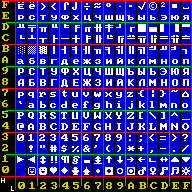
::figure[src="https://upload.wikimedia.org/wikipedia/commons/b/bf/Octets_in_CP866_ordered_by_nibbles.png" caption="octet]] [[code page 866]] font table ordered by nibbles."] ::
In computing, a nibble, also spelled nybble to match byte, is a unit of information that consists of four bits. A nibble is half of a byte, or octet. The unit is alternatively called nyble, nybl, half-byte or tetrade. In networking or telecommunications, the unit is often called a semi-octet, quadbit, or quartet.
As a nibble can represent sixteen (24) possible values, a nibble value is often shown as a hexadecimal digit (hex digit). A byte is two nibbles, and therefore, a value can be shown as two hex digits.
Four-bit computers use nibble-sized data for storage and operations, in the form of the word unit. Such computers were used in early microprocessors, pocket calculators and pocket computers. They continue to be used in some microcontrollers. In this context, 4-bit groups were sometimes also called characters rather than nibbles.
History
The term nibble originates from its representing half a byte, with byte a homophone of the English word bite.
David B. Benson, at the time a Washington State University professor, might have originated the term nibble in 1958 as a joke.
In 1977, an early use of the spelling nybble for the term was recorded within the consumer-banking technology group at Citibank. It created a pre-ISO 8583 standard for transactional messages between cash machines and Citibank's data centers that used the basic data unit nabble.
In the early 1980s, the alternative spelling nybble reflected the spelling of byte, as noted in editorials of Kilobaud and Byte.
Usage
Nibble is used to describe the amount of memory used to store a digit of a number stored in packed decimal format (BCD) within an IBM mainframe. This technique is used to make computations faster and debugging easier. An 8-bit byte is split in half and each nibble is used to store one decimal digit. The last (rightmost) nibble of the variable is reserved for the sign. Thus a variable which can store up to nine digits would be "packed" into 5 bytes. Ease of debugging resulted from the numbers' being readable in a hex dump where two hex numbers are used to represent the value of a byte, as . For example, a five-byte BCD value of represents a decimal value of +314159265.
Historically, nybble was used in many cases for a group of bits greater than 4. On the Apple II, much of the disk drive control and group-coded recording was implemented in software. Writing data to a disk was done by converting 256-byte pages into sets of 5-bit (later, 6-bit) nibbles and loading disk data required the reverse. Moreover, 1982 documentation for the Integrated Woz Machine refers consistently to an "8 bit nibble". The term byte once had the same ambiguity and meant a set of bits but not necessarily 8, hence the distinction of bytes and octets or of nibbles and quartets (or quadbits). Today, the terms byte and nibble almost always refer to 8-bit and 4-bit collections, respectively, and are very rarely used to express any other sizes.
Value representation
A nibble-sized value can be represented in different numeric bases:
::data[format=table]
| Binary | Decimal | Hexadecimal |
|---|---|---|
| 0 | 0 | |
| 1 | 1 | |
| 2 | 2 | |
| 3 | 3 | |
| 4 | 4 | |
| 5 | 5 | |
| 6 | 6 | |
| 7 | 7 | |
| 8 | 8 | |
| 9 | 9 | |
| 10 | A | |
| 11 | B | |
| 12 | C | |
| 13 | D | |
| 14 | E | |
| 15 | F | |
| :: |
Low and high nibbles
The low and high nibbles of a byte are its two halves, which are the least and the most significant bits within the byte, respectively. In a graphical representation of bits within a byte, the leftmost bit could represent the most significant bit (MSB), corresponding to ordinary decimal notation in which the digit at the left of a number is the most significant. In such an illustration, the four bits on the left end of the byte form the high nibble, and the remaining four bits form the low nibble. For example, : the high nibble is 01102 (616), and the low nibble is 00012 (116). The total value is high-nibble × 1610 + low-nibble ().
References
References
- Hollandbeck, Andy. (August 4, 2022). "In a Word: Common Words You Didn’t Know Were Also Units of Measure".
- (1980). "Microprocessors and Digital Systems". [[McGraw-Hill]].
- (2013). "Hacker's Delight". [[Addison Wesley]] – [[Pearson Education, Inc.]].
- (1996). "The New Hacker's Dictionary". [[MIT Press]].
- "Introduction to the use of digital computers: Notes from the Summer Conference Held at the Computation Center of the University of North Carolina, Chapel Hill, N.C., August 17-28, 1959". [[University of North Carolina]] at Chapel Hill, Computation Center.
- (1965). "Digitale Rechenanlagen – Grundlagen / Schaltungstechnik / Arbeitsweise / Betriebssicherheit". [[Springer-Verlag]] / [[IBM]].
- (2012). "Public Data Networks: From Separate PDNs to the ISDN". [[Springer Science+Business Media]].
- (2007). "Webster's New World Telecom Dictionary". [[John Wiley & Sons]].
- (1994). "Data Communications and Networks, Vol. III". [[Institution of Electrical Engineers]].
- (2006-06-27). "Voyage au centre de la HP28c/s". Editions de la Règle à Calcul.
- (1997). "Introduction to C++". [[Morgan Kaufmann]].
- (May 1982). "Beneath Apple DOS". [[Quality Software]].
- (March 1985). "Beneath Apple ProDOS – For Users of Apple II Plus, Apple IIe and Apple IIc Computers". [[Quality Software]].
- (1989-10-31). "Copy II Plus Version 9 – ProDOS/DOS Utilities – Data Recovery, File Management, Protected Software Backup". [[Central Point Software, Inc.]].
- Apple Computer, Inc.. (February 1982). "Integrated Woz Machine (IWM) Specification". DigiBarn Computer Museum.
- (April 1997). "Binary arithmetic".
- (December 1973). "MCS-4 Assembly Language Programming Manual – The INTELLEC 4 Microcomputer System Programming Manual". [[Intel Corporation]].
- (November 1974). "MCS-40 User's Manual For Logic Designers". [[Intel Corporation]].
::callout[type=info title="Wikipedia Source"] This article was imported from Wikipedia and is available under the Creative Commons Attribution-ShareAlike 4.0 License. Content has been adapted to SurfDoc format. Original contributors can be found on the article history page. ::