Nasr (missile)

Pakistani tactical ballistic missile
title: "Nasr (missile)" type: doc version: 1 created: 2026-02-28 author: "Wikipedia contributors" status: active scope: public tags: ["nuclear-missiles-of-pakistan", "ballistic-missiles-of-pakistan", "surface-to-surface-missiles-of-pakistan", "tactical-ballistic-missiles-of-pakistan", "guided-missiles-of-pakistan", "theatre-ballistic-missiles", "military-equipment-introduced-in-the-2010s"] description: "Pakistani tactical ballistic missile" topic_path: "arts" source: "https://en.wikipedia.org/wiki/Nasr_(missile)" license: "CC BY-SA 4.0" wikipedia_page_id: 0 wikipedia_revision_id: 0
::summary Pakistani tactical ballistic missile ::
::data[format=table title="Infobox weapon"]
| Field | Value |
|---|---|
| is_missile | yes |
| name | Hatf-IX Nasr |
| image | Nasr missile at parade.webp |
| caption | Pakistan's Hatf-IX Nasr missile at a military parade. |
| origin | Pakistan |
| type | Short-range ballistic missile (SRBM) |
| used_by | Pakistan Army |
| manufacturer | National Development Complex |
| propellant | Solid fuel |
| service | 2013–present |
| engine | Single-stage solid propellant |
| weight | 1,200 kg |
| length | 6.0 m |
| diameter | 0.4 m |
| vehicle_range | 70 km |
| filling | 400 kg conventional high explosive, cluster munition or plutonium or uranium nuclear warhead tactical nuclear weapon |
| yield | 0.5-5 kilotons |
| launch_platform | Transporter erector launcher (TEL) |
| accuracy | 10 m |
| :: |
::callout[type=note] Pakistan's battlefield missile ::
| is_missile = yes | name = Hatf-IX Nasr | image = Nasr missile at parade.webp | caption = Pakistan's Hatf-IX Nasr missile at a military parade. | origin = Pakistan | type = Short-range ballistic missile (SRBM) | used_by = Pakistan Army
- Army Strategic Forces Command | manufacturer = National Development Complex | unit_cost = | propellant = Solid fuel | production_date = | service = 2013–present | engine = Single-stage solid propellant | engine_power = | weight = 1,200 kg | length = 6.0 m | height = | diameter = 0.4 m | wingspan = | speed = | vehicle_range = 70 km | ceiling = | altitude = | filling = 400 kg conventional high explosive, cluster munition or plutonium or uranium nuclear warhead tactical nuclear weapon | yield = 0.5-5 kilotons | guidance = | detonation = | launch_platform = Transporter erector launcher (TEL) | accuracy = 10 m |width=315px |image1=Nasr Missile and Launch Vehicle |image2=Closeup of Nasr Missile |video1=Video of Nasr Missile Test |video2=A video clip of the Nasr multi-tube ballistic missile}}

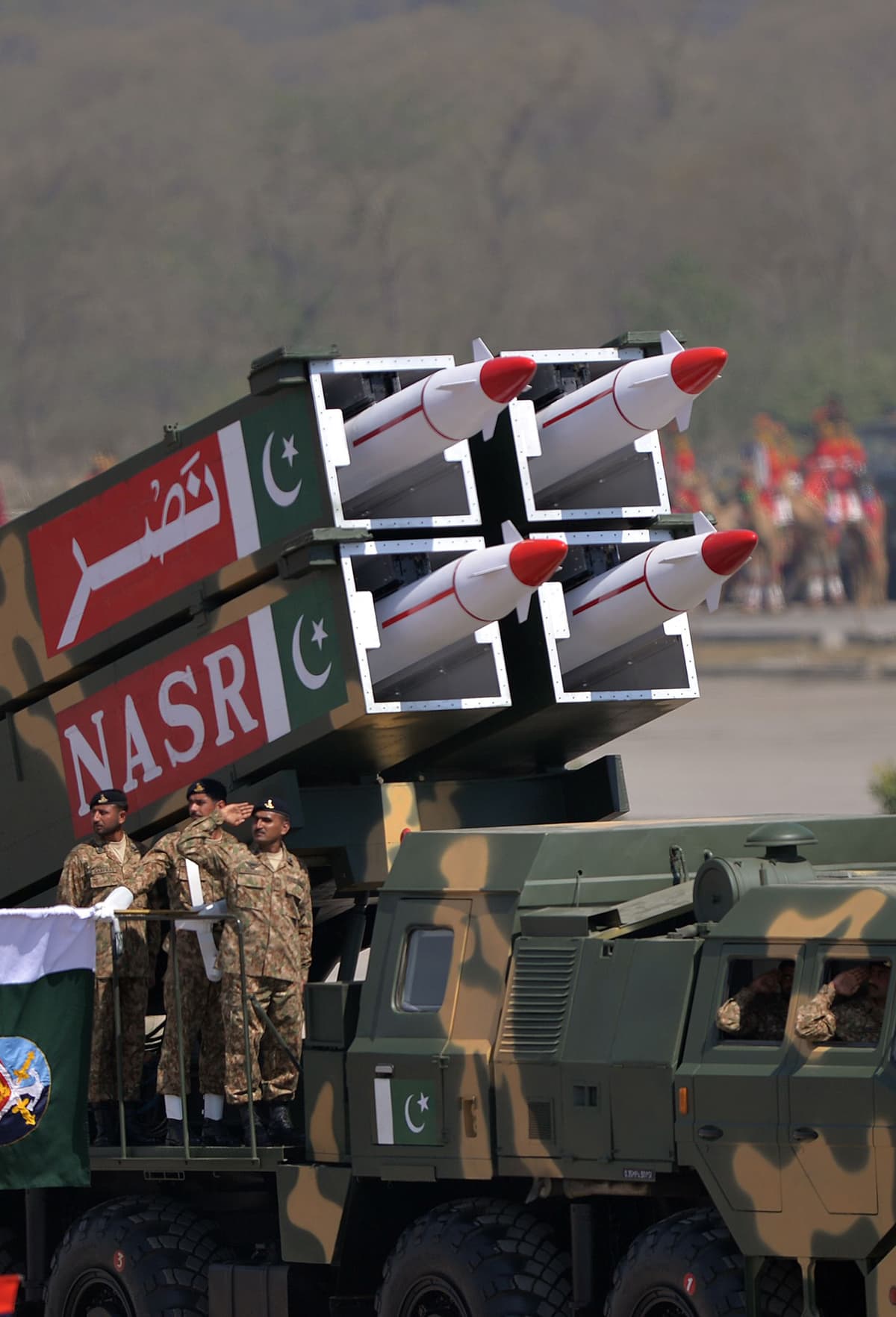
The Nasr (; ; military designation: Hatf-IX), is a solid fuel, short-range nuclear-capable ballistic missile system derived from China's WS-2 tactical rocket, and further developed by the National Development Complex (NDC) of Pakistan, currently in service with the Pakistan Army. Its primary function is to deliver tactical nuclear warheads.
The ISPR described the system as a "multi-tube Ballistic Missile" because the launch vehicle can carry multiple missiles. Its existence as a tactical nuclear delivery system was revealed after a test in 2011, and following further testing, its military deployment seems to have occurred in 2013.
Background
According to defence analysts and missile technology experts, the system appears to have been developed as a "low-yield battlefield deterrent" targeted at "mechanized forces like armed brigades and divisions." Therefore, it is believed by analysts that the system is deployed to deter and respond to India's "Cold Start" doctrine. The military ISPR maintains that the Hatf IX was developed to "add deterrence value... at shorter ranges... with high accuracy, shoot and scoot attributes" for "quick response."
Pakistan confirmed that these tactical nuclear weapons are intended to be used against Indian troops on Pakistani soil. According to analysts, if used just inside Pakistani territory, it would counter the cold start doctrine and maximize ionizing radiation exposure while minimizing blast effects which would be more dangerous for the Indian army than for local people as the blast yield is much lower than strategic nuclear weapons.
Design
The Hatf IX Nasr is a ballistic missile derived from the Chinese WS-2 tactical rocket. Nasr carries a sub-kiloton tactical nuclear weapon out to a range of 70 km. Four missiles are carried on the same Chinese-origin 8x8 transporter erector launcher (TEL) as the Pakistan Army's A-100E 300mm Multiple Launch Rocket System (MLRS), a Chinese version of the BM-30 Smerch.
Capabilities
In test fire footage; the Nasr missile can be seen hitting a target with pinpoint accuracy. However actual figures of the CEP have not been disclosed.
History
The missile's existence was first reported after a test-firing on 19-April-2011. A 4-missile salvo fired on 5 October 2013 is believed to have marked the conclusion of the testing programme and the system's likely entry into service. An extended range missile was tested recently.
References
References
- "Nasr range extended by 10km".
- "Nasr (Hatf 9)".
- (2022-02-11). "Pakistan’s Missiles: Nasr Short Range Ballistic Missile".
- "Nasr (Hatf 9)".
- "Nasr (Hatf 9)".
- Shakil Shaikh. (2011-04-20). "Pakistan test-fires Hatf-IX". The News International.
- Joshua, Anita. (2011-04-19). "Pakistan tests short-range ballistic missile". The Hindu.
- "Making Sense of 'Nasr' | Manohar Parrikar Institute for Defence Studies and Analyses".
- (2018-09-03). "Pakistani nuclear forces, 2018". Bulletin of the Atomic Scientists.
- ":: ISPR :: Inter Services Public Relations - PAKISTAN".
- Reporter, The Newspaper's Staff. (2019-01-25). "Successful ‘training launch’ of ballistic missile Nasr".
- "نصر میزائل کا ایک اور کامیاب تجربہ".
- "Nasr - Tactical ballistic missile".
- "Experts: Missile Test Firing Shows Development Complete".
- Usman Ansari. (6 November 2013). "Experts: Missile Test Firing Shows Development Complete".
- "Nasr range extended by 10km".
::callout[type=info title="Wikipedia Source"] This article was imported from Wikipedia and is available under the Creative Commons Attribution-ShareAlike 4.0 License. Content has been adapted to SurfDoc format. Original contributors can be found on the article history page. ::