Nanoflower
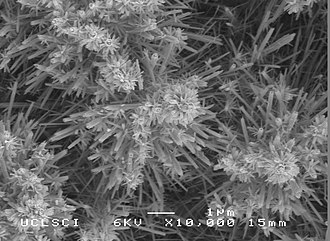
Compound that results in formations which in microscopic view resemble flowers
title: "Nanoflower" type: doc version: 1 created: 2026-02-28 author: "Wikipedia contributors" status: active scope: public tags: ["nanoparticles-by-morphology"] description: "Compound that results in formations which in microscopic view resemble flowers" topic_path: "general/nanoparticles-by-morphology" source: "https://en.wikipedia.org/wiki/Nanoflower" license: "CC BY-SA 4.0" wikipedia_page_id: 0 wikipedia_revision_id: 0
::summary Compound that results in formations which in microscopic view resemble flowers ::
::figure[src="https://upload.wikimedia.org/wikipedia/commons/b/bc/Nanoflowers.jpg" caption="Catalytic nanomaterial with a flower-shaped structure"] ::
A nanoflower, in chemistry, refers to a compound of certain elements that results in formations which in microscopic view resemble flowers or, in some cases, trees that are called nanobouquets or nanotrees. |url=http://nanotechweb.org/cws/article/tech/19739 |title=Silicon carbide nanoflowers bloom - nanotechweb.org |publisher=nanotechweb.org |accessdate=2008-06-18 |last= |first= These formations are nanometers long and thick so they can only be observed using electron microscopy.{{cite web |url = http://www.sciencentral.com/articles/view.php3?type=article&article_id=218392630 |title = Nanoflowers: Science Videos - Science News - ScienCentral |publisher = www.sciencentral.com |accessdate = 2008-06-18 |last = Kalaugher |first = Liz |url-status = dead |archiveurl = https://web.archive.org/web/20080803080335/http://www.sciencentral.com/articles/view.php3?type=article&article_id=218392630 |archivedate = 2008-08-03
Production
Several ways to produce nanoflowers are known:
- A process similar to the making of a carbon nanotube using a hydrocarbon gas.
- Heating gallium (Ga) and then flowing methane (CH4) over, under specific pressure and heat. This forms flower-shaped silicon carbide (SiC) structures.
- Heating a molybdenum dioxide (MoO2) thin film on a piece of molybdenum foil surrounded by sulfur vapour.{{cite web |url=http://nanotechweb.org/cws/article/tech/17264 |title=Nanoflowers blossom in place of nanotubes - nanotechweb.org |publisher=nanotechweb.org |last=Kalaugher |first=Liz |accessdate=2008-06-18 |archive-url=https://web.archive.org/web/20160303231033/http://nanotechweb.org/cws/article/tech/17264 |archive-date=2016-03-03 |url-status=dead
Nanomeadow
In supercapacitors, energy is stored because the electrodes are coated with a porous material that soaks up ions like a sponge, usually activated carbon. Nanomeadow supercapacitors store ions in manganese oxide (MnO), a material with a much greater capacity for ions than activated carbon.
Scientists at Research Institute of Chemical Defence (Beijing, China) and Peking University created a nanomeadow of microscopic structures, fuzzy flowers of MnO each about 100 nanometres across on a field of messy carbon nanotube grass grown on a tantalum metal foil. Nanomeadows perform 10 times better than MnO alone and can store twice as much charge as the carbon-based electrodes in existing ultracapacitors.
Footnotes
References
- Summary of the 2nd E.E.F. (Enosi Ellinon Fysikon, Hellenic Science Society) Conference in Texnopolis Athens, Greece
References
- Colin Barras. (17 September 2008). "Can nanoscopic meadows drive electric cars forward?". New Scientist .
::callout[type=info title="Wikipedia Source"] This article was imported from Wikipedia and is available under the Creative Commons Attribution-ShareAlike 4.0 License. Content has been adapted to SurfDoc format. Original contributors can be found on the article history page. ::