NameBase
Database of names relating to intelligence community
title: "NameBase" type: doc version: 1 created: 2026-02-28 author: "Wikipedia contributors" status: active scope: public tags: ["internet-properties-established-in-1995", "online-databases"] description: "Database of names relating to intelligence community" topic_path: "technology/databases" source: "https://en.wikipedia.org/wiki/NameBase" license: "CC BY-SA 4.0" wikipedia_page_id: 0 wikipedia_revision_id: 0
::summary Database of names relating to intelligence community ::
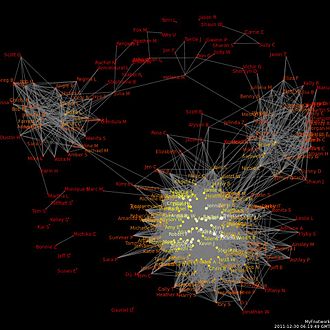
::figure[src="https://upload.wikimedia.org/wikipedia/commons/9/90/Kencf0618FacebookNetwork.jpg" caption="social network diagram]]s ultimately generally similar to this one created by a third-party app in 2011 (displaying friendship ties among a set of [[Facebook]] users)"] ::
NameBase is a web-based social network database of names that focuses on individuals involved in the international intelligence community, U.S. foreign policy, crime, and business. The focus is on the post-World War II era and on left of center, conspiracy theory, and espionage activities up to 2008.{{cite magazine |date=Sep–Oct 1996 | title = NameBase tracks lesser-known political players |magazine=Online | volume = 20 | issue = 5 |page=74 | url = http://www.highbeam.com/doc/1G1-18696782.html | archive-url = https://web.archive.org/web/20121021031359/http://www.highbeam.com/doc/1G1-18696782.html | url-status = dead | archive-date = 2012-10-21
Overview
Founder Daniel Brandt, who later became an Internet activist, began collecting clippings and citations pertaining to influential people and intelligence agents in the 1960s. He did so especially in the 1970s after becoming a member of Students for a Democratic Society, an organization that opposed US foreign policy.
In the 1980s, through his company Micro Associates, he sold subscriptions to this computerized database under its original name, Public Information Research Inc. (PIR). At PIR's onset, Brandt was President of the newly formed non-profit corporation, and investigative researcher Peggy Adler served as its Vice President. The material was described as "information on all sorts of spooks, military officials, political operators and other cloak-and-dagger types". He told The New York Times at the time that "many of these sources are fairly obscure so it's a very effective way to retrieve information on U.S. intelligence that no one else indexes." One research librarian calls it "a unique part of the 'Deep Web'", equally useful to investigative journalists and students.{{cite web |url = https://kb.osu.edu/bitstream/handle/1811/325/rightstuff.pdf |title = The Right Stuff: Research Strategies for the Internet Age |first = Nancy |last = O'Hanlon |date = May 23, 2005 |publisher = Ohio State University Libraries |access-date = 2023-08-22
By 1992, private citizens, news organizations, and universities were all using NameBase.{{cite journal |date=January 1992 | title = Deadly Data | journal = The Progressive | volume = 56 | issue = 1 |page=14 | publisher = Progressive, Inc | location = Madison, Wisconsin | issn = 0033-0736 |title=United States History: A Multicultural, Interdisciplinary Guide to Information Sources |first=Anna H. |last=Perrault |author2=Ron Blazek |page=35 |publisher=Libraries Unlimited |location=Westport, Connecticut; London |isbn=1-56308-874-6 |year=2003 |url=https://archive.org/details/unitedstateshist0002perr|url-access=registration
Similar projects
In the 1980s Daniel Brandt taught former CIA employee Philip Agee how to use computers and computer databases for his research. Former CIA analyst Ralph McGehee developed a similar database he called CIABASE, a website containing information on events, people, and programs concerning the CIA or American intelligence, including links to other texts available to the public.
The Notable Names Database (NNDB) is an online database and self-described "intelligence aggregator" bringing together the biographical details of over 40,000 people.
References
References
- Hand, Mark. [http://www.counterpunch.org/hand01032003.html "Searching for Daniel Brandt"] {{webarchive. link. (2007-03-28 . [[CounterPunch]] (January 3, 2003). Retrieved 15 June 2007.)
- Farhad Manjoo. (August 29, 2002). "Meet Mr. Anti-Google". [[Slate (magazine).
- Daniel Brandt. (December 1992). "An Incorrect Political Memoir". Lobster-magazine.co.uk.
- Morley, Jefferson. (November 7, 1988). "Beltway Bandits: Tinker, Tailor, Soldier, Spywatcher". [[The Nation]].
- Gerth, Jeff. (October 6, 1987). "Washington Talk: The Study of Intelligence; Only Spies Can Find These Sources". [[New York Times]].
- Kantor, Paul B.. (2005). "Intelligence and security informatics". [[Springer Publishing.
- [https://archive.today/20200913182621/https://www.nndb.com/about/ "About."] ''[[NNDB]]''. Retrieved 29 November 2020.
::callout[type=info title="Wikipedia Source"] This article was imported from Wikipedia and is available under the Creative Commons Attribution-ShareAlike 4.0 License. Content has been adapted to SurfDoc format. Original contributors can be found on the article history page. ::