Naimans
12th-century tribal confederation of the Mongolian Plateau
title: "Naimans" type: doc version: 1 created: 2026-02-28 author: "Wikipedia contributors" status: active scope: public tags: ["mongol-peoples", "history-of-inner-mongolia", "mongolian-tribes-and-clans", "southern-mongols", "hazara-tribes", "church-of-the-east-in-central-asia", "kazakh-tribes", "tribes-of-asia", "turkic-peoples-of-asia", "nomadic-confederacies"] description: "12th-century tribal confederation of the Mongolian Plateau" topic_path: "history" source: "https://en.wikipedia.org/wiki/Naimans" license: "CC BY-SA 4.0" wikipedia_page_id: 0 wikipedia_revision_id: 0
::summary 12th-century tribal confederation of the Mongolian Plateau ::
::data[format=table title="Infobox ethnic group"]
| Field | Value |
|---|---|
| group | Naimans |
| image | Naiman Khanate.png |
| image_upright | 1.5 |
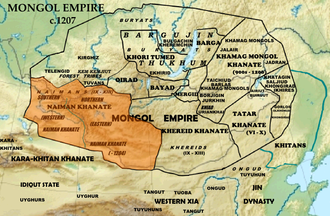
| caption | Location of the Naiman khanate at the start of the Mongol Empire |
| region1 | Mongolia |
| pop1 | |
| ref1 | |
| region2 | China: Naiman Banner |
| pop2 | |
| ref2 | |
| region3 | Kazakhstan |
| pop3 | 940.000 |
| ref3 | |
| languages | Turkic, Mongolic |
| religions | Tibetan Buddhism (Mongolia) |
| Islam (Kazakhstan, Uzbekistan, Kyrgyzstan) | |
| Shamanism | |
| Nestorianism (Former) | |
| native_name | |
| native_name_lang | mn |
| :: |
| group = Naimans | image = Naiman Khanate.png | image_upright = 1.5 | caption = Location of the Naiman khanate at the start of the Mongol Empire | pop = | region1 = Mongolia | pop1 = | ref1 = | region2 = China: Naiman Banner | pop2 = | ref2 = | region3 = Kazakhstan | pop3 = 940.000 | ref3 = | languages = Turkic, Mongolic | religions = Tibetan Buddhism (Mongolia) Islam (Kazakhstan, Uzbekistan, Kyrgyzstan) Shamanism Nestorianism (Former) | related = | native_name = | native_name_lang = mn The Naiman (; Karakalpak: Nayman; , نايمان ; Kyrgyz: Найман; ; Nogai: Найман; Uzbek: Nayman), meaning The Eight, was a medieval tribe originating in the territory of modern Western Mongolia (possibly during the time of the Uyghur Khaganate), and is one of the 92 tribes of Uzbeks, modern Mongols, in the middle juz of the Kazakhs, Karakalpaks, Kyrgyzs and Nogais.
History
In The Secret History of the Mongols, the Naiman subtribe the "Güchügüd" are mentioned. According to Russian Turkologist Nikolai Aristov's view, the Naiman Khanate's western border reached the Irtysh River and its eastern border reached the Mongolian Tamir River. The Altai Mountains and southern Altai Republic were part of the Naiman Khanate. They had diplomatic relations with the Kara-Khitans, and were subservient to them until 1175. Western European and Asian scholars classified them as a Turkic people from Sekiz Oghuz (means "Eight Oghuz" in Turkic). Scholars like Paul Ratchnevsky, Wolfgang-Ekkehard Scharlipp, Hans Robert Roemer, Maria Czaplicka, Steven Runciman, John Man, Morris Rossabi, Frederick W. Mote, Li Tang, Joo-Yup Lee/Shuntu Kuang, Hans-Joachim Klimkeit, René Grousset classified them as Turkic people. UNESCO-published History of Civilizations of Central Asia classified them as Turkic people. In the Russian and Soviet historiography of Central Asia they were traditionally ranked among the Mongol-speaking tribes. For instance, such Russian orientalists as Vasily Bartold, Grigory Potanin, Boris Vladimirtsov, Ilya Petrushevsky, Nicholas Poppe, Lev Gumilyov, Vadim Trepavlov classified them as one of Mongol tribes. However, the term "Naiman" has Mongolian origin meaning "eight", but their titles are Turkic, and they are thought by some to be possibly Mongolized Turks. They have been described as Turkic-speaking, as well as Mongolian-speaking. Chinese historian Feng Chia-Sheng considered the Naimans to be the western branch of the Zubu; in his view, the eastern Zubu were the Jalairs and the Tatars, while the northern Zubu were the Keraites.
Like the Khitans and the Uyghurs, many of them were Nestorian Christians or Buddhists.
The Naimans were located to the west of the Mongols, and there were more Naimans than Mongols in the late 12th century. In 1199, Temüjin (Genghis Khan) together with an ally Ong khan launched a campaign against the Naimans. They defeated Buyirugh, a Naiman khan who ruled the mountain lineage. In 1203, the last Tayang khan, the ruler of Naimans of the steppe, was killed after a battle with Genghis Khan. His son Kuchlug with his remaining Naiman troops then fled to the Kara-Khitan Khanate. Kuchlug was well received there and the Khitan Khan gave him his daughter in marriage. Kuchlug soon began plotting against his new father-in-law, and after he usurped the throne, he began to persecute Muslims in the Hami Oases. But his action was opposed by local people and he was later defeated by the Mongols under Jebe.
Although the Naiman Khanlig was crushed by the Mongols, they were seen in every part of the Mongol Empire. Ogedei's great khatun ("queen") Töregene might have been from this tribe. Hulegu had a Naiman general, Ketbuqa, who died in the Battle of Ain Jalut in 1260.
After the collapse of the Yuan dynasty, the Naiman were eventually assimilated into Mongol, Tatar, and Kazakh tribes.
Among Mongols
The modern Naiman tribe is an ethnic group in Naiman Banner, Inner Mongolia of China. The clan Naiman changed the clan name and mixed with other tribes in Mongolia.
Among Turkic peoples
Karakalpak
Naimans are one tribal groups of Karakalpaks.
Kazakhs
Modern Kazakh historians claim that more than 2 million of the Kazakh population are Naimans (see Modern Kazakh tribes or Middle Juz). They originate from eastern Kazakhstan. Some Naimans dissimilated with the Kyrgyz and Uzbek ethnicities and are still found among them. Now, the Naimans are one of the big tribes of modern Kazakh peoples, they belong to Middle Juz of Kazakhs, live mainly in the eastern, central and southern parts of Kazakhstan, with a population of approximately one million among Kazakhs in Kazakhstan. ::figure[src="https://upload.wikimedia.org/wikipedia/commons/3/38/Zakaukazie-Turkestan1903.jpg" caption="Map from a 1903 Polish encyclopedia showing the Naiman people living north of [[Lake Balkhash]] in eastern Kazakhstan"] ::
They also exist with considerable population among the Kazakhs in China, Uzbekistan and Russia, the Naiman tribe populations in the Kazakhs in China is 700000 or more, mostly living in the western part of Xinjiang Uighur Autonomous Region of China, in the Ili Kazakh Autonomous Prefecture. Naimans are also one of the major tribe among Kazakhs in the Uzbekistan, they also exist among Kazakhs in Kyrgyzstan and Russia.
Genetics
The two most common haplogroups among the Naimans of Kazakhstan are O2a2b1-M134 (42%) and C2-M217 (37%) . At the clan level, haplogroup O2a2b1-M134 is more characteristic of the Tolegetai clan (70%), while haplogroup C2b1a2-M48 is more common among the Saryzhomart clan (61%).
Genetically, the Kazakhs of Kazakhstan are most closely related to the Uzumchins, who live in Inner Mongolia and eastern Mongolia.
According to genetic studies, the Naimans of Kazakhstan most likely descend in the direct paternal line from ancestors bearing haplogroup O, which is typically associated with East Asian populations.
The Naimans, along with such tribal groups as the Uisun, Zhalayir, Kerey, Konyrat, Alimuly, Bayuly, Zhetiru, and Tore, are included in a cluster that finds genetic proximity with the populations of Buryat Ekhirit-Bulagatsky District, various groups of Mongols, Karakalpak, Khamnigan, Hazara, and Evenk populations.
Kyrgyz
Naimans are part of Ichkilik (also known as Bulgachilar) one three largest tribal associations of Kyrgyzs.
Nogais
Naimans are part of Nogai tribes.
Uzbeks
The Naimans is part of 92 tribes of Uzbeks.
Religion
The main religion of the Naimans was shamanism and Nestorian Christianity. The Naimans that adopted Nestorianism probably converted around the same time the Keraites adopted the religion in the 11th century. They remained so after the Mongol conquest and were among the second wave of Christians to enter China with Kublai Khan. Some Nestorian Naiman fled to Kara Khitai during the Mongol conquests where some converted to Buddhism.
There was a tradition that the Naimans and their Christian relatives, the Keraites, descended from the Biblical Magi. The commander of the Mongol army that invaded Syria in 1259, Kitbuqa, was a Naiman: he is recorded to have "loved and honoured the Christians, because he was of the lineage of the Three Kings of Orient who came to Bethlehem to adore the nativity of Our Lord". However, Kitbuqa was slain and his army decisively defeated at the Battle of Ain Jalut, ensuring continued Muslim hegemony over the Levant.
Nestorianism declined and vanished among the Naiman soon after the collapse of the Yuan dynasty. Mongolian Naimans converted to Tibetan Buddhism in the sixteenth century. The Naiman assimilated into other ethnic groups living in Eurasia and likely adopted the religion and culture of the dominant group. The Naimans who settled in the western khanates of the Mongol Empire all eventually converted to Islam.
References
References
- Хороо, Үндэсний Статистикийн. "Үндэсний Статистикийн Хороо".
- Очир А. Монгольские этнонимы: вопросы происхождения и этнического состава монгольских народов / д.и.н. Э. П. Бакаева, д.и.н. К. В. Орлова. — Элиста: КИГИ РАН, 2016. — 286 с. — С. 116—119. — {{ISBN. 978-5-903833-93-1.
- 978-0-8108-7983-6.
- Казахов посчитали по родам: самые многочисленные — аргыны и дулаты https://365info.kz/2016/08/kazahov-poschitali-po-rodam-samye-mnogochislennye-argyny-i-dulaty
- Man, John. (2013). "Genghis Khan: Life, Death, and Resurrection". St. Martin's Publishing Group.
- Rossabi, Morris. (2012). "The Mongols: A Very Short Introduction". Oxford University Press.
- Mote, Frederick W.. (2003). "Imperial China 900-1800". Harvard University Press.
- Тодаева Б. Х.. (1985). "Язык монголов Внутренней Монголии. Очерк диалектов". Наука.
- Бартольд В. В.. (1968). "Сочинения. Том V. Работы по истории и филологии тюркских и монгольских народов". Наука.
- Кузембайулы А., Абиль Е. А.. (2006). "История Казахстана". Костанайский региональный институт исторических исследований.
- Malikov A. "92 Uzbek Tribes" in Official Discourses and the Oral Traditions from the sixteenth to nineteenth centuries
- History of Mongolia, Volume II, 2003
- Michael Biran. The Empire of the Kara Khitai in Eurasian History, 2005, page 57.
- Ratchnevsky, Paul. "Genghis Khan: His Life and Legacy". 2000, pp.1–4.
- Roemer, Hans Robert. (2000). "History of the Turkic Peoples in the Pre-Islamic Period". Klaus Schwarz Verlag.
- Czaplicka, Marie Antoinette. (2001). "The Turks of Central Asia in History and at the Present Day". Adamant Media Corporation.
- Runciman, Steven. (1987). "A History of the Crusades". [[Cambridge University Press]].
- Man, John. (2024-06-04). "Genghis Khan: Life, Death, and Resurrection". Macmillan.
- Rossabi, Morris. (2012-05-04). "The Mongols: A Very Short Introduction". Oxford University Press.
- Mote, F. W.. (2003-11-15). "Imperial China, 900–1800". Harvard University Press.
- Winkler, Dietmar W.. (2009). "Hidden Treasures and Intercultural Encounters. 2. Auflage: Studies on East Syriac Christianity in China and Central Asia". LIT Verlag Münster.
- Seyfeydinovich, Asimov, Muhammad. (2000-12-31). "History of civilizations of Central Asia: The Age of Achievement: A.D. 750 to the End of the Fifteenth Century". UNESCO Publishing.
- Grousset, René. (1970). "The Empire of the Steppes: A History of Central Asia". Rutgers University Press.
- Lee, Joo-Yup. (2017-10-18). "A Comparative Analysis of Chinese Historical Sources and y-dna Studies with Regard to the Early and Medieval Turkic Peoples". Inner Asia.
- (2000). "Philologiae Et Historiae Turcicae Fundamenta: T. primus. History of the Turkic peoples in the pre-islamic period". Klaus Schwarz.
- Czaplicka, Marie Antoinette. (1999-01-01). "The Turks of Central Asia in History and at the Present Day: An Ethnological Inquiry Into the Pan-Turanian Problem, and Bibliographical Material Relating to the Early Turks and the Present Turks of Central Asia". Adegi Graphics LLC.
- Runciman, Steven. (1987-12-03). "A History of the Crusades". CUP Archive.
- Man, John. (2024-06-04). "Genghis Khan: Life, Death, and Resurrection". Macmillan.
- Rossabi, Morris. (2012-05-04). "The Mongols: A Very Short Introduction". Oxford University Press.
- Mote, F. W.. (2003-11-15). "Imperial China, 900–1800". Harvard University Press.
- Winkler, Dietmar W.. (2009). "Hidden Treasures and Intercultural Encounters. 2. Auflage: Studies on East Syriac Christianity in China and Central Asia". LIT Verlag Münster.
- Lee, Joo-Yup. (2017-10-18). "A Comparative Analysis of Chinese Historical Sources and y-dna Studies with Regard to the Early and Medieval Turkic Peoples". Inner Asia.
- (2001). "Этнический национализм и государственное строительство". Институт Востоковедения РАН.
- Gumilev, Lev. (2002). "Поиски вымышленного царства".
- Li Tang. (29 May 2009). "Hidden Treasures and Intercultural Encounters. 2. Auflage: Studies on East Syriac Christianity in China and Central Asia". Lit Verlag.
- (19 May 2010). "Encyclopedia of the Peoples of Asia and Oceania". Chelsea House Publishers.
- Wittfogel, Karl A.; Feng, Chia-Sheng. ''History of Chinese Society: Liao, 907–1125''. Philadelphia: American Philosophical Society, 1949, pp. 581–583.
- (26 January 1995). "The Cambridge History of China: Volume 6, Alien Regimes and Border States, 907–1368: Alien Regimes and Border States, 710 -1368 v. 6". Cambridge University Press.
- Tang, Li. (2011). "East Syriac Christianity in Mongol-Yuan China". Harrassowitz.
- The Empire of the Steppes: A History of Central Asia, by René Grousset, p190
- "Qaraqalpaq uruwlari".
- ""Kazakh shezhire"".
- Zhabagin, M. K.. (2017). "Analysis of the Relationship Between Y-Chromosome Polymorphism and Tribal Structure in the Kazakh Population". Unknown.
- Zhabagin, M. K.. (2017). "Analysis of the Relationship Between Y-Chromosome Polymorphism and Tribal Structure in the Kazakh Population".
- Sabitov, Zh. M.. (2013). "Ethnogenesis of the Kazakhs from the Point of View of Population Genetics". The Russian Journal of Genetic Genealogy.
- Zhabagin, M. K.. (2017). "Analysis of the relationship between Y-chromosome polymorphism and tribal structure in the Kazakh population".
- О.Karataev. Кыргыз этнографиясы боюнча сөздүк. Бишкек. "Бийиктик" - 2005
- Trepavlov. История Ногайской Орды. — М.: Восточная литература
- Heim. Начертание всеобщаго землеописания по новейшему разделению государств и земель
- Cary-Elwes, Columba. ''China and the Cross''. (New York: P. J. Kennedy and Sons, 1956) p. 37
- ''In regno Tarsae sunt tres prouinciae, quarum dominatores se reges faciunt appellari. Homines illius patriae nominant Iogour. Semper idola coluerunt, et adhuc colunt omnes, praeter decem cognationes illorum regum, qui per demonstrationem stellae uenerunt adorare natiuitatem in Bethlehem Judae. Et adhuc multi magni et nobiles inueniunt inter Tartaros de cognatione illa, qui tenent firmiter fidem Christi.'' (In the kingdom of Tarsis there are three provinces, whose rulers have called themselves kings. the men of that country are called Uighours. They always worshipped idols, and they all still worship them, except ten families of those Kings who through the appearance of the Star came to adore the Nativity in Bethlehem of Judah. And there are still many of the great and noble of that family found among the Tartars who hold firmly to the faith of Christ.) [https://books.google.com/books?id=x9tEAAAAcAAJ ''De Tartaris Liber,''], 1307 AD, also called ''La flor des estoires de la terre d'Orient'', by [[Hayton of Corycus]] in ''Novus orbis regionum ac insularum veteribus incognitarum,'' edited by [[Simon Grynaeus]] and [[Johannes Huttichius]], Basel, 1532, caput ii, ''De Regno Tarsae'', p.420. [http://rbedrosian.com/hetumint.htm English translation].
- Hayton of Corycus, ''La flor des estoires de la terre d'Orient'' (1307), quoted in [[Ugo Monneret de Villard]], ''Le Leggende orientali sui Magi evangelici,'' Citta del Vaticano, Biblioteca apostolica vaticana, 1952, p.162. Also found in [https://books.google.com/books?id=x9tEAAAAcAAJ ''De Tartaris Liber''], caput XXX, ''De Cobila Can quinto Imperatore Tartarorum '', on page 445: "Nam ipse [Guiboga] fuerat de progenie trium regum, qui uenerunt natiuitatem domini adorare" ("For he was a descendant of the Three Kings who came to the Nativity to adore the Lord").
::callout[type=info title="Wikipedia Source"] This article was imported from Wikipedia and is available under the Creative Commons Attribution-ShareAlike 4.0 License. Content has been adapted to SurfDoc format. Original contributors can be found on the article history page. ::