Muzo
title: "Muzo" type: doc version: 1 created: 2026-02-28 author: "Wikipedia contributors" status: active scope: public tags: ["municipalities-of-boyacá-department", "populated-places-established-in-1559", "1559-establishments-in-the-spanish-empire", "colombian-emeralds"] topic_path: "geography/spain" source: "https://en.wikipedia.org/wiki/Muzo" license: "CC BY-SA 4.0" wikipedia_page_id: 0 wikipedia_revision_id: 0
::data[format=table title="Infobox settlement"]
| Field | Value |
|---|---|
| name | Muzo |
| nickname | Emerald capital of the world |
| other_name | Villa de la Santísima Trinidad de los Muzos |
| etymology | Muzo |
| settlement_type | Municipality and town |
| image_skyline | Panorámica de Muzo, Boyacá.JPG |
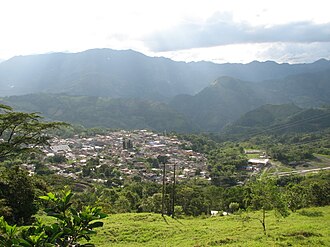
| image_caption | View of Muzo |
| image_flag | Flag of Muzo (Boyacá).svg |
| image_map | Colombia - Boyaca - Muzo.svg |
| mapsize | 250px |
| map_caption | Location of the municipality and town of Muzo in the Boyacá Department of Colombia |
| pushpin_map | Colombia |
| pushpin_mapsize | 300 |
| pushpin_map_caption | Location in Colombia |
| coordinates | |
| subdivision_type | Country |
| subdivision_name | Colombia |
| subdivision_type1 | Department |
| subdivision_name1 | Boyacá Department |
| subdivision_type2 | Province |
| subdivision_name2 | Western Boyacá Province |
| leader_title | Mayoress |
| leader_name | Ximena Elizabeth Castañeda |
| (2024–2027) | |
| established_title | Founded |
| established_date | 20 February 1559 |
| founder | Luis Lanchero |
| area_total_km2 | 147 |
| population_as_of | 2015 |
| population_total | 9040 |
| population_density_km2 | auto |
| population_urban | 5350 |
| timezone | Colombia Standard Time |
| utc_offset | -5 |
| elevation_m | 815 |
| website | |
| :: |
|name = Muzo |native_name = |nickname = Emerald capital of the world |other_name = Villa de la Santísima Trinidad de los Muzos |motto = |etymology = Muzo |settlement_type = Municipality and town |image_skyline = Panorámica de Muzo, Boyacá.JPG |imagesize = |image_caption = View of Muzo |image_flag = Flag of Muzo (Boyacá).svg |image_seal = |image_map = Colombia - Boyaca - Muzo.svg |mapsize = 250px |map_caption = Location of the municipality and town of Muzo in the Boyacá Department of Colombia |pushpin_map = Colombia |pushpin_mapsize = 300 |pushpin_map_caption = Location in Colombia |coordinates = |subdivision_type = Country |subdivision_name = Colombia |subdivision_type1 = Department |subdivision_name1 = Boyacá Department |subdivision_type2 = Province |subdivision_name2 = Western Boyacá Province |leader_title = Mayoress |leader_name = Ximena Elizabeth Castañeda (2024–2027) |established_title = Founded |established_date = 20 February 1559 |founder = Luis Lanchero |area_magnitude = |area_total_km2 = 147 |area_total_sq_mi = |area_land_km2 = |area_land_sq_mi = |area_water_km2 = |area_water_sq_mi = |area_water_percent = |area_urban_km2 = |area_urban_sq_mi = |area_metro_km2 = |area_metro_sq_mi = |population_as_of = 2015 |population_note = |population_total = 9040 |population_density_km2 = auto |population_density_sq_mi = |population_metro = |population_density_metro_km2 = |population_density_metro_sq_mi = |population_urban = 5350 |timezone = Colombia Standard Time |utc_offset = -5 |timezone_DST = |utc_offset_DST = |elevation_m = 815 |elevation_ft = |website = |footnotes =
Muzo () is a town and municipality in the Western Boyacá Province, part of the department of Boyacá, Colombia. It is widely known as the world capital of emeralds for the mines containing the world's highest quality gems of this type. Muzo is situated at a distance of 178 km from the departmental capital Tunja and 118 km from the capital of the Western Boyacá Province, Chiquinquirá. The urban centre is at an altitude of 815 m above sea level. Muzo borders Otanche and San Pablo de Borbur in the north, Maripí and Coper in the east, Quípama in the west and the department of Cundinamarca in the south.
Etymology
The town of Muzo was called Villa de la Santísima Trinidad de los Muzos, or simply Trinidad, when the Spanish conquistadors first founded the settlement in western Boyacá. Muzo is the autonym of the Muzo, the indigenous people who inhabited the region before the Spanish conquest.
Climate
The median temperature of Muzo is 26 C and the annual precipitation 3152 mm.
History
Main article: Muzo people
Before the Spanish conquest of the Eastern Colombian Andes, the region of Muzo was inhabited by the people with the same name. They extracted emeralds in pre-Columbian times, giving them the name "The Emerald People". Using poles of hard tropical wood and water, the people peeled the emeralds from the formations, in particular the Muzo Formation, named after the municipality. Historians have estimated the Muzo settled in the area of Muzo around 1000 AD.
The Cariban-speaking Muzo, like their Chibcha neighbours, adored the Sun and Moon as deities. Unlike their eastern neighbours, they did not construct temples.
Spanish conquest
After the successful conquest by the Spanish of the eastern neighbours, the Muisca, and partial submittal of the Panche, the southern neighbours of the Muzo, the Spanish, in search of valuable resources, sent various conquistadors into the territories inhabited by the Muzo. The first to arrive in Muzo territory was Luis Lanchero, soldier of the conquest expedition led by Nikolaus Federmann, in 1539. He encountered fierce resistance by the indigenous Muzo and had to return to the newly founded capital Santafe de Bogotá of the New Kingdom of Granada in 1541. The Muzo used the rugged terrain to their advantage and attacked the forty conquistadors, whose horses had problems crossing the hills of Muzo, using poisoned arrows. During a second invasion by the Spanish into the Muzo lands, in 1544, conquistador Diego Martínez discovered the rich emerald deposits of Muzo.
A third campaign to submit the Muzo was executed by conquistador Pedro de Ursúa in 1552. Also he failed to conquer the Muzo. A fourth time the Spanish attempted to subdue the Muzo to the Spanish Crown was successful; Luis Lanchero returned to the area where he was driven out almost two decades earlier, defeated the Muzo and founded the town of Villa de la Santísima Trinidad de los Muzos on February 20, 1559.
Colonial period
The first evangelisation was performed by Juan de los Barrios in 1566. The Spanish were highly interested in the emeralds of Muzo, proving to be the highest quality emeralds worldwide. They set up encomiendas to guard the valuable gemstones and used the indigenous people to perform slave labour for the extraction of the minerals.
Economy
The main economical activity with approximately 75% of the municipal income is emerald mining. Agriculture and livestock farming comprise the remaining quarter of the economy of Muzo. Agricultural products cultivated are sugarcane, cacao, yuca, avocados and citrus fruits.
Emerald mining
The Muzo mines are situated in the western flank of the Eastern ranges of the Colombian Andes. The Devonshire, one of the world's most famous uncut emeralds, is from the Muzo mines. It is a 1383.95 carat emerald and was a gift to the 6th Duke of Devonshire by Emperor Dom Pedro I of Brazil in 1831.
The US National Museum Division of Mineralogy and Petrology carried out a study of the mines in 1916.
Gallery
File:Beryl-Calcite-22511.jpg|Muzo emerald on calcite 5.3 x File:Béryl var. émeraude sur gangue (Muzo Mine Boyaca - Colombie) 14.jpg|Emerald from Muzo File:Béryl var. émeraude sur gangue (Muzo Mine Boyaca - Colombie) -2.jpg|Muzo emeralds File:Beryl-122884.jpg|Emerald File:Beryl-130023.jpg|Individual emerald
References
Bibliography
References
- {{in lang. es [https://archive.today/20150602115535/http://www.muzo-boyaca.gov.co/informacion_general.shtml Official website Muzo]
- Tequia Porras, 2008, p. 25
- Henao & Arrubla, 1820, p. 126
- Puche Riart, 1996, p. 99
- Tequia Porras, 2008, p. 35
- Uribe, 1960, p. 2
::callout[type=info title="Wikipedia Source"] This article was imported from Wikipedia and is available under the Creative Commons Attribution-ShareAlike 4.0 License. Content has been adapted to SurfDoc format. Original contributors can be found on the article history page. ::