Muneeswarar
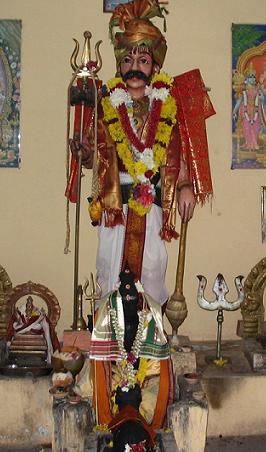
Hindu deity
title: "Muneeswarar" type: doc version: 1 created: 2026-02-28 author: "Wikipedia contributors" status: active scope: public tags: ["forms-of-shiva", "tamil-deities"] description: "Hindu deity" topic_path: "general/forms-of-shiva" source: "https://en.wikipedia.org/wiki/Muneeswarar" license: "CC BY-SA 4.0" wikipedia_page_id: 0 wikipedia_revision_id: 0
::summary Hindu deity ::
::data[format=table title="Infobox deity"]
| Field | Value |
|---|---|
| image | Muneeswarar.jpg |
| type | hindu |
| other_names | |
| abode | Not accurate |
| weapon | Aruval,Gada,Trishūla, Silver stick |
| mount | Horse |
| day | [Wednesday |
| :: |
| image = Muneeswarar.jpg | type = hindu | other_names = | abode = Not accurate | weapon = Aruval,Gada,Trishūla, Silver stick | mount = Horse | day = Wednesday|Friday|Saturday Muneeswarar, or Muneeswaran (Tamil: முனீஸ்வரன் Malayalam: മുനീശ്വരൻ ), is a popular Hindu deity within Hinduism, and is worshipped by many, in countries such as India, Malaysia, Singapore, Indonesia, Fiji and many more. He is sometimes referred to by different names, such as Muniyandi, Muniyappan, Muni Ayya, Ayya amongst many others. Muneeswarar is mostly considered a guardian deity or minor, but is in some cases hierarchically considered to be on par with Shiva, one of the main deities in the Hindu trinity. Although not much is known on the exact origins and history of Muneeswarar, he is often regarded to be related to Shiva. His name is a combination of "Muni" (sage or saint), and "Ishvara", an epithet or title of Shiva.
Depiction
Muneeswarar is often believed to be an old/middle aged male deity. He is often portrayed wearing a large moustache and wielding weapons such as a trident, Indian machete, whip and spear. His forehead and body is believed to be smeared with holy ash, an indication of his association with Shiva.
Muneeswaran is mostly worshipped in the form of statues (granite, metals, clay etc) depicting his physical appearance, or merely in the form of the weapons he is associated with. In some cases, he is also worshiped in the form of a rock, brick, lamp or nothing at all. He is sometimes accompanied by other minor deities and animals (bulls, horses or dogs), which are believed to be his vehicles.
Different worship methods
Muneeswarar is worshipped in both the orthodox Vedic ways as well as the Non-Vedic ways. The former is based heavily on the Vedas, Agamas and other sacred Hindu texts. Muneeswarar worship in this regard is usually done in an elaborate and systematic way, with many strict rules to be followed. For example, prayers and rituals are usually conducted in the Sanskrit language by Bhramins, and only vegetarian food products are offered to the deity for prayers and rituals. This method is mostly common in Agamic temples that are very common in India, Singapore and Malaysia. In such temples, Muneeswaran is venerated as a “higher” deity, and treated as Shiva himself.
The Non-Vedic way on the other hand is less rigid and not heavily bounded to sacred texts like the Vedas and Agamas. Its worship methods sometimes involve the usage of many items and methods that are otherwise considered taboo in Vedic Hinduism. Theses include things such as animal sacrifices, the offerings of non-vegetarian food items, alcohol and tobacco. This form of worship sometimes also sees the innovation of deity through phenomenons like Alaipu or trance. This style of worships can be found in Non-Agamic temples, shrines and homes. Due to the differences in worship methods, Muneeshwaran has a variety of disciples from many different demographics.
History and legend
::figure[src="https://upload.wikimedia.org/wikipedia/commons/6/61/Muneeswaran.jpg" caption="Nandhi]] (vehicle of Shiva) in front of him, just like [[Shiva]]."] ::
Different forms
In some cases, there seems to be more than one form of Muneeshwaran, with each having his own respective characteristics and traits. The number of forms of Muneeshwaran vary from 3,7,9,18,108 and even 1008 in some cases. The most common forms are Shiva Muni, Maha Muni, Gnana Muni, Paandi Muni, Dharma Muni, Naadha Muni, Jada Muni, Vaal Muni, Thava Muni. Most other forms of Muneeshwaran are inspired from the above mentioned. In special cases, new forms of Muneeshwarans are introduced based on the devotees perception, vision or dream of the deity. An example of this slightly altered form of the deity would be Sri Veera Muthu Muneeshwaran in Singapore, in which the deity is portrayed as a strong warrior.
In most cases, Muneeshwaran is portrayed to be a fierce man, which supposedly is dedicated towards to the destruction of evil and other negative traits of humans alike. In other cases, Muneeshwaran is portrayed in a peaceful manner, which supposedly denotes his spiritual and boon giving tendencies. Despite the difference in intensity, Muneeshwaran is almost always seen wearing a long and thick moustache and holding weapons, like a trident, machete or whip.
Worship in Sri Lanka
::figure[src="https://upload.wikimedia.org/wikipedia/commons/4/4e/Muneeshvaran@nittawelatmple2.jpg" caption="Muneeshvaran/Muniyaandi replica"] ::
::figure[src="https://upload.wikimedia.org/wikipedia/commons/5/5e/Muneeshvaran@nittawelatmple1.jpg" caption="Muneeshvaran/Muniyaandi replica"] ::
Statues of Munyandi or Munisewaran from a village in Kandy, Sri Lanka
Worship in Singapore and Malaysia
Besides India, Muneeshwaran worship is extremely popular in Singapore and Malaysia, with many shrines and temples dedicated to the deity. Most of these temples were initially set up by immigrants that came to Malaya from Tamilnadu, particularly Thanjavur, Thiruvarur, Nagapattinam, Madurai and Salem, where the worship of the deity was prevalent. Newer temples of Muneeshwaran were set up by descendants of these early Tamil migrants.
Most shrines and temples started with the worship of simple religious objects that represented the deity, such as hero stones, tridents, small bricks or stones. As the temples developed over the years, they built more intricate and complex statues of the deity, which portrayed his physical features. Some of these statues are colourfully painted and taller than average human beings. Other temple structures, such as Gopurams, were also developed and upgraded. Some of these small temples were converted into Vedic temples in the years. While this was the case for most temples, some temples still continue to be in its original state till date.
Muneeshwaran is sometimes worshipped along with deities from other religions such as Taoism and Buddhism. Countries like Singapore and Malaysia are home to people of many different cultures and faiths, which allows for the above mentioned phenomenon. In these instances, Muneeshwaran is seen as a contemporary to the deities of the various faiths. He is sometimes also venerated in different ways, including the offering Chinese joss sticks and food items.
Trance
Trance is an important phenomenon that occurs in some forms of Muneeshwaran worship, particularly the Non-Vedic ones. This phenomenon essentially enables the deity to possess the body of a human, who then goes on to display physical traits of the deity. This is usually done at major festivals or prayers, and is considered to be a clear sign of the physical presence or blessing of the deity. Some practitioners willingly invoke the deity into their bodies, while for others it happens without their control. Trance is also used as a platform for devotees to communicate with the deity and vice versa, to provide solutions and advises for a multitude of topics.
This topic is highly controversial and does not have unanimous support. Some claim that Muneeshwaran is god, who is above all human attributes and perceptions. Thus, it is impossible and not practical for him to possess people. Others on the other hand believe that his spirit is within the earthly realms, and thus it is possible for one to be possessed by him.
References
References
- Sinha, Vineeta. (2007). "A New God in the Diaspora?: Muneeswaran Worship in Contemporary Singapore". NUS Press.
- "Muneeswaran".
- "Darma Muneeswaran Temple Singapore History".
- Champakalakshmi, R.. (2001). "The Hindu temple". Roli Books.
- Punzo Waghorne, Joanne. (2007). "Diaspora of the Gods modern Hindu temples in an urban middle-class world". Oxford Univ. Press.
- Orr, Leslie C.. (2013). "Words for Worship: Tamil and Sanskrit in medieval temple inscriptions". Institut Français de Pondichéry.
- "Sri Mariamman Temple Singapore History".
- Fuller, CJ. "Only Śiva can Worship Śiva': Ritual Mistakes and their Correction in a South Indian Temple". Contributions to Indian Sociology.
- Sinha, Vineeta. (2011-04-13). "Religion and Commodification". Routledge.
- Ward, Colleen. (1984). "Thaipusam in Malaysia: A Psycho-Anthropological Analysis of Ritual Trance, Ceremonial Possession and Self-Mortification Practices". Ethos.
- "Jada Muni History".
- "Sri Veeramuthu Muneeswarar Temple".
- "Muneeshwaran Temple Singapore".
- Sinha, Vineeta. (2013). "Religion-State Encounters in Hindu Domains: From the Straits Settlements to Singapore". Institute of Southeast Asian.
- Sinha, Vineeta. (2011). "Mohammedan and Hindu Endowments Board, 1905–1968: The Singapore Experience". Springer Netherlands.
- Sinha, Vineeta. (2007-12-11). "'Hinduism' and 'Taoism' in Singapore: Seeing points of convergence". Journal of Southeast Asian Studies.
- Babb, Lawrence A.. (1974). "Hindu Mediumship in Singapore 1". Asian Journal of Social Science.
- McNeal, Keith E.. (2011-12-18). "Trance and Modernity in the Southern CaribbeanAfrican and Hindu Popular Religions in Trinidad and Tobago". University Press of Florida.
- (2017-12-31). "8. Thaipusam Considered: The Divine Crossing". ISEAS Publishing.
::callout[type=info title="Wikipedia Source"] This article was imported from Wikipedia and is available under the Creative Commons Attribution-ShareAlike 4.0 License. Content has been adapted to SurfDoc format. Original contributors can be found on the article history page. ::