Multiple edges
In graph theory, edges incident/directed between the same vertices
title: "Multiple edges" type: doc version: 1 created: 2026-02-28 author: "Wikipedia contributors" status: active scope: public tags: ["graph-theory-objects"] description: "In graph theory, edges incident/directed between the same vertices" topic_path: "science/mathematics" source: "https://en.wikipedia.org/wiki/Multiple_edges" license: "CC BY-SA 4.0" wikipedia_page_id: 0 wikipedia_revision_id: 0
::summary In graph theory, edges incident/directed between the same vertices ::
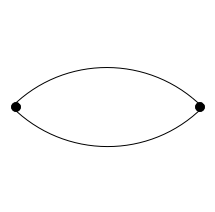
::figure[src="https://upload.wikimedia.org/wikipedia/commons/e/e7/Multiple_edges.png" caption="Multiple edges joining two vertices."] ::
In graph theory, multiple edges (also called parallel edges or a multi-edge), are, in an undirected graph, two or more edges that are incident to the same two vertices, or in a directed graph, two or more edges with both the same tail vertex and the same head vertex. A simple graph has no multiple edges and no loops.
Depending on the context, a graph may be defined so as to either allow or disallow the presence of multiple edges (often in concert with allowing or disallowing loops):
- Where graphs are defined so as to allow multiple edges and loops, a graph without loops or multiple edges is often distinguished from other graphs by calling it a simple graph.
- Where graphs are defined so as to disallow multiple edges and loops, a multigraph or a pseudograph is often defined to mean a "graph" which can have multiple edges.
Multiple edges are, for example, useful in the consideration of electrical networks, from a graph theoretical point of view. Additionally, they constitute the core differentiating feature of multidimensional networks.
A planar graph remains planar if an edge is added between two vertices already joined by an edge; thus, adding multiple edges preserves planarity.
A dipole graph is a graph with two vertices, in which all edges are parallel to each other.
Notes
References
- Balakrishnan, V. K.; Graph Theory, McGraw-Hill; 1 edition (February 1, 1997). .
- Bollobás, Béla; Modern Graph Theory, Springer; 1st edition (August 12, 2002). .
- Diestel, Reinhard; Graph Theory, Springer; 2nd edition (February 18, 2000). .
- Gross, Jonathon L, and Yellen, Jay; Graph Theory and Its Applications, CRC Press (December 30, 1998). .
- Gross, Jonathon L, and Yellen, Jay; (eds); Handbook of Graph Theory. CRC (December 29, 2003). .
- Zwillinger, Daniel; CRC Standard Mathematical Tables and Formulae, Chapman & Hall/CRC; 31st edition (November 27, 2002). .
References
- For example, see Balakrishnan, p. 1, and Gross (2003), p. 4, Zwillinger, p. 220.
- For example, see Bollobás, [https://books.google.com/books?id=SbZKSZ-1qrwC&pg=PA7 p. 7]; Diestel, [https://books.google.com/books?id=aR2TMYQr2CMC&pg=PA28 p. 28]; Harary, p. 10.
- Bollobás, [https://books.google.com/books?id=SbZKSZ-1qrwC&pg=PA39 pp. 39–40].
- Gross (1998), [https://books.google.com/books?id=CRDMgj-DfdEC&pg=PA308 p. 308].
::callout[type=info title="Wikipedia Source"] This article was imported from Wikipedia and is available under the Creative Commons Attribution-ShareAlike 4.0 License. Content has been adapted to SurfDoc format. Original contributors can be found on the article history page. ::