Mu Pegasi
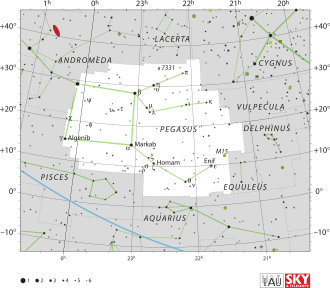
Star in the constellation Pegasus
title: "Mu Pegasi" type: doc version: 1 created: 2026-02-28 author: "Wikipedia contributors" status: active scope: public tags: ["g-type-giants", "pegasus-(constellation)", "bayer-objects", "durchmusterung-objects", "flamsteed-objects", "gliese-and-gj-objects", "henry-draper-catalogue-objects", "hipparcos-objects", "bright-star-catalogue-objects", "stars-with-proper-names", "population-i-stars"] description: "Star in the constellation Pegasus" topic_path: "science/astronomy" source: "https://en.wikipedia.org/wiki/Mu_Pegasi" license: "CC BY-SA 4.0" wikipedia_page_id: 0 wikipedia_revision_id: 0
::summary Star in the constellation Pegasus ::
| image = | image=Pegasus IAU.svg | float=center | width=250 | position=right | mark=Red circle.svg | mark_width=10 | mark_link=ι Exa | x%=44.5 | y%=37.8 | caption=Location of μ Pegasi (circled) | epoch = J2000 | ra = | dec = | appmag_v = 3.514 | constell = Pegasus | type = Yellow giant | class = G8 III | b-v = +0.932 | u-b = +0.674 | variable = | radial_v = +13.54 ± 0.20 | prop_mo_ra = +145.240 | prop_mo_dec = | pm_footnote = | parallax = 28.934 | p_error = 0.189 | parallax_footnote = | absmag_v = +0.432 | mass = | radius = | luminosity = | temperature = | gravity = | metal_fe = | rotational_velocity = | rotation = | age_myr = | names = |Simbad=mu+Peg
Mu Pegasi or μ Pegasi, formally named Sadalbari (), is a star in the northern constellation of Pegasus. The apparent visual magnitude of this star is 3.5, which is bright enough to be seen with the naked eye even on a moonlit night. Based upon parallax measurements taken by the Gaia spacecraft, it is approximately 113 ly from the Sun.
Nomenclature
μ Pegasi (Latinised to Mu Pegasi) is the star's Bayer designation.
It bore the traditional name Sadalbari, which derives from saʿd al-bāriʿ, the “auspicious star of the splendid one.” In 2016, the International Astronomical Union organized a Working Group on Star Names (WGSN) to catalogue and standardize proper names for stars. The WGSN approved the name Sadalbari for this star on 21 August 2016 and it is now so included in the List of IAU-approved Star Names.
In Chinese, 離宮 (Lì Gōng), meaning Resting Palace, refers to an asterism consisting of Mu Pegasi, Lambda Pegasi, Omicron Pegasi, Eta Pegasi, Tau Pegasi and Nu Pegasi. Consequently, the Chinese name for Mu Pegasi itself is 離宮二 (Lì Gōng èr, "the Second Star of Resting Palace").
Properties
The spectrum of this star matches a stellar classification of G8 III. The luminosity class of 'III' means that it has exhausted the hydrogen fuel at its core and evolved into a giant star. It is 520 million years old and 2.6 times more massive than the Sun, but has expanded to nine times the Sun's radius. The effective temperature of the outer atmosphere is about 4,961 K, which is cooler than the Sun and gives it the yellow hue of a G-type star. The abundance of elements other than hydrogen and helium, what astronomers term the metallicity, is a bit smaller than the abundance in the Sun.
References
References
- Allen, Richard Hinckley. (1963). "Star Names: Their Lore and Meaning". [[Dover Publications]] Inc..
- "IAU Working Group on Star Names (WGSN)". [[International Astronomical Union]].
- {{in lang. zh ''中國星座神話'', written by 陳久金. Published by 台灣書房出版有限公司, 2005, {{ISBN. 978-986-7332-25-7.
- {{in lang. zh [http://www.lcsd.gov.hk/CE/Museum/Space/Research/StarName/c_research_chinengstars_ala_alz.htm 香港太空館 - 研究資源 - 亮星中英對照表] {{webarchive. link. (2008-10-25, Hong Kong Space Museum. Accessed on line November 23, 2010.)
- (2015-02-01). "Stellar parameters and chemical abundances of 223 evolved stars with and without planets". Astronomy and Astrophysics.
- (2024-02-01). "Gaia FGK benchmark stars: Fundamental Teff and log g of the third version". Astronomy and Astrophysics.
- {{cite DR3. 1876510592179455744
- (2021). "Angular Diameters and Fundamental Parameters of Forty-four Stars from the Navy Precision Optical Interferometer". The Astronomical Journal.
- (December 2009). "REM near-IR and optical photometric monitoring of pre-main sequence stars in Orion. Rotation periods and starspot parameters". Astronomy and Astrophysics.
- (January 2005). "Local kinematics of K and M giants from CORAVEL/Hipparcos/Tycho-2 data. Revisiting the concept of superclusters". Astronomy and Astrophysics.
- (September 1975). "A new photometric metal abundance and luminosity calibration for field G and K giants.". [[Monthly Notices of the Royal Astronomical Society]].
- "48 Peg -- High proper-motion Star". [[Centre de Données astronomiques de Strasbourg]].
- "SADALBARI (Lambda and Mu Pegasi)". University of Illinois.
- (December 21, 2004). "The Colour of Stars". [[Commonwealth Scientific and Industrial Research Organisation]].
- (September 2006). "Elemental abundances in the atmosphere of clump giants". Astronomy and Astrophysics.
- "Naming Stars". IAU.org.
::callout[type=info title="Wikipedia Source"] This article was imported from Wikipedia and is available under the Creative Commons Attribution-ShareAlike 4.0 License. Content has been adapted to SurfDoc format. Original contributors can be found on the article history page. ::