Mount Sodom
Hill in Israel
title: "Mount Sodom" type: doc version: 1 created: 2026-02-28 author: "Wikipedia contributors" status: active scope: public tags: ["hebrew-bible-mountains", "hills-of-israel", "dead-sea", "sodom-and-gomorrah", "judaean-desert"] description: "Hill in Israel" topic_path: "geography/israel" source: "https://en.wikipedia.org/wiki/Mount_Sodom" license: "CC BY-SA 4.0" wikipedia_page_id: 0 wikipedia_revision_id: 0
::summary Hill in Israel ::
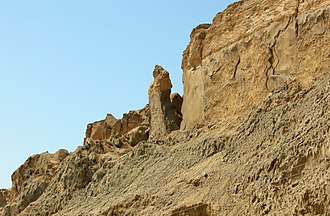
::figure[src="https://upload.wikimedia.org/wikipedia/commons/e/e3/MountSodom061607.jpg" caption="The "Lot's Wife" pillar on Mount Sodom, Israel, made of [[halite"] ::
::figure[src="https://upload.wikimedia.org/wikipedia/commons/8/8a/Sodom_Salt_Cave_031712.JPG" caption="Salt cave in Mount Sodom"] ::
::figure[src="https://upload.wikimedia.org/wikipedia/commons/7/7d/Mount_Sodom_Halite_Layers_071213.jpg" caption="Bedded [[halite]] at Mount Sodom"] ::
Mount Sodom (, Har Sedom) is a hill along the southwestern part of the Dead Sea in Israel; it is part of the Judaean Desert Nature Reserve. It takes its name from the biblical city of Sodom, whose destruction is the subject of a narrative in the Bible.
History
Mount Sodom began its rise hundreds of thousands of years ago and continues to grow taller at a rate of 3.5 mm a year.
Movements of the Great Rift Valley system, along with the pressure generated by the slow accumulation of earth and rock, pressed down on the layers of salt, creating Mount Sodom. It is about 80% salt, 220 m high, capped by a layer of limestone, clay and conglomerate that was dragged along as it was squeezed up from the valley floor.
It is approximately 8 km long, 5 km wide, and 742 ft above the Dead Sea water level, yet 557 ft below world mean sea level. Because of weathering, some portions have separated. One of these pillars is known as "Lot's wife", in reference to the Biblical account of the destruction of Sodom and Gomorrah.
References
References
- (2018). "Proceedings of the 12th EuroSpeleo Forum: Ebensee, Austria, August 23rd-26th, 2018 : Connecting Science". Speleological Society of Ebensee.
- Hareuveni. Imanuel. (1985). [[Israel Ministry of Defense]]
- Ruby, Robert. (18 December 1991). "Punished for looking back, Lot's wife may fall forward". [[The Baltimore Sun]].
- Lefond, Stanley J.. (2012). "Handbook of World Salt Resources". Springer.
::callout[type=info title="Wikipedia Source"] This article was imported from Wikipedia and is available under the Creative Commons Attribution-ShareAlike 4.0 License. Content has been adapted to SurfDoc format. Original contributors can be found on the article history page. ::